Blog
Get Pay Right on ADP Workforce Now® Next Gen™
Bringing trusted compensation intelligence and seamless planning to even more ADP users.
Written by Salary.com Staff
June 26, 2026

A performance improvement plan will help the employee identify the issues they are encountering in their role and help them to get back on track in their job.
This guide provides a blueprint for performance improvement plans. It defines the terms, discusses the components of a plan, how to implement them, and what the outcomes of such a plan would be.
HR and compensation professionals can use this information to create processes and plans for improving employee performance.
A performance improvement plan, or PIP, is a document that lays out the problems with an employee's performance and the steps that they will need to take to meet their job expectations. It provides the employee with a chance to improve within a timeframe, with the assistance of their manager and HR department.
The plan is not meant to be punished. It is a tool to be used within the management process. Managers can use the plan to document the issues and set goals for the employee. Follow-up meetings will allow the manager to track the employee's progress. This ensures fairness for all parties involved.
A good PIP will focus on facts and future actions. It will avoid focusing on the employee's possible complaints regarding their job. At the end of the performance improvement plan, both the employee and the company will have a clear picture of how well the plan worked and ensure the trust in the HR system.
CompAnalyst® can support this process by helping HR verify that employees are being evaluated against the correct job benchmarks and responsibilities. Accurate job matching improves consistency when identifying performance gaps.
A PIP is one important part of a larger performance management system that includes regular feedback, goal setting, and evaluations.
The employee's performance continues to exist.
This step in the process is linked to the employee's job and the company's standards and expectations from each job.
During the PIP, the manager and employee will have regular meetings to monitor the employee's progress and to make any changes to the PIP as needed.
Successfully completing the PIP will return the employee to the normal process of tracking their performance.
An effective PIP includes clear details about the problem, the expected changes, and how success will be measured.
Description of the performance issue: Provide specific examples of the issues with dates and data to show the employee the changes that are needed.
Clear performance goals: Establish performance goals based on job description and company standards. The goals should be realistic.
Action steps and support: Make sure the employee knows what they will do and what support the company will provide to them.
Timeline and review schedule: Include a timeline with start and end dates for the employee and a schedule of the reviews for the management team.
Consequences for not meeting goals: Let the employee know the consequences for not meeting the goals, such as further discipline or termination.
CompAnalyst® can help managers compare role requirements and compensation competitiveness when assessing employee performance expectations.
SMART goals make a PIP focused and measurable by turning vague ideas into concrete targets.
Specific: Use action words in the goal to make it clear what the employee should do.
Measurable: Include a number or data point that indicates the goal that you have established for the employee.
Achievable: Make sure the goal is challenging for the employee, but also that the goal is still possible to meet with the resources and support that are provided to the employee.
Relevant: Ensure that each goal is related to the employee's job and the goals of the company.
Time-bound: Give each goal and the entire plan for the employee with a deadline.
Implementing a PIP requires careful steps to keep the process fair and effective.
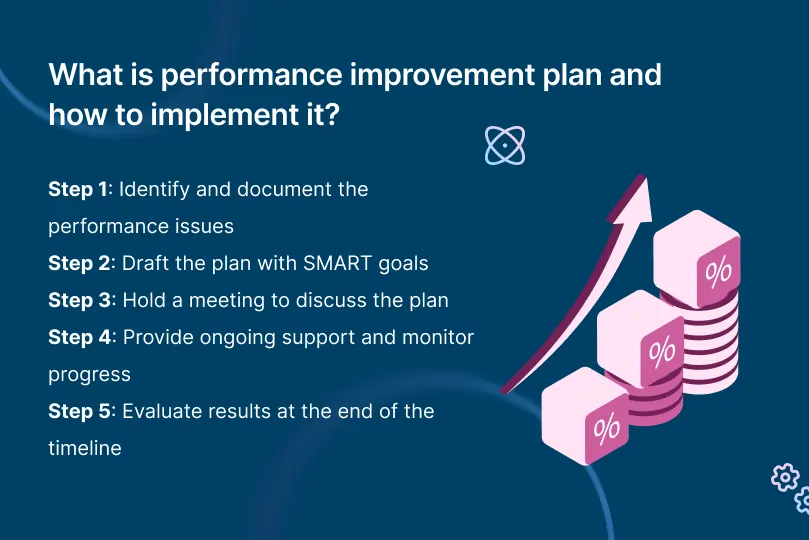
Step 1: Identify and document the performance issues
Find ways to show where the employee falls short. Have a meeting with human resources to discuss the situation and to determine whether a PIP is appropriate. Base the PIP on these facts.
Step 2: Draft the plan with SMART goals
Work with the manager and HR to write the document that will outline the issues, goals, actions, support needed, timeline, and possible consequences. Share the draft with the employee to obtain input as appropriate.
Step 3: Hold a meeting to discuss the plan
Schedule a private meeting with the employee, the manager, and HR. Explain the reasons for the plan and review the components of the plan during the meeting. Address any questions that the employee has.
Step 4: Provide ongoing support and monitor progress
Schedule regular check-in meetings to review advancement. Offer training, resources, or coaching as promised. Document all discussions and adjustments to keep records accurate.
CompXL® supports merit increase planning by helping organizations manage pay-for-performance strategies that align employee contributions with compensation outcomes.
Step 5: Evaluate results at the end of the timeline
Review all the data and feedback that you have gathered because of implementing the recommendations. Based on the outcome of the feedback and data, decide on the next steps for your organization.
After a PIP ends, the organization reviews the results and decides the appropriate next steps to support the employee or protect business needs.
If the employee meets the goals established in the plan, the employee returns to the regular performance management process.
In some cases, the manager may extend the PIP for a short time if the employee is close to meeting the goals but has not yet accomplished them altogether.
The documentation created during the PIP will be stored in the employee's records for future reference.
Possible outcomes of a PIP range from full success to further action depending on the employee's progress.
Successful improvement indicates that the employee has met or beaten the goals assigned to them and has returned to standard reviews.
Partial improvement indicates that the employee has met some goals but needs to extend the plan and focus on meeting the remaining goals.
No improvement indicates that further steps in the discipline process may be required, including a change in role or employment status.
Termination after a PIP usually happens when the employee does not meet the agreed goals despite the support provided.
Documenting the process protects the company and demonstrates the employee had a chance to improve
The termination will follow the company policy and legal requirements. The human resources department will review all the records of the employee.
There is typically a final meeting to discuss the outcome of the performance review and the next steps in the process.
Progressive discipline builds a series of steps that increase in seriousness, with a PIP often serving as a key formal stage.
Coaching and verbal warnings are used for early issues.
Written warnings follow if there are still issues.
A PIP follows if the employee continues to have issues.
This shows fairness to the employee and provides them with several chances to correct their issues.
Escalation pathways in progressive discipline move from informal talks to formal actions when earlier steps do not resolve the issue.
Verbal counseling is used for minor issues and resolved quickly.
Written warnings are given for ongoing issues.
Performance improvement plans are given for significant issues with a plan for resolution.
The final steps are taken for cases where no improvement is made, such as suspension, demotion, or termination.
Here are some FAQs for better understanding
Coaching and corrective action both aim to improve performance, but they differ in structure and timing within a performance improvement plan.
| Aspect | Coaching | Corrective action in PIP |
|---|---|---|
| Focus | Informal, ongoing guidance | Formal, documented steps with timelines |
| Timing | Early, preventive | After initial steps fail |
| Documentation | Light notes | Detailed written plan and records |
| Goal | Build skills and habits | Address specific gaps with measurable results |
| Tone | Supportive and developmental | Structured with clear expectations and consequences |
Termination can be considered following the implementation of a PIP in the case that the employee does not exhibit improvements. Such a termination is to occur according to the company policy and review of the documentation.
Experts continue to stress the importance of processes such as consulting the legal guidelines for the company and maintaining documentation of these processes.
Common KPIs include metrics related to the employee's role, such as the number of errors made, the percentage of projects completed, sales made, or the satisfaction of the customers served by those employees. These indicators can be tracked digitally by the organization. Such digital tracking permits quicker performance evaluations of those employees. Some of the most common performance metrics include the percentage of projects delivered on time and the quality scores received from other team members or customers.

The latest research, expert advice, and compensation best practices all in one place.
Blog
Bringing trusted compensation intelligence and seamless planning to even more ADP users.

Blog
Learn how to train managers for effective pay conversations and build trust.

Blog
Total rewards package flexibility lets employees choose what matters - pay, perks, and benefits tailored to their needs.