Blog
Get Pay Right on ADP Workforce Now® Next Gen™
Bringing trusted compensation intelligence and seamless planning to even more ADP users.
Written by Salary.com Staff
August 07, 2026

Contingent workforce management covers hiring workers who do not work for your organization on a permanent basis, but whose efforts support your operations. These employees could come from various populations and are hired on a temporary basis. However, with contingent workforce management becoming more crucial in today's economy, organizations are looking for ways to improve this specific process.
Contingent workforce management is the process of sourcing, onboarding, managing, and offboarding non-permanent workers who aid your organization's operations on a temporary basis. These individuals can include independent contractors, temp workers from a staffing agency, freelance workers, and even gig workers.
A vendor management system (VMS) can assist with this process and provide increased visibility into the contingent workforce spend, performance of the contingent workers, and their compliance with your organization's policies.
| Core Function | What It Covers |
|---|---|
| Sourcing | Finding contingent workers from various sources, including talent pools within your organization and staffing agencies |
| Onboarding | Getting contingent workers up and running in your organization and making them compliant with your policies |
| Performance Tracking | Regularly reviewing the performance of contingent workers to make better hiring and management decisions |
| Compliance | Ensuring that contingent workers remain legally classified appropriately and follow your policies from the time they come on board until they leave the organization |
| Offboarding | Providing an organized and effective outboarding process for contingent workers when their term in your organization ends |
The different types of contingent workers include independent contractors, temp workers, freelance workers, gig workers, and consultants.
These workers could come from multiple suppliers but will work for your organization. They are not on your payroll, do not have access to your healthcare plans for them, and will work for you on a project or time-limited basis.
Companies are placing more importance on contingent workforce management due to the uncertainty of the economy and the increasing number of contingent workers in the workforce.
According to a recent survey, 36% of the United States workforce competes as independent workers. This is close to 58 million individuals who represent a portion of the labor market that your organization cannot ignore.
There are several benefits that contingent workforce management can provide for your company:
Cost savings and cost control: Regular reviews of contingent labor spend help control costs and eliminate redundant vendor relationships.
Access to specialized skills: Hiring contingent workers fills skill gaps quickly without long term employment commitments, giving organizations a competitive advantage.
Workforce flexibility: Strategic management enables organizations to scale talent resources quickly during economic uncertainty or seasonal demand.
Better compliance and risk management: Centralized management reduces compliance risk through proper worker classification and consistent internal policies.
Improved business outcomes: Integrating contingent labor into workforce planning reduces last minute hiring and enables seamless integration of external talent with your workforce mix.
SalaryIQ™ tracks millions of job postings across 35+ countries to show how companies are hiring and setting pay right now — so your team can benchmark contingent labor rates against live market data instead of relying on outdated figures.
Worker classification involves determining whether the workers performing the work for your organization are classified as employees or independent contractors. Getting this wrong could put your company at risk of legal problems, including having to pay taxes for them, fines, and even lawsuits.
For instance, the IRS puts the tax liability on the company if they misclassify an employee as an independent contractor. They would have to pay taxes for them for Social Security, Medicare, unemployment taxes, and others.
| Classification Test | Agency | What It Evaluates |
|---|---|---|
| Common Law Test (20 Factor Test) | IRS | Looks at behavioral, financial, and the relationship between the worker and the company |
| Economic Reality Test | DOL | Evaluates whether the worker is dependent on the company financially or they work independently |
| ABC Test | State Agencies | Employers must prove the worker is an independent contractor to the company |
The IRS uses the common law test to evaluate the worker as an independent contractor by looking at the behavioral, financial, and relationship of the worker to the company. The DOL evaluates whether the worker is dependent on the company financially or if they perform independently of the company's work.
As of May 2025, the DOL reverted to using the economic reality test to classify contingent workers rather than the 2024 45% rule. The ABC test is used by most states in the nation to require the company to prove that the contingent worker is an independent contractor to them.
Vague role definitions are one of the fastest ways to trigger a misclassification ruling. JobArchitect® lets you create and approve standardized job descriptions with AI writing assistance and customizable templates — clearly documenting a contingent worker's scope, duties, and project boundaries to build a defensible classification record.
An example of a contingent worker is an IT consultant hired by a company on a staffing agency to complete a project over six months.
These individuals have specific skills that could benefit your company but are not on your payroll as a permanent employee.
They will work with you for a limited time frame for a specific project and will be off the payroll once that work is done.
The limited scope of their work for a specific project means they will not seek to work on other projects during this time.
There are five key steps you can take to improve your contingent workforce management process.
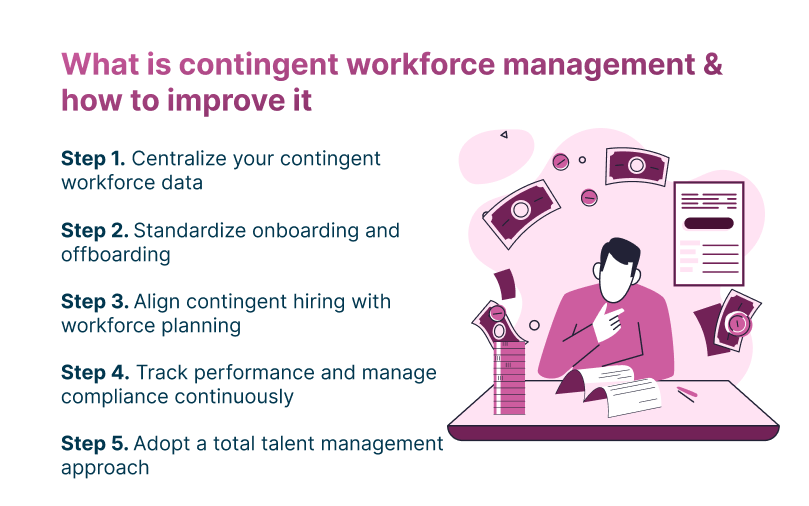
Currently, most organizations have fragmented processes for contingent workers. However, by centralizing the data for contingent workers into a vendor management system, you can streamline their experience in your company and ultimately make it easier for your management team to track their performance.
CompAnalyst® brings market pricing, salary structures, analytics, and reporting into a single platform — giving your team one place to benchmark contingent roles, track spend across vendors, and spot where you're overpaying. Its HRIS integrations with ADP, Workday, UKG, and others keep your data synchronized automatically
Many companies have an increased risk of data breaches when they onboard contingent workers. By creating a standard onboarding process for contingent workers, you can better ensure that they are compliant with your company's policies and do not present a security risk for your organizational data.
By integrating contingent workers into your workforce planning, you can avoid hiring last minute. With contingent workers, you can have a better workforce composition that avoids hiring individuals that will not add as much value to your company's projects.
By tracking the performance of your contingent workers by your key performance indicators and the outcomes of the projects they are completing, you can make better hiring and management decisions for your organization.
Additionally, by using your vendor management system to manage their compliance to your policies and labor laws, you can avoid fines and better manage the contingent labor cost for your organization.
Total talent management can help your HR and management departments unify your strategy for permanent employees and contingent workers. This will allow your company's HR leaders to more effectively align the talent in your company with your long-term business goals.
Additionally, with AI systems that can find contingent workers that match your job opening requirements and can provide insight into the future talent needs in your organization, this management approach is more attainable than ever before.
Here are the frequent questions about the topic:
Traditional staffing companies hire permanent employees. Contingent workforce management companies hire temporary workers and work with them throughout their time in your company.
Responsibility often sits across HR and procurement functions, though many organizations assign ownership to a dedicated program manager or managed services provider. HR leaders handle talent acquisition and compliance while procurement manages vendor relationships and cost control.
There is no universal answer to the cost. Most programs use vendor management systems that offer subscription plans that range from $100 per month for smaller organizations to six-figure investments for huge organizations. However, the cost savings will typically be earned within the first year of implementing this program.
Not having a strategy in place will put your organization at risk of hiring the wrong contingent workers, losing valuable data from a data breach, not having an even workforce composition, and not having the reputation that contingent workers require to deliver quality work for your company.

The latest research, expert advice, and compensation best practices all in one place.
Blog
Bringing trusted compensation intelligence and seamless planning to even more ADP users.

Blog
Learn how to train managers for effective pay conversations and build trust.

Blog
Total rewards package flexibility lets employees choose what matters - pay, perks, and benefits tailored to their needs.