Blog
Get Pay Right on ADP Workforce Now® Next Gen™
Bringing trusted compensation intelligence and seamless planning to even more ADP users.
Written by Salary.com Staff
July 10, 2026

For HR and compensation professionals, understanding hiring costs is an essential part of effective human resource management and budget management.
This guide breaks down what hiring costs mean and offers ways to improve them. It discusses the different types of cost per hire and offers strategies to lower them. By the end of the article, you will know the steps you can take to reduce your hiring costs.
Hiring cost refers to the total amount of money a company spends to hire someone for a specific job opening. It goes beyond recruitment fees. Many hiring professionals calculate the cost per hire to assess the efficiency of their hiring process.
Hiring an employee takes time and effort from numerous team members. Hiring the right person benefits a company's team and employee retention. Poor management of the cost per hire can have adverse impacts on a business's budget and growth potential.
Organizations can support cost per hire analysis with CompAnalyst® which provides compensation benchmarking, market pricing, salary structure management, analytics, reporting, survey management, and job matching capabilities.
Total hiring costs include many elements going into hiring for a position. Here is a breakdown of the main elements of total cost per hire.
Recruitment costs include the fees for job boards, the advertising costs for job boards, and the costs for premium or niche job boards.
Beyond the external recruiting costs associated with agency fees and recruiter salaries are the internal recruiting costs related to the time of the internal recruitment team and hiring managers as well as recruitment software licenses.
The onboarding and training costs associated with hiring a new employee include the costs of onboarding the new hire, training the new hire, and any costs associated with providing the new hire with company benefits.
Compliance and background check costs to ensure that the company meets all legal requirements for the position and new hire, as well as any administrative costs associated with performing these actions.
Vacancy costs place pressure on companies when employees remain unemployed for longer than planned. These costs come from lost productivity and strain on existing employees.
Companies lose productivity when employees cannot complete tasks in their roles. This lost productivity amounts to thousands of dollars per month.
Higher recruitment costs occur when it takes longer to hire a candidate for a role.
Vacancy costs also impact company retention as existing employees begin to feel overloaded due to having to deal with increased responsibilities.
Other costs associated with vacancies contribute to an overall cost much higher than the cost per hire estimate for the position.
Direct recruitment costs are typically the most visible of recruitment costs and usually comprise a large portion of the total cost of recruitment.
Companies often must pay for job postings and advertising on job boards and social media to find the right candidates for the open positions.
Companies may hire recruitment agencies or incur external recruitment costs to source candidates for the positions.
Companies may also invest in hiring events and sourcing tools to connect with new hires.
Companies can implement employee referral programs and offer bonuses for referrals to hire new employees.
Organizations can strengthen compensation competitiveness with CompAnalyst® which supports compensation planning and market competitiveness analysis. Competitive pay strategies can improve candidate attraction and potentially reduce recruitment challenges.
The sourcing of external candidates for a company incurs advertising costs. These vary depending on the sourcing channels.
Premium job boards and niche job boards offer better results but cost more job board fees.
Advertising on various job boards can increase the visibility of the job but increase the cost of recruiting.
The time recruitment staff spends reviewing job applications from various sources is an internal recruitment cost.
Offering employee referral bonuses lowers some recruitment costs and increases employee engagement with the hiring process.
The cost of agency fees and recruiting team salaries usually makes up a significant portion of a company's cost per hire. They are used to hire employees internally and externally.
Recruitment agencies require a percentage of an employee's salary, which could be high for positions that are hard to fill.
Companies must pay their recruitment team salaries and benefits to handle the hiring process in-house.
Companies may hire external recruiters, which adds to the costs of hiring.
Other costs related to hiring include training for recruitment teams.
Organizations can improve consistency in hiring and job documentation with JobArchitect® which helps create, manage, and standardize job descriptions, job families, and career frameworks. Well-structured job architecture can support more efficient recruiting workflows.
Hidden cost per hire can be surprising when recruiters first start to think about the true cost of recruitment. These costs can add significantly to the total cost of each hire. Some of these costs include:
The productivity that is lost while the position is vacant
The administrative costs and time taken up by hiring managers during the interview process
The training costs and the learning curve that the new hire must experience
The indirect costs to the company because of the hiring process (such as impacts on company culture)
The costs of onboarding extend beyond the hiring process itself. They ensure that the new hire becomes productive as fast as possible.
The costs of onboarding and training encompass the training itself and the trainers.
Benefits such as health insurance and taxes start right away for the new hire.
There are costs associated with onboarding that relate to administrative tasks.
Companies may also offer perks such as tuition reimbursement to be attracted to prospective hires.
Background checks are an essential part of ensuring that a company follows the hiring of employees.
Ensures that the company is complying with the legal requirements to prevent bad hires.
The cost of background checks can range from the basics to the detailed check of the applicant.
While there is an investment of time in the process of conducting background checks, the benefit to the company is significant.
Part of the total cost of hiring employees for a company.
HR analytics uses data to make smarter choices in human resource management. It helps lower costs while improving results.
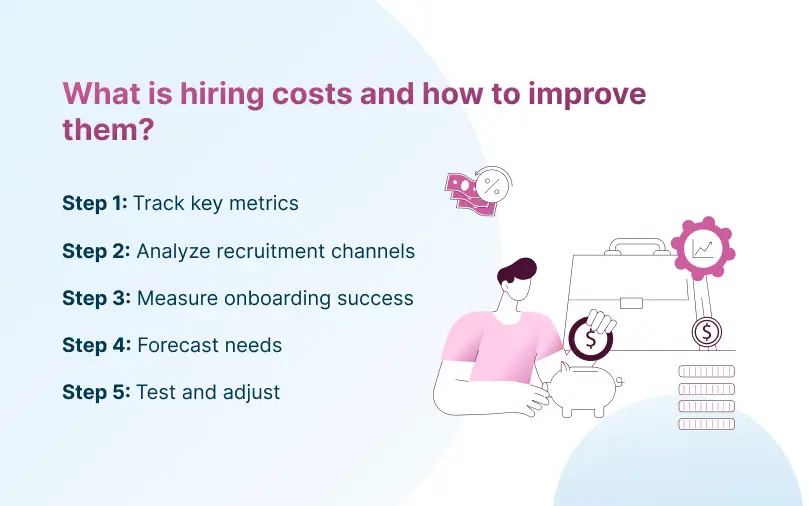
Look at the key metrics for your recruitment process. Use your ATS and previous hires to gather the necessary data to observe patterns in your hiring process.
Identify which job boards or employee referral programs bring the best qualified candidates at lower recruiting costs. Cut spending on channels that underperform.
Review training costs and new hire productivity to spot areas where better processes can reduce lost time.
Use data on employee retention and turnover to plan hiring strategy ahead and avoid rushed, expensive recruitment.
Run small experiments with changes like enhanced employee referral programs and track impact on total cost per hire. Keep refining based on real numbers.
Here are some FAQs for better understanding.
Recruitment costs focus mainly on finding and attracting candidates, while cost per hire includes the full picture up to a productive new employee.
| Aspect | Recruitment costs | Hiring costs |
|---|---|---|
| Scope | Sourcing, advertising, job board fees | All recruitment plus onboarding, training, compliance |
| Examples | Job posting fees, agency fees | Adds lost productivity, benefit costs, background checks |
| Time period | Up to offer acceptance | Until the new hire is fully contributing |
The standard formula for cost per hire is to divide the total number of internal and external cost per hire by the total number of hires during that same timeframe. This standard formula provides an organization with a reliable average.
Many use the cost per hire formula to benchmark their hiring results. Compensation professionals can use this formula to understand the impact of hiring decisions on the company.
Often overlooked are the costs of vacancies or the cost of training new team members. These costs often increase the total cost to be well above the initial estimate.
Experts recommend including the cost of vacancies and indirect costs in your budget estimate to get an accurate cost for the restaurant. This will aid your human resource management decision making process.

The latest research, expert advice, and compensation best practices all in one place.
Blog
Bringing trusted compensation intelligence and seamless planning to even more ADP users.

Blog
Learn how to train managers for effective pay conversations and build trust.

Blog
Total rewards package flexibility lets employees choose what matters - pay, perks, and benefits tailored to their needs.