Blog
Get Pay Right on ADP Workforce Now® Next Gen™
Bringing trusted compensation intelligence and seamless planning to even more ADP users.
Written by Salary.com Staff
August 21, 2026

Employee misconduct is one of the most pressing challenges in human resources today. If not managed correctly, it can cause significant damage to the company. This management includes understanding what constitutes misconduct and then having a robust process in place for investigating and correcting such instances of misconduct.
Employee misconduct refers to any behavior by a worker that violates workplace rules, company policy, or legal standards. It can take many shapes, from chronic lateness and misuse of company resources to severe acts like fraud, theft, or workplace violence. Understanding how misconduct is defined in your employee handbook is the first step toward managing employee misconduct effectively.
Minor misconduct includes less severe infractions such as repeated failure to meet performance standards. Gross misconduct involves serious offenses like sexual harassment, workplace violence, or unlawful conduct that typically warrant immediate termination.
According to a report, 38% of U.S. employees report witnessing workplace harassment in the past five years, and 21% say they have been direct targets. The same report also found that 28% of employees do not feel fully protected by their employers, with concerns about retaliation cited as the top barrier to reporting.
| Category | Description | Examples |
|---|---|---|
| Simple misconduct | Minor violations of company policy or work rules | Chronic lateness, personal use of company resources, attendance violations |
| Gross misconduct | Severe offenses with intentional disregard for rules or the law | Theft, sexual harassment, workplace violence, fraud, substance abuse at work |
| Policy violations | Disregarding established company protocols | Safety violations, misuse of intellectual property, falsifying records |
| Behavioral misconduct | Inappropriate behavior disrupting the work environment | Verbal abuse, workplace harassment, insubordination |
Clear job expectations can help employees understand their responsibilities and the standards they are expected to meet. JobArchitect® helps HR teams create, manage, and standardize job content, making it easier to maintain consistent role expectations across the organization.
Misconduct in the workplace can range from subtle to overt. Employee handbooks should clearly define acceptable behavior so employees understand what crosses the line.
Harassment and discrimination: Harassment includes unwelcome conduct based on protected characteristics such as race, national origin, or sexual orientation. Sexual harassment can involve co workers, supervisors, or clients.
Theft and fraud: Theft includes taking office supplies, company property, or proprietary data. Falsifying documents can lead to serious legal consequences.
Substance abuse: Using illegal drugs or alcohol on company premises creates safety risks and disrupts operations.
Workplace violence: This ranges from verbal abuse to physical assaults, putting other employees at risk.
Insubordination: Refusing to follow lawful directives from a supervisor or senior leadership.
Misuse of company resources: Using equipment or intellectual property for personal gain.
Attendance violations: Chronic tardiness, excessive absenteeism, and abuse of sick leave. This can also involve falsifying time records.
Safety violations: Ignoring safety protocols can lead to workplace accidents and lawsuits.
The process of investigating employee misconduct ensures that the employee is given due process. The human resources department can use their case management system to investigate this issue.
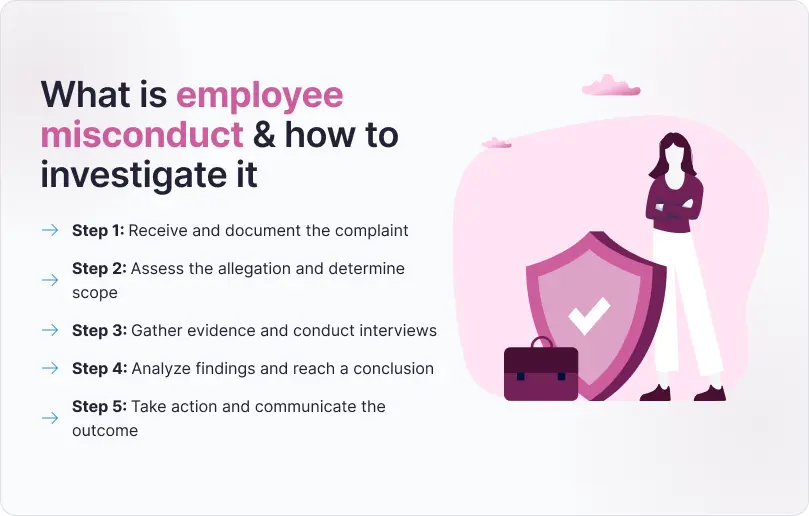
The investigation of the employee misconduct starts with a report. The company can create a process for the employee to report the misconduct. Providing an anonymous communication channel for employees to report misconduct ensures that employees do not feel uncomfortable reporting the misconduct of their coworker. OSHA protects employees who report workplace safety issues to their supervisor.
Allegations of gross misconduct, such as sexual assault or workplace violence, require an immediate response from the employer. For less critical issues, conducting a limited review will suffice. Placing the employee on administrative suspension may be appropriate if the issue poses a threat to other employees.
Interview the complainant, the accused employee, and any witnesses to the incident. Review any documentation related to the incident. Documenting incidents of employee misconduct is essential for the protection of the employees involved in the investigation. Maintaining a log of gathered evidence is part of the investigation process.
HR teams often need accurate employee information when reviewing workplace incidents. HRIS/HCM integrations can help keep employee data synchronized across systems, reducing manual data entry and making it easier for HR teams to work with current employee records.
Review the evidence that was gathered during the investigation. Determine whether the employee's behavior violated company policy, the employee handbook, or the law. Should the determination be that there are legal consequences to the observed behavior, consult with legal counsel regarding such consequences. In order to ensure fairness in the disciplinary process, it is crucial for the employer to establish a policy that is consistently enforced throughout the organization.
Based on the findings of the investigation, take the appropriate action against the employee. According to a report, the organization received 90,743 discrimination charges, representing a 4% increase from the prior year's total, with a favorable outcome in 96.5% of all district court cases. By taking swift action against the employee, the organization can protect itself from further issues.
Clear communication is an important part of managing employee relations. Tools such as Elevate® can give employees and managers a centralized place to access important employment and career information, supporting greater transparency throughout the employee experience.
Disciplinary action should be proportionate to the offense and applied consistently. Progressive discipline gives employees a chance to correct behavior while protecting the employer from legal exposure.
According to the EEOC's FY 2025 reports, the agency processed 88,201 new discrimination charges and secured nearly $660 million for affected workers, its third highest annual recovery ever.
| Disciplinary level | Action | When to apply |
|---|---|---|
| Level 1 | Verbal warning | First minor offense such as chronic lateness or minor policy violation |
| Level 2 | Written warning | Repeated failure to correct behavior after a verbal warning |
| Level 3 | Corrective action plan (CAP) | Ongoing issues requiring structured improvement goals |
| Level 4 | Suspension | Serious or repeated violations; may also apply during an investigation |
| Level 5 | Termination for cause | Gross misconduct (theft, violence, fraud) or failure to improve |
Whistleblower policies should address industry specific risks, and organizations must ensure employees who report concerns are not subject to retaliation. Toxic environments drive employee turnover and increase recruitment costs, so addressing inappropriate behavior early protects workplace culture.
Here are the frequent questions about the employee misconduct:
Yes. Gross misconduct such as theft, workplace violence, or fraud typically warrants immediate termination without progressive discipline. In most U.S. states, employment is at will. However, HR should document the specific behavior and consult legal counsel to reduce legal exposure.
Misconduct involves a deliberate or intentional disregard for company policy or legal standards. It is a behavioral issue. Poor performance relates to an employee's inability to meet job duties or performance standards despite adequate support. Each calls for a different response: misconduct may lead to immediate disciplinary action, while poor performance triggers a corrective action plan.
Include the date and time, names of parties involved, a description of the specific behavior, evidence collected, witness statements, and action taken. Use objective, factual language. Documentation must be thorough and consistent in all cases so as to be defensible should legal action arise.
An employee terminated for gross misconduct such as theft, violence, or substance abuse may be disqualified from unemployment benefits in most U.S. states. Simple misconduct or poor performance is less likely to affect eligibility. State laws vary, so maintain thorough documentation and consult legal counsel.
The EEOC requires employers to keep all personnel or employment records for one year. If an employee is involuntarily terminated, records must be retained for one year from the termination date.
Most HR experts recommend retaining misconduct records for three to seven years after separation to cover state requirements. If a discrimination charge has been filed, retain records until fully resolved.

The latest research, expert advice, and compensation best practices all in one place.
Blog
Bringing trusted compensation intelligence and seamless planning to even more ADP users.

Blog
Learn how to train managers for effective pay conversations and build trust.

Blog
Total rewards package flexibility lets employees choose what matters - pay, perks, and benefits tailored to their needs.