Blog
Get Pay Right on ADP Workforce Now® Next Gen™
Bringing trusted compensation intelligence and seamless planning to even more ADP users.
Written by Salary.com Staff
June 13, 2025

Understanding how to measure HR effectiveness is important for organizations aiming to align their human resources (HR) strategies with business goals. According to a study, organizations that effectively measure HR effectiveness are 2.5 times more likely to achieve their business objectives.
This article explores key metrics, strategies, and actionable steps on how to measure HR performance effectively.
HR effectiveness refers to the ability of the HR function to deliver value to the organization through strategic HR management, efficient HR operations, and impactful HR initiatives. An effective HR team supports employee engagement, fosters a positive employee experience, and aligns HR practices with company success.
Employee happiness: Effective HR creates a supportive work environment that boosts employee sentiment.
Talent acquisition: The HR team ensures the recruitment process attracts high-potential employees.
Workforce planning: HR aligns the number of employees with organizational growth goals.
HR services: Streamlined HR processes improve efficiency and employee satisfaction.
Measuring HR effectiveness is essential for demonstrating the HR department’s impact on organizational performance. Without clear HR metrics, it’s challenging to justify HR investments or identify areas for improvement. For instance, high employee turnover or a prolonged time to hire can signal inefficiencies in HR practices.
Tracking key performance indicators (KPIs), HR professionals can make data-driven decisions, reduce training costs, and enhance the employer brand. Moreover, measuring HR performance ensures alignment with business goals, such as increasing productivity and achieving sales revenue targets, ultimately contributing to company success.
To accurately measure HR performance, organizations must track a variety of HR KPIs. These metrics provide valuable insights into the efficiency of HR activities and their impact on organizational growth. Here are some critical HR metrics to consider:
Employee turnover rate
Calculate the percentage of employees leaving voluntarily or involuntarily over a period, divided by the total number of employees. A high turnover rate may indicate issues with employee engagement or the hiring process.
To calculate employee turnover, use the following formula:
Turnover rate (%) = (Employees who departed ÷ Total workforce) × 100
Keep in mind that newly hired employees are not counted among those who left during the period.
Example: Suppose your company employed 150 people at the start of 2023. Over the course of the year, 12 employees left the organization, and you brought in 8 new hires. Using the formula:
(12 ÷ 150) × 100 = 8%
So, the turnover rate for 2023 would be 8%.
Cost per hire
Measure the total expenses associated with recruitment, including advertising and agency fees, divided by the number of new hires. This metric helps evaluate the efficiency of the recruitment process.
To determine your cost per hire, use this formula:
Cost per hire = Total hiring expenses ÷ Total number of new hires
Example: Imagine your organization brought 60 new employees over the past year, and the total recruiting expenses amounted to $120,000. Using the formula:
$120,000 ÷ 60 = $2,000 per hire
In this case, your cost per hire would be $2,000.
Employee net promoter score (eNPS)
Assess employee sentiment by asking how likely employees are to recommend the company as a workplace. A higher eNPS reflects strong employee happiness.
To determine your Employee Net Promoter Score (eNPS), you start with a simple survey question: “On a scale of 0 to 10, how likely are you to recommend this company as a great place to work?”
Employees respond with a rating, and based on their answers, they’re sorted into three categories:
Promoters (scores 9–10): Enthusiastic employees who are highly engaged and loyal.
Passives (scores 7–8): Satisfied but not particularly enthusiastic—neutral in loyalty.
Detractors (scores 0–6): Unhappy employees who may discourage others from joining the company.
To calculate the eNPS:
eNPS = % of Promoters – % of Detractors
Example: If 68% of your employees are Promoters and 18% are Detractors, your eNPS would be:
68 - 18 = 50
10 to 30: A solid and healthy workplace environment.
Above 30: An exceptional workplace culture with strong employee advocacy.
Time to hire
Track the average time from job posting to offer acceptance. A shorter hire time indicates an efficient talent acquisition process.
To calculate Time to hire, use the following formula:
Hiring duration = Offer acceptance date – Initial application date
Example: If an applicant submitted their application on March 2, 2025, and accepted the job offer on April 10, 2025, the hiring duration would be:
Hiring Duration = April 10, 2025 – March 2, 2025 = 39 days
Internal mobility rate
Measure the percentage of employees moving to new roles within the organization. A high internal mobility rate supports retention and career development.
To determine your internal mobility rate, use the following formula:
Internal mobility rate = (Internal moves ÷ Total employees) × 100
This shows the percentage of employees who changed roles within the company. But this number alone doesn’t tell the whole story. You should look at it with other HR data, like turnover.
Example:
If internal mobility is 8% and turnover is 7%, it means most roles are being filled by current staff. This suggests good career development and planning.
But if mobility is 8% and turnover is 30%, it shows most roles are filled externally, which could mean a lack of internal growth opportunities.
Absenteeism rate
Calculate the frequency of unplanned absences to gauge employee engagement and workplace satisfaction.
To determine an employee’s absenteeism rate, use this formula:
Absenteeism rate (%) = (Total days absent ÷ Total scheduled workdays) × 100
Example: Imagine you’re calculating Jake’s absenteeism rate for the year 2024. Excluding weekends and public holidays, Jake was scheduled to work 240 days. During that time, he missed 8 days due to unplanned absences. Using the formula:
(8 ÷ 240) × 100 = 3.33%
So, Jake’s absenteeism rate for 2024 is 3.33%.
Improving HR effectiveness requires a combination of innovative HR technology, employee-focused HR practices, and alignment with executive teams. Here are some strategies to boost HR success:
Invest in HR technology: Tools like HR analytics platforms streamline data collection and provide insights into employee performance and HR operations.
Enhance training effectiveness: Develop training programs that address skill gaps and measure completion rates to ensure impact.
Promote employee engagement: Regular surveys and self-assessments can gauge employee satisfaction and identify areas for improvement.
Optimize the hiring process: Use data-driven decisions to reduce the cost per hire and improve the quality of new hires.
Strengthen employer brand: Showcase a positive workplace culture to attract top talent and reduce involuntary turnover.
Compensation Software delivers advanced analytics to evaluate compensation practices, identify pay equity issues, and detect flight risks due to uncompetitive pay. This tool provides deep insights into pay practices, supports compliance, and helps retain talent through competitive compensation.
To effectively measure HR effectiveness, organizations should follow a structured approach. Below are four actionable steps to assess and improve HR performance.
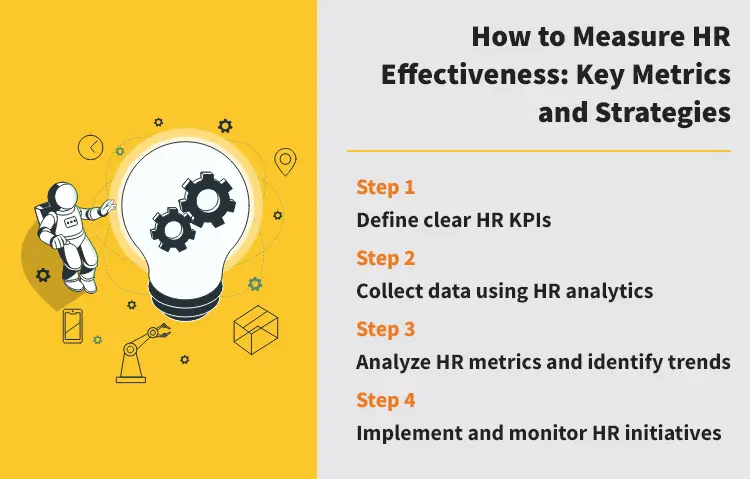
Start by identifying the key performance indicators that align with your organization’s goals. For example, if reducing employee turnover is a priority, track metrics like retention rate and involuntary turnover. Ensure KPIs cover all aspects of HR functions, including talent acquisition, training effectiveness, and employee engagement. Clear KPIs provide a foundation for measuring HR success and guide HR initiatives.
Leverage HR analytics tools to collect data on HR metrics. For instance, use software to track time to hire, cost per hire, and absence rate. Regularly survey employees to measure employee net promoter score and gather feedback on HR services. Accurate data collection enables HR professionals to gain valuable insights into workforce trends and make informed decisions.
Customizable Dashboard provides a user-friendly interface to monitor and manage compensation data in real time. With personalized views and interactive visuals, it ensures accurate data collection for workforce trends.
Analyze the collected data to identify patterns and areas for improvement. For example, a high absenteeism rate may indicate low employee satisfaction, while a low internal mobility rate could suggest limited career growth opportunities. Compare your HR KPIs against industry benchmarks to assess the HR effectiveness. This step helps HR teams pinpoint inefficiencies and develop targeted HR strategies.
Labor Cost Forecasting predicts future labor costs based on market trends and compensation strategies, helping identify cost-related trends and plan strategically. It models labor expenses and tests pay raise scenarios for proactive budgeting.
Based on your analysis, implement HR initiatives to address identified gaps. For instance, if training costs are high but completion rates are low, redesign the training program to improve engagement.
Continuously monitor HR metrics to evaluate the impact of these initiatives on organizational performance. Regular monitoring ensures that HR practices remain aligned with business growth objectives.
HR Technology Integration supports continuous monitoring by syncing compensation data with HR systems, ensuring accurate tracking of initiative impacts.
Mastering how to measure HR effectiveness empowers HR professionals to drive employee happiness, optimize HR processes, and contribute to organizational growth. Defining clear HR KPIs, leveraging HR analytics, analyzing trends, and implementing strategic initiatives, organizations can enhance HR performance and achieve business goals. With the right metrics and strategies, the HR department has become a catalyst for company success, fostering a thriving workforce and a strong employer brand.

The latest research, expert advice, and compensation best practices all in one place.
Blog
Bringing trusted compensation intelligence and seamless planning to even more ADP users.

Blog
Learn how to train managers for effective pay conversations and build trust.

Blog
Total rewards package flexibility lets employees choose what matters - pay, perks, and benefits tailored to their needs.