Blog
Get Pay Right on ADP Workforce Now® Next Gen™
Bringing trusted compensation intelligence and seamless planning to even more ADP users.
Written by Salary.com Staff
April 03, 2026

Compensation trends relate to how firms compensate their employees in a changing labor market. They help firms stay competitive in terms of how they provide for the needs of employees and how their compensation relates to their goals. For 2026, many organizations are struggling with new types of compensation adjustment due to changing economic conditions and employee demands.
This article outlines the significant changes to compensation and provides guidance on how best to address them.
Compensation trends refer to the major adjustments to employee pay, like base pay, incentives, and employee benefits that businesses make based on market demand. Businesses track compensation trends to stay competitive in hiring and cost management. The 2026 compensation trends focus on fair pay and tailored rewards that match employees’ skill levels.
These trends come from surveys and economic data regarding what workers expect. And they help HR departments build strong compensation packages. If trends change, firms have to adapt. That ensures that the employees are happy and that turnover is kept to a minimum.
Market Pricing enables organizations to price jobs accurately against the external market using reliable survey data. This directly supports monitoring compensation trends and maintaining competitive pay levels.
Compensation trends also help bring in new employees and keep current employees.
Employees coming in are looking for a good deal. Trends keep the compensation packages competitive.
Employees will be less likely to leave if the company values them, which can be done with trend-compliant practices like pay transparency.
Skill-based compensation trends help keep valuable employees who become loyal to the company.
Losing employees to other companies because of bad compensation trends negatively impacts the company.
Salary.com’s Competitive Compensation capabilities help organizations design pay programs that attract talent while staying aligned with market realities.
Here are six key compensation trends that HR pros should watch in 2026 to build effective pay strategies.
Salary increases are reasonable as employers try to find balance in a nervous economy.
Merit budgets are flattening with less of the “big win” performance reward.
Variable and performance-based incentives drive the reward strategy.
Pay transparency and equity audits go standard with legal requirements and employee pushback.
Market adjustments are still a key tool for correcting hot-market pay disparities.
Location and industry variation still apply.
Salary growth is slowing in 2026 as organizations manage consistent but fiscally cautious investments. This is a result of balancing costs with retention, but many organizations now project lower increases to remain in line with economic developments.
A recent survey provided information to employers about a projected average merit increase for 2026 of 3.2% and total salary increases of 3.5%. This marks the third year of consistent still reduced growth after much higher increases in previous years. With this information, it is clear that companies are at the beginning stages of budgeting with additional updates to come.
Labor Cost Forecasting helps organizations model salary increase scenarios and assess long-term cost impact before budgets are finalized.
With the uncertainty of the economy, companies are exercising caution when it comes to lavish increases. Wage inflation remains a priority concern with tighter than normal budgets, however, maintaining such budgets helps ensure sustained viability.
Merit budgets are flatter in 2026. There is less differentiation in increases based on performance. This suggests a greater focus on providing the same increase to everyone. It helps with cost management but might be a shock for your top people.
According to a leading survey, U.S. companies are budgeting for average salary increase budgets of 3.6% for next year down from 3.7% in 2025. This is a sign of the ongoing cooling of what was a hot inflationary post-pandemic salary increase market. The survey looks at various employee levels, and they all exhibit the same behavior.
Flat budgets promote more meaningful goal discussions. Firms get pushed to rely on non-monetary rewards. This helps maintain morale high without needing a huge increase in cash expenditure.
In 2026, the use of variable incentives continues to rise with pay based on performance and objectives. This is a great way for firms to pay for results without increased cost commitments. This is particularly effective in a time of uncertainty.
Many companies plan to use more bonuses and performance-based compensation for differentiation. For instance, variable compensation drives compensation for strategic roles. The increased use leads to greater alignment with corporate strategy.
The programs are effective because metrics are well defined. When linked to team performance, the level of engagement is higher. Firms get more out of this.
Pay transparency standardized in 2026 as more companies engage in public salary disclosure. Equity audits ensure payment of equity across various groups, building trust and compliance with legal regulations.
Legal regulations in several jurisdictions now require pay transparency which helps bolster this initiative. Equity audits help ensure all gaps are accounted for and corrected, gaps such as gender and race. This is becoming more commonplace as a means to avoid liability.
Implement clear salary band expectations. Train supervisors for equitable conversations. Check regularly to ensure equity remains in place.
Market adjustments necessary in 2026 to align pay with job demand alterations. These adjustments remedy low pay in critical fields. These prevent loss of talent in competitive markets.
Statistics justify specific increases for high-demand positions whether in technology or healthcare. This prevents loss of talent to other firms. Adjustments are typically greater than the average percentile.
Bring turnover report data into play first. Compare to market range regularly. Act quick on gaps to hold talent.
Compensation in 2026 is localized and sometimes elevated for technology and finance professions. Geographic variations are also relevant for budgets, e.g., increased expenses in urban areas. Industry requirements matter for compensation, too.
WorldatWork sees limited U.S. geographic variation, with the Western region at 3.6% and the Northeast at 2.9%. Such complexities require tailored programs.
Use local data for decision-making. Account for remote work arrangements. This guarantees compensation fairness across locations.
To ensure that companies can adjust to these trends, organizations must have a playbook for pay that is aligned with their business model and workforce expectations.
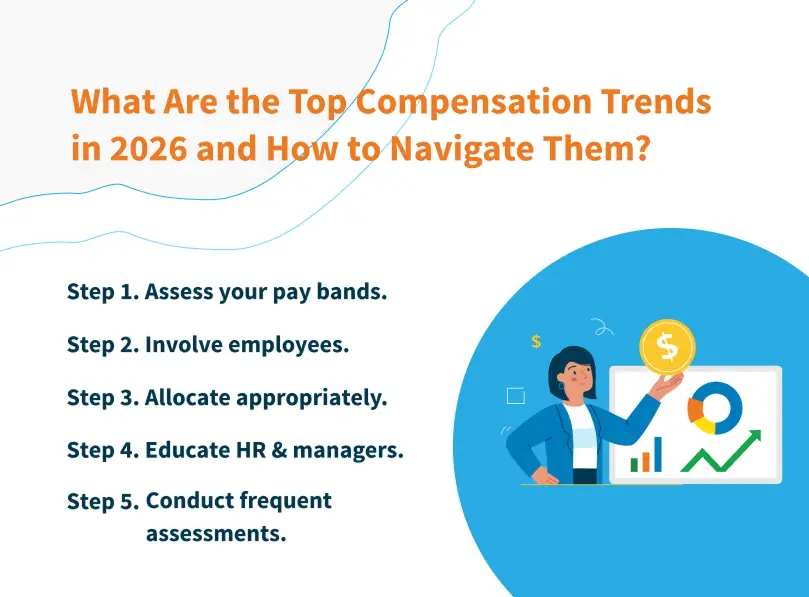
Compare your pay bands to the market. Ensure they reflect 2026 trends like moderation. It aids in early problem detection.
Get employee feedback on pay perceptions via surveys. Use it to create incentives. It ensures buy-in and trust.
Target flat merit and variable opportunities. Allocate budget appropriately. It aligns spending.
Focus on training on the rules of transparency. Cover equity audit basics. Educated staff helps apply trends.
Check for trend changes quarterly. Adjust plans as needed. It keeps the firm innovative. Adopt Total Rewards. Identify value beyond pay. Connect to trends for retention. Workers want comprehensive packages.
Here are some FAQs for better understanding:
Pay transparency laws push companies to share salary info, which shapes trends toward fairer pay. This reduces gaps and boosts trust. For example, the EU directive in 2026 requires more open reporting.
Skills-based hiring shifts pay from job titles to what workers can do, making rewards more flexible. It encourages bonuses for new skills and helps close talent gaps. A Salary.com guide notes this speeds up hiring and boosts performance
Forecasting will be necessary to create an attainable budget based on the data.
Assess external benchmarks for salary expectations. Look at surveys that compare salaries like WorldatWork and Salary.com to get a better average salary expectation.
Analyze your own organization’s attrition. What makes people leave?
Assess external benchmarks against competition. Look at similar companies to find salary ranges.
Watch general economic developments including inflation and employment levels.
Use "what if" budgeting scenarios to account for various lows and highs.
Revise budget plans quarterly using current data.

The latest research, expert advice, and compensation best practices all in one place.
Blog
Bringing trusted compensation intelligence and seamless planning to even more ADP users.

Blog
Learn how to train managers for effective pay conversations and build trust.

Blog
Total rewards package flexibility lets employees choose what matters - pay, perks, and benefits tailored to their needs.