

Blog
Get Pay Right on ADP Workforce Now® Next Gen™
Bringing trusted compensation intelligence and seamless planning to even more ADP users.
Written by Salary.com Staff
October 30, 2026

How do you know whether your HR policies and processes are actually working? An HR audit report helps answer that question by turning an HR audit's findings into a clear, actionable summary. It can cover areas such as hiring, compensation, employee records, benefits, and compliance, giving leadership a practical view of what needs attention.
This article explains what an HR audit report should include, how to structure it, and how to prepare one effectively.
An HR audit report summarizes the results of a human resource audit. It reviews a company's HR policies, processes, records, and systems to show what is working, what needs attention, and what can be improved.
The report gives HR and senior leadership a clear picture of the current state of HR operations. It can also provide a baseline for measuring progress and evaluating future HR initiatives.
Compensation is often an area where HR teams find gaps. Without current market data, pay can fall out of line over time. CompAnalyst® helps HR teams compare pay with market data and use that information in an HR audit report.
An HR audit report can help your organization turn audit findings into clear actions and better decisions. It can:
Communicate key findings
Turn audit results and HR data into clear information that leaders and other stakeholders can understand and act on.
Build leadership support
Show the impact of HR issues and help HR make a stronger case for funding, resources, or changes tied to broader business objectives.
Help set priorities
Give the HR team a clearer view of which issues need attention first, whether that's a specific HR function like recruiting or something that touches HR departments more broadly.
Hiring is one example. SHRM found that recruiting was HR's top priority in 2024, but only 56% of HR professionals said their organization's recruiting efforts were effective.
Guide resource decisions
Provide evidence for decisions about HR budgets, technology, policies, and other initiatives that support operational efficiency and HR efficiency.
When those decisions involve compensation budgets specifically, CompAnalyst® gives HR teams the market data to back up the request with numbers leadership can act on.
Support mergers and acquisitions
Provide insight into the workforce, HR practices, potential liabilities, and retention risks during an M&A.
Create accountability
Document findings, action items, responsibilities, and deadlines so HR can follow through.
Track progress
Establish a baseline for comparing future results and measuring whether improvements are working, from employee turnover to employee productivity.
Support compliance
Help identify policy gaps and other HR issues that need to be addressed. Wage and hour compliance is a good example of why this matters financially, not just legally.
The U.S. Department of Labor's Wage and Hour Division recovered more than $259 million in back wages and damages for nearly 177,000 workers in fiscal year 2025, a reminder that payroll and recordkeeping gaps carry real cost once they're caught.
A useful HR audit report follows a logical structure:
Executive summary
A brief overview of the audit, including its purpose, main findings, risks, and recommendations. It should give executives a quick understanding of the results.
Audit scope and objectives
Explain which HR areas were reviewed, such as recruitment, compensation, or compliance. Include the time period covered, what the audit looked at, and whether the audit was done by an internal team, external consultants, or both.
Methodology
Explain how you collected and reviewed information, such as through documents, data, surveys, or interviews. Mention the tools you used. This shows how the audit was carried out.
Summary of findings
This is the heart of the report. Organize it by HR function so readers can follow the logic, and back every finding with relevant data.
A finding like "performance reviews are inconsistently completed" means much more when paired with a completion rate, whether that data comes from HRIS data or manual tracking.
Risk assessment
For each finding, explain how it could affect the organization, such as through financial, legal, or reputational risks. Note how serious each issue is so leadership knows what to address first, especially safety and compliance issues.
Strengths and opportunities
An audit isn't only about problems. Calling out what's working well and where those strengths can be extended keeps the report balanced and credible.
Action plan
This is where findings turn into next steps and future improvements. Each action item should note who owns it, what resources it needs, a realistic timeline, and how success will be measured.
Tying action items to HR metrics makes it easier to track whether they're actually working.
Progress tracking and review
Name who will monitor the action plan and when the next audit or check-in will happen.
Appendix (optional)
Supporting material that helps support findings, like survey results or detailed data tables, so the main report stays focused and easy to read.
How you present your findings matters almost as much as the findings themselves.
Choose a medium that fits your audience
Slides work well for live executive meetings where discussion matters. A written document, whether PDF or Word, suits a detailed review meant for broader distribution.
A short video summary can also help convey key points quickly, especially for stakeholders who won't read a full report.
Make key findings easy to spot
Use bold text, callout boxes, or a dedicated highlights section, so high-impact information doesn't get buried in dense paragraphs.
Use visuals with restraint
Simple tools like color coding or status indicators can communicate risk levels at a glance. Avoid dense charts that require their own explanation.
Keep it clean and professional. Consistent formatting and a clutter-free layout make your findings easier to trust and act on.
A clear HR audit report starts with a structured process. Follow these steps to organize the findings, highlight key issues, and turn the results into practical actions:
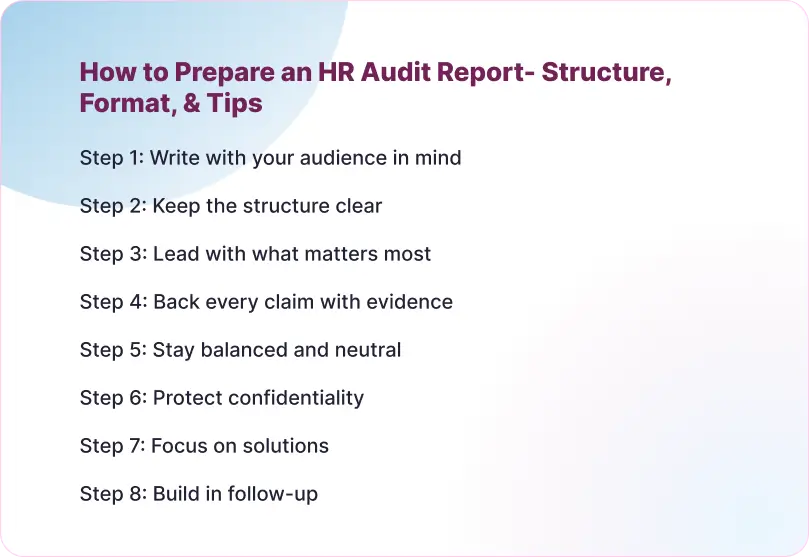
Executives want concise, high-level insight tied to business impact. HR colleagues may need more operational detail. Adjust tone and depth for who's reading.
Consistent headings, logical flow, and enough white space make a long report easier to digest.
Put high-risk findings early and always surface them in the executive summary.
Data, proper documentation, and specific examples make your findings harder to dispute and easier to act on.
Point out gaps honestly but avoid language that assigns blame to individuals or teams. Frame issues as systemic and solvable.
HR audits often touch sensitive employee data, so anonymize where possible and double-check every figure before the report goes out.
Don't just list what's broken. Pair every issue with a proposed fix or next step.
If the audit finds a pay equity gap, for instance, CompAnalyst® Pay Equity Suite can help HR investigate the issue, document the findings, and track the steps taken to address it.
Assign someone to track the action plan and set a date to review progress. This helps make sure the recommended changes are completed.
Here are frequently asked questions related to the topic:
It depends on company size and scope, but a mid-size organization typically needs several weeks to a few months to gather data, conduct interviews, and draft findings.
HR leadership usually owns the process, often with input from legal counsel, department managers, and sometimes external consultants for compliance-heavy areas.
Most organizations aim for annual or biannual audits, with additional reviews triggered by major changes like mergers, new leadership, or new regulatory requirements.
The HR audit is the investigation itself. The report is the document that summarizes findings, risks, and recommended actions so leadership can act on them.
No. Many organizations scope audits narrowly, focusing on one area like compensation or compliance, rather than a thorough review of every internal process at once.

The latest research, expert advice, and compensation best practices all in one place.
Blog
Bringing trusted compensation intelligence and seamless planning to even more ADP users.

Blog
Learn how to train managers for effective pay conversations and build trust.

Blog
Total rewards package flexibility lets employees choose what matters - pay, perks, and benefits tailored to their needs.
