Blog
Get Pay Right on ADP Workforce Now® Next Gen™
Bringing trusted compensation intelligence and seamless planning to even more ADP users.
Written by Salary.com Staff
July 11, 2025

Businesses are currently facing intense competition for acquiring top talent in 2025. This alone highlights the critical need for organizations to measure and optimize recruitment efforts through precise talent and recruitment KPIs.
According to a recent study, US companies are now spending an average of 35 days filling each job vacancy, receiving about 74 applications per job post but inviting only 43% of the candidates to interview.
So, what are recruitment KPIs exactly? What are the top examples for 2025? And how do you effectively set them for your company? Let’s find out in this brief overview of recruiting KPIs in 2025.
Recruitment key performance indicators (KPIs) are measurable metrics used to evaluate the effectiveness and efficiency of a company’s recruitment process. These indicators provide companies valuable insights into how well an organization attracts, screens, and hires qualified candidates.
Talent acquisition KPIs similarly focus on the broader strategy and outcomes of acquiring talent, encompassing recruitment metrics that track every stage of the hiring funnel from job postings to successful company hires.
Real-Time Job Posting Salary Data Solution provides a strategic advantage that puts organizations like yours in a position ahead of the curve through real-time datasets that reflect immediate job market conditions.
Recruitment KPIs are crucial to any organization because they transform recruitment from an intuitive recruiting process into a data-driven strategy. They help hiring teams and recruitment managers to:
Measure success: It quantifies recruitment performance against business objectives.
Optimize recruiting efforts: Identifies bottlenecks in the recruitment workflow and offers improvement solutions.
Control costs: Tracks cost per hire and refines recruitment budget efficiency.
Improve candidate experience: Measures against metrics like positive candidate experience and candidate net promoter score (NPS).
Ensure quality of hire: Links recruitment outcomes to employee performance and retention.
Support strategic decisions: Utilizes recruiting portals, job boards, job sites, and recruiting agencies to build a reliable pipeline of high-quality candidates and enhance the company's reputation.
In this global market seeking talent intelligence, accessibility is key to successful talent acquisition. Real-Time Job Posting Salary Data Solution showcases what organizations are currently advertising along with the compensation they are willing to offer for talent, allowing you to adjust your strategies accordingly.
To effectively measure recruitment performance in 2025, companies should focus on these top 10 recruitment KPIs and their brief overviews:
Time to fill - measures the number of days from job opening to the acceptance of a job offer. A recent study reveals that the U.S. average for time to fill is 35 days.
Cost per hire - refers to the total recruiting costs divided by the number of successful hires, including job ads, agency fees, onboarding, and lost productivity. This metric analyzes the financial side of your hiring strategies.
Quality of hire - evaluates the new hires’ performance, cultural fit, and retention to ensure recruitment efforts yield top talent.
Offer acceptance rate - refers to the percentage of candidates who accept job offers, indicating the attractiveness of your recruitment site and job postings.
Candidate net promoter score (NPS) - measures candidate satisfaction and their likelihood of recommending your company based on the recruitment experience.
Applicant-to-interview ratio - this figure refers to the percentage of qualified applicants invited to interviews after applying for the job.
Interview-to-hire ratio - this is the percentage of interviewed candidates who receive job offers after.
Applicant-to-hire ratio - also known as applicant success rate, refers to the number of candidates that are applying for a job position compared to the number of people a company needs to hire.
Recruitment funnel effectiveness - tracks conversion at each stage of the hiring process: application, interview, offer, and hire.
Hires to goal - measures progress against hiring targets to align recruitment with business goals.
Keep in mind that these recruitment KPIs are just guidelines on how you could effectively measure your talent acquisition team's efforts. Using an advanced recruitment analytics tool such as SalaryIQ enhances competitiveness against real-time data competitors.
The most important part in learning about recruitment KPIs is knowing how to set and implement them to your own company’s hiring practices. Here are four actionable steps you can follow:
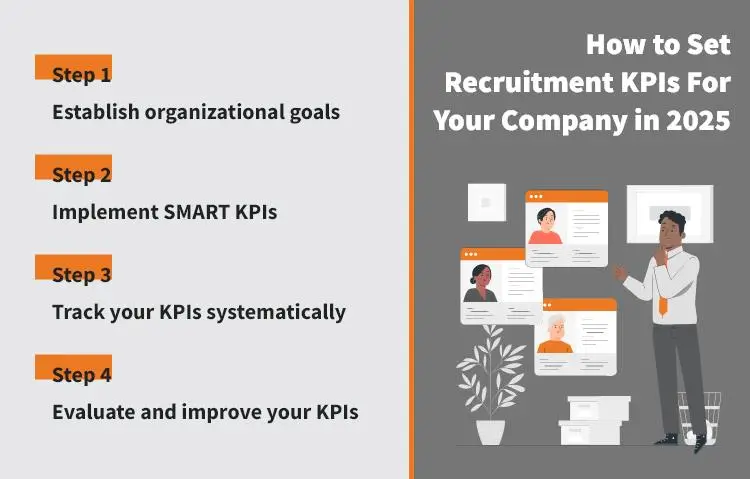
Start by aligning recruitment KPIs with your company’s broader business objectives. Determine what your hiring managers and recruitment team need to achieve, such as reducing time to fill, improving quality of hire, or increasing diversity.
Clear goals ensure your recruitment metrics focus on outcomes that matter most to your company’s growth and culture. A reliable tool like the Real-Time Job Posting Salary Data Solution puts you on the right track in these situations.
It provides the most comprehensive view of the labor market, combining tactical and strategic insights for effective recruiting, compensation, and talent management.
Practice setting recruitment KPIs that are SMART (Specific, Measurable, Achievable, Relevant, and Timely). These SMART talent acquisition KPIs help your recruitment team track progress and stay accountable.
For example, instead of using a vague goal like “improve hiring speed,” you can define a KPI such as “reduce time to fill from 40 to 30 days within six months.”
Consider using an applicant tracking system (ATS) and recruitment analytics tools to collect and analyze data continuously. Monitor recruitment site analytics, recruitment pipeline status, and recruitment workflow efficiency.
Regular tracking enables your recruiting team to identify issues early, such as high recruitment costs or low candidate satisfaction, and adjust recruiting efforts accordingly.
Recruitment KPIs should evolve with your company’s needs and market conditions. Make sure you periodically review your recruitment performance data, gather feedback from hiring managers and candidates, and refine your KPIs to better measure recruitment success.
The 3Ps of recruitment are people, process, and purpose—three critical phases that influence hiring success:
People: Focus on drawing in a diverse pool of qualified candidates using innovative recruiting channels like social media, employee referrals, job fairs, and recruitment agencies. Expanding your recruitment site analytics and recruitment channels enhances your reach to top talent.
Process: This phase involves screening, interviewing, and selecting the best candidates who not only have the right skills but also fit your company culture. Improving the application process with panel interviews and predictive hiring assessments can increase hiring accuracy and reduce turnover.
Purpose: This phase focuses on your organization’s purpose in hiring top talents. This involves effective onboarding, which sets new hires up for success by integrating them into the company culture and clarifying expectations. A strong onboarding program improves retention rates and overall recruitment performance.
By setting and tracking the right recruitment KPIs and talent acquisition metrics, your company can optimize recruitment efforts, reduce hiring costs, and attract high quality candidates who contribute to long-term success.
Make sure that you establish clear goals, implement SMART KPIs, leverage recruitment analytics such as Salary.com’s Real-Time Job Posting Salary Data Solution, and refine your recruiting strategy continuously to stay competitive in 2025’s dynamic labor market.

The latest research, expert advice, and compensation best practices all in one place.
Blog
Bringing trusted compensation intelligence and seamless planning to even more ADP users.

Blog
Learn how to train managers for effective pay conversations and build trust.

Blog
Total rewards package flexibility lets employees choose what matters - pay, perks, and benefits tailored to their needs.