Blog
Get Pay Right on ADP Workforce Now® Next Gen™
Bringing trusted compensation intelligence and seamless planning to even more ADP users.
Written by Salary.com Staff
April 03, 2025

One of the most crucial mechanisms in talent acquisition is the salary package or compensation an employee receives. The compensation package represents an employer’s work culture, reputation, and capability to attract top talent—as well as its willingness to financially support them.
According to a recent study, 64% of American job seekers believe that salary and benefits are critical considerations when accepting a new job. This further highlights the importance of salary packages, as they’re still a major influencing factor in recruitment.
In this guide, we’ll dive deeper into the concept of a salary package. What are its components, benefits, and examples? Most importantly, how do you structure a salary package that appeals to top talents? Let’s find out!
A salary package or compensation package refers to the total compensation an employee receives in exchange for the work he’s done for the company. It includes more than just the base pay such as additional benefits, bonuses, and commissions.
Remember—when an employer mentions salary in the job offer, he is just talking about an employee’s base pay. A salary package relates to more than that. Here’s an example to understand it better:
Example: Employee A is in his fifth year as sales manager and is expected to receive an annual salary package of $150,000, which includes health insurance, housing, and a vehicle allowance.
In a global market seeking talent intelligence, organizations that take advantage of real-time datasets that capture job postings and labor market analytics are ahead of the competition. The Real-Time Job Posting Salary Data Solution provides exactly these features and a lot more through advanced AI.
As mentioned above, a total compensation package encompasses more than just an employee’s base salary. To help you make more informed decisions and understand how to create an appealing compensation package, you should know more about its components:
Base salary: Refers to the fixed regular payment that an employee receives in exchange for his work. The base salary can be calculated in terms of a specific pay period like hourly, daily, weekly, monthly, or yearly.
Bonus: Employee bonuses are additional monetary rewards that are often tied to different aspects such as milestones, loyalty, performance, or company success.
Overtime pay: This is the compensation received by employees for their hours worked beyond the standard workweek. However, eligibility to receive overtime pay depends on the classification of an employee—whether he’s exempt or nonexempt.
Health insurance: This is an employee benefit allowing coverage for medical expenses including personal, dental, vision care, and other employee support services.
Paid time off (PTO): These are standard paid vacation, sick, or holiday leaves.
Fringe benefits: Companies often reward employees for the work they perform, these are called fringe benefits. Some examples of non-taxable fringe benefits are life insurance and retirement plans. On the other hand, fringe benefits taxed by the government are housing allowances, company cars, education assistance, and more.
Competitive compensation is key to winning the war for talent. Real-Time Job Posting Salary Data Solution showcases what organizations are currently advertising and the compensation they are willing to offer for top talent, allowing you to always stay ahead of the curve.
Offering an appealing compensation package not only benefits a company’s talent acquisition process but its entire performance as well. This further showcases that structuring a good salary package is an investment rather than an expense. The following is a detailed breakdown of notable advantages of a good salary package:
Increased productivity: Making employees feel more valued through competitive salary packages boosts their motivation to be more productive and always perform at their best.
Attracting and retaining talent: Competitor companies are now more willing to spend money on acquiring highly skilled and in-demand employees. Having an appealing compensation package that outshines your competitors’ offerings is key to attracting and retaining top talent.
Reduced employee turnover: According to a recent study, 74% of HR professionals believe that inadequate compensation is the top reason behind employee turnover. Therefore, structuring a good compensation package can significantly reduce turnover and enhance employee satisfaction.
Enhanced company reputation: How an organization treats its employees directly reflects the services and products it offers. So, offering competitive salary packages also cements a company’s reputation as one of the best in the industry, therefore attracting more talent and highly skilled workers.
Understanding how a good salary package benefits your company is the first step in mastering how to structure an effective company philosophy. Make sure to always utilize tools like the Real-Time Job Posting Salary Data Solution to stay ahead of crucial market trends.
To ensure that the salary packages being offered are competitive and appealing to top talents, organizations will have to make necessary preparations and assessments. Here are 5 key steps to create an appealing compensation package:
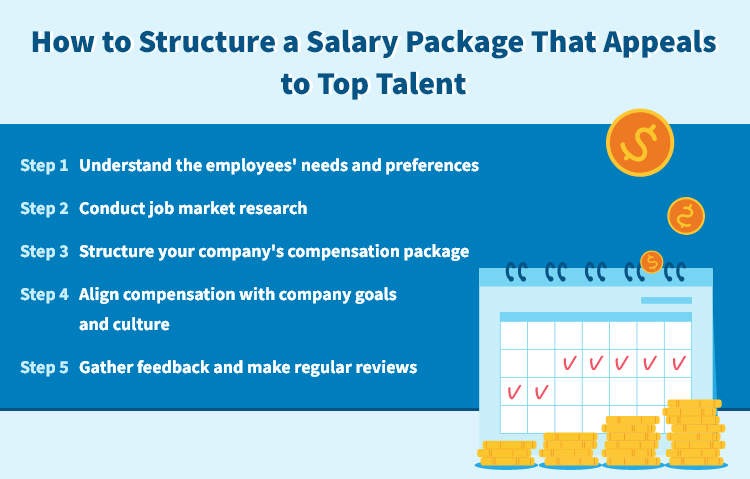
This would be the simplest yet most essential step—put yourself in the shoes of your employees. Is the salary package you have in mind adequate to help employees cope with rising costs of living? Tuition reimbursements? Health costs? Or housing needs?
To gain a better idea of the current state of the job market, make sure to conduct comprehensive market research and compensation benchmarking. The best way to do this is by understanding industry trends and analyzing the salary packages of your competitors.
With the help of Real-Time Job Posting Salary Data Solution, you can easily access the immediate market conditions and the evolving needs of employers. Utilizing this information helps you stay ahead of the curve and outperform other companies in effective recruiting.
The next step would be to structure your company’s compensation package by establishing job valuations, pay grades, and salary ranges according to the different roles within your organization. Every company has a unique salary structure, as also represented by every company’s unique needs.
Make sure that the compensation package you created is aligned with your company’s goals and culture. What are your overall business objectives? Do you plan to attract and retain top talents long-term? Do you want to drive top company performance and establish your organization in the industry?
Remember—it’s hard to hit the jackpot on your first try. The same thing applies to creating an appealing compensation package. You would have to clearly communicate the results with your employees, gather feedback, and revise it accordingly.
It’s a good strategy to gather employee feedback, suggestions, and negotiations about salary packages. Doing this will improve an organization’s compensation practices, stay competitive, and promote great partnerships with its workforce.
To gain an even better understanding of developing a good compensation package, here are actual compensation package examples you can go through:
Employee A: Sales Representative
| Base salary | $100,000 per year |
| Commission | 10% of sales |
| Quarterly bonus | $7,500 for exceeding sales targets |
| Car allowance | $7,500 per year |
| Health benefits | Full medical, dental, and vision coverage |
| Retirement plan | 401(k) with 5% employer’s match |
| Expenses reimbursement | Travel, food, and client entertainment |
Explanation: As you can see, sales representative roles typically have lower base salaries but high earning potential through commissions and bonuses. This also serves as motivation for them to close more deals and clients. Moreover, car allowances and expense reimbursements are typical for sales representatives since they are always on the field to close potential clients.
Employee B: Startup IT Developer
| Base salary | $120,000 per year |
| Equity compensation | 1% company ownership |
| Annual bonus | Up to 15% (performance-based) |
| Remote work | Fully remote work setup (with $2,000 work stipend) |
| Health and wellness | Health insurance with mental health support |
| Professional development | $4,000 annual learning stipend |
| Flexible PTO | Unlimited paid vacation |
Explanation: Startup companies often offer lower base salaries but attract top employees with equity, stock options, or ownership in the company. They also implement remote work setups while offering lifestyle perks such as learning stipends, gym memberships, or even unlimited PTO.
Taking care of your employees through competitive salary packages and well-deserved compensation reflects the culture your organization has to offer. When top talents recognize that, it increases their chance of working for your company and ultimately boosts your reputation.

The latest research, expert advice, and compensation best practices all in one place.
Blog
Bringing trusted compensation intelligence and seamless planning to even more ADP users.

Blog
Learn how to train managers for effective pay conversations and build trust.

Blog
Total rewards package flexibility lets employees choose what matters - pay, perks, and benefits tailored to their needs.