Blog
Get Pay Right on ADP Workforce Now® Next Gen™
Bringing trusted compensation intelligence and seamless planning to even more ADP users.
Written by Salary.com Staff
November 14, 2025

For HR professionals, finance leaders, and business executives, understanding strategic compensation planning helps connect employee pay with business goals. It turns compensation from just an expense into a valuable tool for driving success.
This guide will walk you through the essential framework for effective strategic compensation management in 2025 and beyond.
Strategic compensation planning is the process of designing, implementing, and managing an organization's total compensation system to support its overall business strategy and goals. Unlike traditional compensation which often focuses only on fixed pay and benefits, strategic compensation planning takes a holistic view, integrating performance incentives, long-term rewards, and employee engagement strategies.
This proactive approach to strategic compensation management is essential because it directly addresses key business drivers:
Talent acquisition: Offering a competitive, strategically designed total rewards package attracts top-tier candidates who see a clear value proposition.
Performance alignment: By linking pay to measurable Key Performance Indicators (KPIs) and business outcomes, strategic compensation planning ensures that employee efforts directly drive corporate success.
Cost control and budgeting: A well-defined strategy ensures that compensation funds are used wisely, maximizing the return on investment in talent while maintaining financial balance.
Legal compliance and equity: It helps establish fair pay practices, ensuring compliance with laws like the Fair Labor Standards Act and proactively addressing pay equity issues.
In essence, successful strategic compensation management transforms the conversation from "What are we paying employees?" to "What return are we getting on our investment in our people, and are they motivated to achieve our goals?" The continued focus on this strategic approach is what sets market leaders apart.
Effective strategic compensation management is built upon a comprehensive 'total rewards' philosophy. This encompasses all forms of financial and non-financial value an employee receives.
The key components of a robust strategic compensation planning structure include:
| Component | Description | Strategic Goal |
|---|---|---|
| Base pay | Fixed salary or hourly wage, determined by job evaluation and market data. | Establish internal equity and external competitiveness. |
| Variable pay | Performance-based rewards like commissions, bonuses, and profit-sharing. | Motivate desired behavior and align employee performance with business objectives. |
| Benefits | Health insurance, retirement plans (e.g., 401(k) match), and paid time off. | Promote employee wellbeing, security, and long-term commitment. |
| Non-monetary rewards | Recognition programs, flexible work arrangements, professional development, and career paths. | Enhance engagement, job satisfaction, and retention. |
An organization must ensure these components are aligned with its compensation philosophy, which serves as the foundational guiding document for all decisions in strategic compensation management.
Implementing a successful strategic compensation planning system requires a systematic, data-driven approach. Following this 6-step framework ensures that your efforts in strategic compensation management are aligned, competitive, and sustainable.
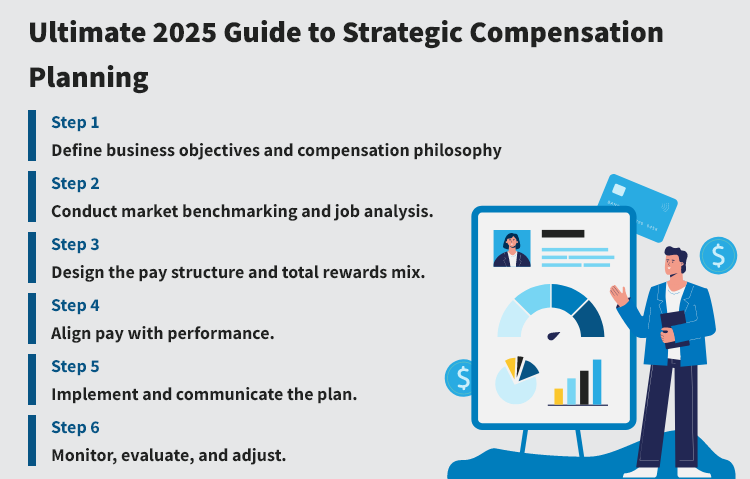
Before designing any pay structure, leadership must clearly articulate the organization's short-term and long-term business objectives. Is the focus rapid growth, cost reduction, or market leadership through innovation? The strategic compensation planning process must support these goals. Next, establish a clear compensation philosophy that defines your position relative to the market (e.g., pay at the 75th percentile for base salary) and the role of pay in motivating performance.
To ensure your strategic compensation management is competitive, you must analyze external market rates for comparable roles. Utilize reliable sources like Salary.com data, industry surveys, and government statistics. Simultaneously, conduct a thorough job analysis to understand the responsibilities, required skills, and internal value of each position. This dual approach ensures both external competitiveness and internal equity.
Based on your philosophy and market data, create a formal pay structure including salary grades, pay ranges (minimum, midpoint, maximum), and guidelines for progression. Determine the appropriate mix of base pay, variable pay, and benefits for different job families, ensuring your strategic compensation planning reflects the market norms and motivation levers for each group. For instance, sales roles may have a higher variable pay component.
This is a critical element of strategic compensation planning. Develop measurable key performance indicators (KPIs) that link variable pay directly to individual, team, and organizational performance. The design must be transparent, understood by employees, and genuinely motivational. A strong structure ensures that exceptional performance is rewarded proportionately, reinforcing the objectives of strategic compensation management.
Roll out the new strategic compensation planning framework with clear, consistent communication. Transparency is vital. Employees need to understand how their pay is determined, how their performance impacts their rewards, and what opportunities exist for advancement. Train managers to be confident and articulate in communicating pay decisions, fostering trust and reducing confusion.
The business landscape, market conditions, and talent needs are constantly evolving. Effective strategic compensation management is an ongoing cycle, not a one-time event. Continuously monitor key metrics like employee turnover, time-to-hire, pay equity gaps, and budget adherence. Annually review market data and employee feedback, making necessary adjustments to your strategic compensation planning to ensure it remains competitive and strategically aligned.
Ready to implement a new plan? Here are answers to common questions about strategic compensation planning and its execution.
Strategic compensation planning improves retention by aligning pay, incentives, and benefits with employee goals and company strategy. When employees feel valued and fairly compensated, they are more likely to stay. A U.S. National Library of Medicine study found that well-structured compensation plans can significantly reduce turnover rates among medical laboratory technologists.
Modern compensation tools help automate pay reviews, track performance, and ensure internal equity. Tools like CompXL by Salary.com streamline planning, improve accuracy, and support data-driven decisions.
Global organizations apply a unified compensation philosophy but adjust for local market rates, currency, and regulations. Centralized strategic compensation management tools like Salary.com’s platform help maintain global consistency while allowing regional flexibility and compliance.

The latest research, expert advice, and compensation best practices all in one place.
Blog
Bringing trusted compensation intelligence and seamless planning to even more ADP users.

Blog
Learn how to train managers for effective pay conversations and build trust.

Blog
Total rewards package flexibility lets employees choose what matters - pay, perks, and benefits tailored to their needs.