Blog
Get Pay Right on ADP Workforce Now® Next Gen™
Bringing trusted compensation intelligence and seamless planning to even more ADP users.
Written by Salary.com Staff
March 07, 2025

In today's competitive employment market, it is imperative for an organization to recruit and retain skilled workers in order to ensure its long-term success. To attract top talent, it is essential to provide compensation packages that are both competitive and equitable.
However, this necessitates a data-driven approach. Companies can acquire useful insights to benchmarks within the industry, regional pay trends, and role-specific compensation standards by utilizing salary data analytics.
Salary data analytics entails systematic gathering and analysis of the data of compensation data to enhance and refine an organization's compensation frameworks. The data analysis includes a continuous review of job boards, career websites, and other publicly accessible information to supply organizations with current competitive intelligence.
This allows organizations to remain proactive in response to market fluctuations and refine a compensation strategy utilizing data from millions of job posts. Salary data analytics enables companies to make informed decisions about employee compensation, guaranteeing equity, competitiveness, and compliance with existing market trends.
Integrating Real-time Job Posting Salary Data into talent analysis enables companies to maintain competitive compensation packages, thus recruiting and keeping skilled workers.
Organizations that seek to recruit and retain top talent have adopted the integration of talent intelligence and salary data analytics as a cornerstone. Companies can establish effective recruitment strategies, guarantee equitable compensation, and preserve a competitive advantage by utilizing data-driven insights.
Organizations are gradually implementing data-driven approaches to optimize their recruitment processes. Companies may modify their strategies to address specific requirements by examining market trends, talent availability, and competitive hiring procedures.
For example, regression models have been shown to be effective in projecting employee salaries, which has aided the development of competitive offers.
Studies indicate that selective recruitment strategies aimed at obtaining competent employees enhance organizational performance and decrease turnover rates. Hiring skilled workers is crucial for several reasons:
Enhanced productivity: Skilled employees contribute specific knowledge and expertise, resulting in improved productivity and innovation. Competent workers require minimal supervision and can manage complex jobs more effectively, hence reducing downtime and enhancing productivity.
Competitive advantage: Competent talent management is fundamental to gaining a competitive advantage in the competitive industry. A study discussed that companies prioritizing the acquisition, development, and retention of skilled workers are more likely to outperform their competition.
Growth of organization: Skilled workers are essential for fostering organizational growth and attaining strategic objectives. Strategic planning, when combined with a competent team, offers a definitive framework for growth and market recognition. A study indicated that successful strategic planning is favorably correlated with organizational growth, since it aligns resources and operations towards mutual goals.
Utilizing Real-time Job Posting Salary Data from job postings allows companies to obtain the information necessary to make informed decisions regarding compensation and talent acquisition approaches.
The utilization of salary data analytics in recruitment provides numerous benefits but at the same time it comes with challenges that organizations must also deal with.
Benefits of salary data analytics
Improved decision-making in candidate matching: Recruitment improves with algorithms that assess cultural fit, growth potential, and soft skills beyond abilities. Machine learning analyzes past hiring, team dynamics, and project success to identify top candidates. A 2023 study found data-driven recruitment boosts employee engagement by 22%.
Market alignment: Companies can improve their risk management procedures. This allows organizations to understand the effects of fluctuations in labor market trends. Regular data analysis of compensation variations guarantees that salaries are in accordance with industry benchmarks, leading to better-informed business decisions.
Real-time Job Posting Salary Data enables organizations to remain ahead of the curve by providing real-time intelligence into market trends, thereby supporting these objectives.
Enhance branding: Employer branding is key to attracting top talent. Salary data analytics reveals how applicants perceive your company, guiding improvements. A strong, data-driven brand attracts candidates who value aligned workplace culture.
Challenges of salary data analytics
Data accuracy: Preventing compensation misalignment requires accurate salary data. Data integrity might be jeopardized when integrating various data sources. Studies have highlighted that data integration and quality issues are significant obstacles in implementing human resource analytics. Reliable salary metrics are ensured through regular audits and cleansing.
Cultural resistance: The organizational culture is essential for the successful utilization of salary data analytics. Research indicates that cultural influences and lack of support from management can be a significant challenge. Resistance to change and insufficient support from the top management could prevent the implementation of data-driven strategies.
To effectively utilize salary data analytics for attracting skilled workers, companies might consider the subsequent steps:
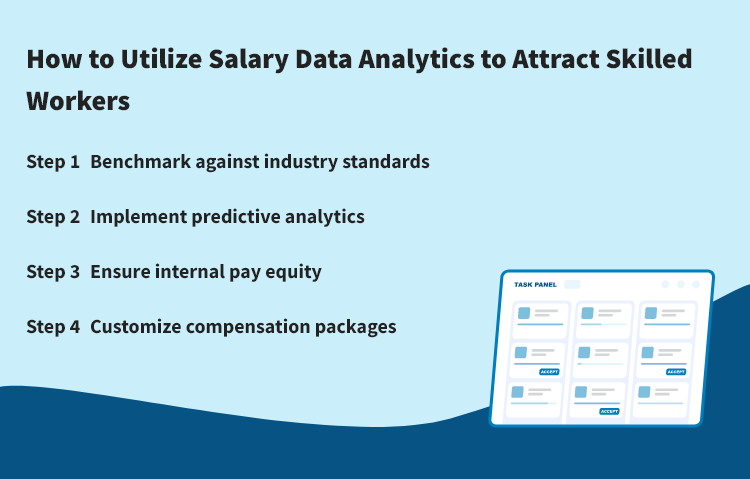
Acquire comprehensive salary data from credible sources that are pertinent to your industry. Ensure that what you offer is competitive by identifying and analyzing current compensation trends.
Real-time Job Posting Salary Data offers significant insights into salary trends and market-driven information, assisting you in aligning your recruitment strategy with current standards and ensuring that your salary offerings remain competitive.
Salary forecasting and planning are improved by predictive analytics. A study employed machine learning to estimate salaries across industries, thereby enabling organizations to make informed compensation decisions to remain competitive and attract skilled workers.
Conduct audits along with regular reviews of internal salary distributions to identify and resolve discrepancies. To cultivate trust and attract prospective workers, it is imperative to effectively communicate compensation policies.
Leverage analytics to determine the incentives and benefits that your prospective talent pools prioritize. Customize compensation strategies to accommodate the diverse requirements of potential employees. A compensation package that is effective in attracting top talent and reducing attrition is well-designed and includes a combination of base salary, bonuses, and benefits.

The latest research, expert advice, and compensation best practices all in one place.
Blog
Bringing trusted compensation intelligence and seamless planning to even more ADP users.

Blog
Learn how to train managers for effective pay conversations and build trust.

Blog
Total rewards package flexibility lets employees choose what matters - pay, perks, and benefits tailored to their needs.