Blog
Get Pay Right on ADP Workforce Now® Next Gen™
Bringing trusted compensation intelligence and seamless planning to even more ADP users.
Written by Salary.com Staff
June 12, 2026

A global mobility program is the process in which companies can meet their needs for moving employees across countries. Such a program covers aspects like international assignments, permanent transfer, localization, remote work abroad, business traveler compliance, compensation, immigration and payroll, tax, and repatriation.
For United States HR teams this is not simply a relocation process. This is about managing global talent while reducing legal, financial and employee experience risks, factors identified in the 2026 Mobility Reimagined Survey as critical for any process of ownership within HR, tax, payroll, and immigration departments.
A global mobility program provides HR with a structured way to deal with employee movement between a home country and a host country. Without such a clear program, the company may end up managing each relocation as a separate case, leading to inconsistent payscales, missed work visa steps, payroll errors, and employee frustration.
| Program Area | What HR Manages |
|---|---|
| Assignment lifecycle management | Selection, approval, relocation, support, repatriation |
| Immigration compliance | Work visa, residence permit, travel rules |
| Payroll compliance | Shadow payroll, split payroll, local reporting |
| Compensation | Expatriate compensation and assignment package |
| Risk control | Duty of care, tax, cost, policy governance |
A good program will clearly relate employee movements with the company's mobility strategy. This does not mean HR simply moves employees according to managerial requests. Such movements should better suit business expansion, leadership delivery, or critical skills requirements.
The 2025 Talent Mobility Outlook noted again that mobility professionals saw the activity trend within global mobility as stable or increasing, confirming the importance of such activities to workforce planning.
Global mobility governance is critical because any employee movement introduces many different risks at once. The HR, finance, tax, payroll, legal, immigration, and business leaders all need to understand who approves such moves, who funds them, what policy governs them and how compliance is tracked. Good governance means preventing exceptions from developing into unfair practices and giving leaders a means of comparing assignment ROI relative to total assignment cost.
The goal is to create a written policy that explains how moves will be handled, in a way that is both practical and fair for managers. The policy should not become a long document full of legal terms. The goal is to establish clear rules regarding eligibility, pay, benefits, compliance, support, and return planning.
Key items to include are:
Assignment type and business reason
Home and host country responsibilities
Work visa and residence permit requirements
Tax equalization rules
Payroll compliance process
Housing and cost of living allowance
Family support and duty of care aspects
Repatriation and career planning elements
CompAnalyst® can support a global mobility program by helping HR price jobs, build salary structures, and model different pay scenarios. For companies managing permanent transfers, localization, or international assignments, this helps create more consistent and data-backed pay decisions.
The policy should make clear who can qualify for such support, what benefits are offered, and what approvals are required, and what occurs should the assignment develop differently. Such a policy should also make clear how considerations like business traveler compliance and work abroad on a remote basis are reviewed even on a short-term basis.
There is merit in treating international assignments, permanent transfers, and localization as separate processes and with different purposes. International assignments work best for maintaining a link to a home country. Permanent transfers mean more of a shift into the host country's structure. Localization works best for a shift from assignment terms to local terms after some set period.
| Move Type | Best Use | HR Focus |
|---|---|---|
| International assignment | Temporary business need | Allowances, assignment package, return plan |
| Permanent transfer | Long term role in host country | Local contract, benefits, payroll setup |
| Localization | Employee stays after assignment | Transition from expatriate terms to local terms |
Such work should involve tax, payroll, and immigration partners well before the employee moves abroad. Tax equalization can ensure employees are not paying simply due to the assignment. Payroll compliance may involve shadow payroll or split payroll structures. Immigration compliance ensures the right work visa or residence permit is in place before the employee starts work.
Expatriate compensation should be fair and consistent with business needs. The compensation teams need to establish whether the employee maintains a home-based pay rate, uses host-based pay, or features some special package elements. The appropriate approach depends upon a range of factors of assignment length, host country cost, employee level, family needs, and business value.
Common elements of such packages include:
Base salary
Cost of living allowance
Housing allowance
Tax equalization support
Relocation travel
Medical and security support
Schooling or family assistance elements
Repatriation support
The balance sheet approach is often used in expatriate compensation structures because it allows the employee to maintain a similar lifestyle abroad. Home-based pay supports retention of connection to the home country pay structure while host-based pay introduces alignment with the local market of the host country.
| Pay Approach | How It Works | Best Fit |
|---|---|---|
| Home-based pay | Pay is linked to home country structure | Temporary assignment |
| Host-based pay | Pay is linked to host country market | Permanent transfer or localization |
| Balance sheet approach | Adjusts for tax, housing, and living cost | Expatriate assignment |
The package should include only what is needed to facilitate the move and provide for the employee. HR must avoid overpromising benefits that may later be hard to remove. Every allowance should have a purpose, end date, and approval process. All essential elements for cost control and fairness across employees.
The best approach involves performing a cost projection prior to approval of any assignment. Such projections can include all elements, pay and allowances, tax support, relocation, immigration processes and HR systems, housing, travel, and repatriation elements. HR can also measure assignment ROI to determine if it filled a critical role, developed future company leaders, or expanded markets and skills.
Consulting can help HR and compensation teams review complex pay policies, salary structures, and assignment cost decisions before employees move abroad. This is useful when companies need expert support for cost projections, assignment compensation, localization, and repatriation planning. With added guidance, HR can make global mobility decisions that are more consistent, cost-aware, and aligned with business goals.
Focus upon these six streamlined steps to manage the overall program effectively:
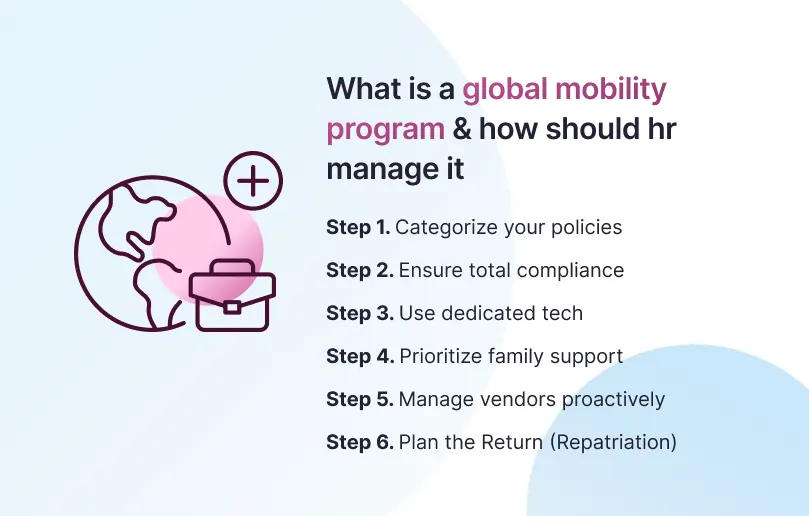
Get away from a one-size-fits-all policy. Instead, define tiered packages according to moves, balancing costs, and employee needs.
Work with experts managing the so-called "big three" immigration (visas), tax (to avoid double taxation), and payroll (local vs. home country reporting).
Ditch your spreadsheets and implement proper Global Mobility Management (GMM) software to centralize data, manage expiration dates, and offer real-time cost reporting.
HR teams can also use CompAnalyst® Market Data Global to compare compensation across countries and markets. This helps support host country pay, assignment packages, localization decisions, and fair cross border compensation planning.
Most international assignments fail for personal reasons. Offer "soft-landing" services, cultural training, housing, or school searches for trailing family members.
Consolidate external service partners, movers, tax firms, or lawyers and use volume-based discounts.
Create career plans for the employee six months before their return, ensuring new global expertise is well utilized and that they do not leave the company.
Here are the frequent questions about global mobility program:
Indicators include employees moving across countries, managers requesting international roles or work, growing interest in remote work abroad, or when payroll and immigration elements are handled on a case-by-case basis.
The program reduces risk associated with immigration compliance, payroll compliance, duty of care, tax equalization, and assignment benefits, as well as repatriation support.
The HR function needs to involve tax, payroll, legal, immigration, finance, compensation, security, and talent management, along with the business leader requesting employee moves.
The best start is with a simple global mobility policy, an approval checklist and trusted external partners for tax responsibilities and immigration, with clear documentation of each move.
HR should avoid issues like unclear approvals, inconsistent benefits of delivery, late immigration reviews, weak cost projections, missing shadow payroll considerations, and no repatriation plan at all. Such elements create cost and trust issues within the HR function.

The latest research, expert advice, and compensation best practices all in one place.
Blog
Bringing trusted compensation intelligence and seamless planning to even more ADP users.

Blog
Learn how to train managers for effective pay conversations and build trust.

Blog
Total rewards package flexibility lets employees choose what matters - pay, perks, and benefits tailored to their needs.