Blog
Get Pay Right on ADP Workforce Now® Next Gen™
Bringing trusted compensation intelligence and seamless planning to even more ADP users.
Written by Salary.com Staff
April 03, 2026

Yield ratio is one of the most important HR recruitment metrics showing how many candidates make it through the hiring process and where you lose them. It’s a great process to pinpoint the weaknesses of your process while saving time and money.
In this article, we explain the yield ratio in more detail, why it matters, and walk you through calculating yield ratio in the most basic formulas. You will also find examples and recommendations to make the ratio more favorable for you.
The yield ratio is the percentage of candidates who survive each phase of your recruitment and selection process. It is like a funnel; many candidates enter the top, and few exit at the bottom. It's a relatively simple but powerful metric that shows whether your recruitment strategy sources the right candidates. You don’t even need any special tools to work this out.
The selection ratio can be used from applications to interview or interviews to offers. If you wanted to calculate it, you would number those who progressed to the next step, divide that by the number who stood at the previous step, and multiply it by 100. This shows you where the process falls down. If lots of people are dropped after a particular screening, it shows you, when monitoring this over time, valuable insight into how to budget for hiring processes.
To understand how salary expectations affect candidate progress, HR teams can use Minimum Wage Data. Fair wage information helps attract better applicants who are more likely to stay in the hiring funnel.
The selection ratio is useful because it helps improve the efficiency and effectiveness of your hiring process in a resource-sensitive, outcome-focused way.
It helps you spot flaws in your process - where do candidates fail to progress?
It helps evaluate the effectiveness of your sourcing methods - which sources yield the best candidates?
It helps you budget for hiring - correlating spend with yield
It helps inform diversity efforts - how different groups progress at different stages
It helps forecasting - how many candidates you need to hire X number of roles
And according to Salary.com, using selection ratios can help refine your strategy and make recruitment a whole lot more predictable.
While selection ratios are an excellent tool, there are a few issues with using them in practice.
Your data quality needs to be very accurate, but this can be labor-intensive to track.
There are many variables that can skew your ratios and make it difficult to compare them across different time periods.
It doesn’t account for the quality of the candidates, so a more excellent ratio doesn’t mean better candidates if their skills don’t fit the bill.
You'll often find that small sample sizes in niche positions will be false positives and negatives that don't tell the whole story.
They can be difficult to integrate with other metrics—especially for smaller teams.
Calculating selection ratio is simple and gives immediate results at each selection stage to fine-tune your process.
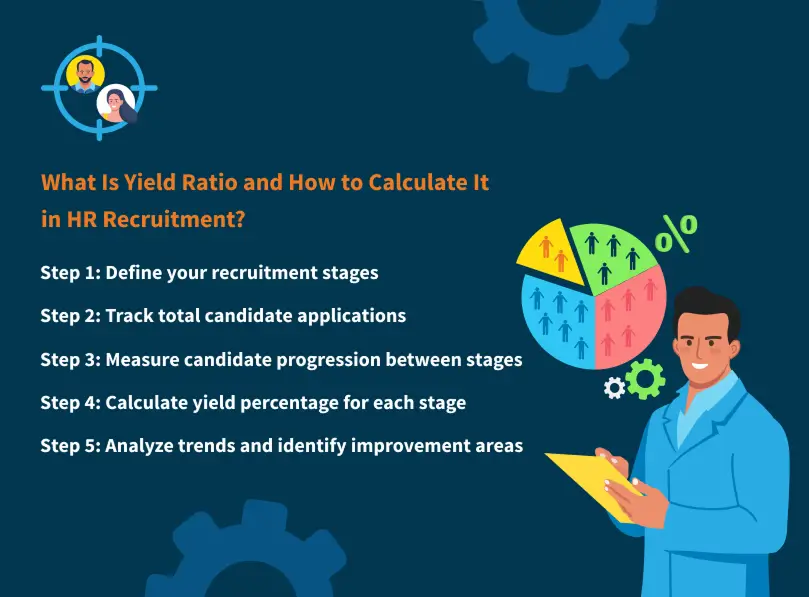
Clearly define your recruitment stages: applications, screenings, interviews, offers, hires. This keeps team members on the same page and focused on what’s important to measure.
Counting the candidates entering your selection process, like total applications received. You can get this from the application tracker in your software or the spreadsheets. Count and confirm the numbers you find to avoid mistakes.
Count how many make it to the next stage - like candidates who passed screening. Track this over a specific timeframe (month, quarter), keeping your comparison windows consistent. Note any candidates who dropped out and why.
To connect candidate progress with reward expectations, HR teams can use Total Compensation Statement. Understanding total pay value helps retain candidates through hiring stages.
Use the selection ratio formula: number of candidates who progress / number of candidates at the selection stage (application stage) x 100. For example, if 50 out of 200 interviewed applicants’ selection ratio is (50/200) x 100 = 25 percent. Do this for each selection stage to get your ratios.
Review and compare ratios over time to see trends and where you can improve. Discuss with team members to generate ideas for improvements.
To predict hiring costs and candidate needs, HR teams can use Labor Cost Forecasting. Forecasting helps plan hiring volume based on historical selection ratios.
Here are some practical examples to show how yield ratio works in real scenarios, making it easier to apply in your own recruitment.
Example 1: You get 300 applications for a position, and 90 of the applicants are good enough to warrant a phone screen. Your yield percentage is (90/300) x 100 = 30 percent. One third of your applicants are worth speaking to–not bad for an entry level job!
Example 2: From 50 interviews you determine that only 10 applicants are good enough to offer the position to. Your yield percentage is (10/50) x 100 = 20 percent. If this seems paltry, consider whether your interview questions need to be revamped to find the right match.
Example 3: You extend 20 job offers, and 15 candidates accept and start work. That’s a yield percentage of 75%–terrific! But be sure to check back and see if your yield percentage remains this successful.
A study from the U.S. Office of Personnel Management highlights how yield ratios help agencies measure recruitment success and plan better for future hires.
To boost your yield percentage, you need to take a targeted approach to streamline the process and attract the right people from the off.
First make sure your job descriptions are crystal clear and actually appeal to people who've got the skills to do the job - the kind of people who will stick around long-term.
Use past hire data to figure out which sourcing channels are actually worth using - and you might be surprised to find that things like employee referrals work out pretty well.
Get your team trained on how to screen efficiently so they can spot top talent quickly without losing sight of the good stuff either.
Keep those candidates engaged through the process, so they don't suddenly drop out of the running.
Keep a close eye on your ratios and go in and make some tweaks - like speeding up response times - and see what makes the biggest difference.
Here are some FAQs for better understanding:
A yield percentage helps you plan your workforce with a bit more accuracy because it gives you a clear idea of how candidates are moving through the hiring process. For example, if you know that 20% of applicants are going to make it to an interview, you'll have a much better idea of how many candidates you need to start with to hit your targets, which should mean fewer nasty surprises and more realistic timelines. Over time it's a lot more reliable.
Yes, a yield percentage can give you a pretty good idea of your future hiring capacity, as long as you know how to use past data to make some sensible predictions. So if your ratios are pretty low in certain areas, it might be time to bring in a bit more support or try some new approaches to make sure you can fill those roles on time, which should help you meet your growth needs down the line.
Standardizing your yield percentage can be a good way to create some common benchmarks, but you need to give yourself a bit of room for flexibility, especially if you're dealing with different departments or job types. What works for sales might not fly for tech, since those roles need different kinds of skills. So start with some basic guidelines, then use feedback from your team to adjust. That way, you can create some consistency without losing your way.

The latest research, expert advice, and compensation best practices all in one place.
Blog
Bringing trusted compensation intelligence and seamless planning to even more ADP users.

Blog
Learn how to train managers for effective pay conversations and build trust.

Blog
Total rewards package flexibility lets employees choose what matters - pay, perks, and benefits tailored to their needs.