Blog
Get Pay Right on ADP Workforce Now® Next Gen™
Bringing trusted compensation intelligence and seamless planning to even more ADP users.
Written by Salary.com Staff
October 09, 2026

Filling an open role does not always mean looking outside your organization. A well written internal job posting gives current employees a clear path to new opportunities while saving your HR team time and money.
Thousands of compliant templates. Save hours of work.
This guide covers what an internal job posting is, what to include, and how to write one using a ready made template.
An internal job posting is a job advertisement shared exclusively with existing employees before opening the role to external candidates. It is published on an internal job board, company intranet, or through an internal job posting email so eligible employees can apply for an internal job opening without competing against outside applicants.
Internal job postings drive internal mobility, support internal talent development, and give your workforce ongoing development pathways for career growth.
| Benefit | Why It Matters |
|---|---|
| Lower hiring costs | Internal hires cost less than external candidates. SHRM data shows the average cost per hire is approximately $4,700. |
| Faster ramp up | Internal hiring reduces time to productivity due to existing organizational knowledge. |
| Higher retention | A clear internal job posting policy boosts employee morale, helping retain top talent. |
| Stronger culture | Internal hiring fosters continuous learning and development. |
| Transparency | Internal job posting policies promote fairness across the organization. |
An effective internal job posting should be transparent, concise, and contain the following elements:
Job title and department: The job title should indicate the function of the position and the level of experience required for the role (e.g., Senior Project Coordinator, Marketing Department).
Position overview: Provide a brief description of the position and its primary goal.
Key responsibilities: List the specific duties of the position.
Qualifications: State the skills, experience, and knowledge necessary to perform the position.
Eligibility requirements: State any requirements regarding an employee's tenure in the company or the level of their job performance.
Reporting structure: State whom the employee will report to and who they will report to their job.
Compensation details: State the salary and pay grade for the position. Job postings are legally required to include this information.
Application instructions: State when the position will be filled and include a link to the job application. Indicate whether a cover letter is required to apply.
Contact details: Include the name of the HR representative in charge of hiring for the position.
Creating a consistent internal job posting starts with having clear and well-defined job information. JobArchitect® helps organizations create, manage, and organize job content, making it easier to maintain consistent job descriptions and role information across the organization.
A standardized template saves time in job posting creation and keeps the hiring team aligned.
Consistency: Templates ensure professionalism in internal job ads across departments.
Fewer errors: A well designed template reduces errors and missing information.
Easy adaptation: Templates can be adapted for various internal roles, from senior leadership roles to lateral moves.
Speed: Instead of drafting a brand new job posting from scratch, the HR team fills in the blanks and shares internal jobs within hours.
Below is a practical template your HR team can copy, customize, and publish on your internal HR portal.
Auto-matching tools for a clear, fair organization.
[Company Name] Internal Job Posting
Job Title: [e.g., Senior Project Coordinator]
Department: [e.g., Marketing Department]
Location: [Office/Remote/Hybrid]
Reports To: [e.g., Director of Marketing]
Salary Range: [e.g., $75,000 to $90,000]
Posting Date: [Date]
Application Deadline: [Date]
Dear Team,
We are excited to announce an internal job opening for a [Job Title] in the [Department]. This is a significant career advancement opportunity for a motivated professional looking to take the next step.
Position Overview: [Explain why the role exists and how it fits the team's mission.]
Key Responsibilities:
[e.g., Plan and execute scalable marketing campaigns]
[e.g., Guide project team members and mentor junior team members]
[e.g., Coordinate with senior leadership on strategic initiatives]
Required Qualifications:
[e.g., 3+ years in a project coordination or management role]
[e.g., Proficiency in project management software]
Preferred Qualifications:
[e.g., Experience with data analytics tools]
[e.g., PMP or similar certification]
Eligibility:
[e.g., 12+ months in current role]
[e.g., Most recent performance review rated "meets expectations" or above]
Application Process: Submit resume and cover letter through [internal HR portal/link]. Contact [HR Contact Name] at [contact details] with questions.
Example: Filled out internal job posting
Bright Solutions Inc. Internal Job Posting
Job Title: Senior Project Coordinator
Department: Marketing Department
Location: Hybrid (New York, NY)
Reports To: Director of Marketing
Salary Range: $78,000 to $92,000
Posting Date: September 1, 2025
Application Deadline: September 14, 2025
Dear Team,
We are excited to announce an internal job opening for a Senior Project Coordinator in the Marketing Department. This is a significant career advancement opportunity for a motivated professional looking to lead cross functional projects.
Position Overview: This role streamlines project execution across the marketing department. The senior project coordinator will guide project team members, mentor junior team members, and ensure campaigns are delivered on time.
Key Responsibilities:
Plan and execute scalable marketing campaigns
Guide project team members and mentor junior team members
Coordinate with senior leadership on strategic initiatives
Required Qualifications:
3+ years in a project coordination or management role
Proficiency in project management software (Asana, Monday, or similar)
Strong communication and cross functional collaboration skills
Preferred Qualifications:
Experience with data analytics tools
PMP or similar certification
Eligibility:
Must have completed at least 12 months in current role
Most recent performance review rated "meets expectations" or above
Application Process: Submit your resume and cover letter through the internal HR portal at [insert link]. For questions, contact Jane Smith, HR Business Partner, at jane.smith@brightsolutions.com.
Once you have the template in hand, follow these five steps to fill it out and publish a polished internal job posting.
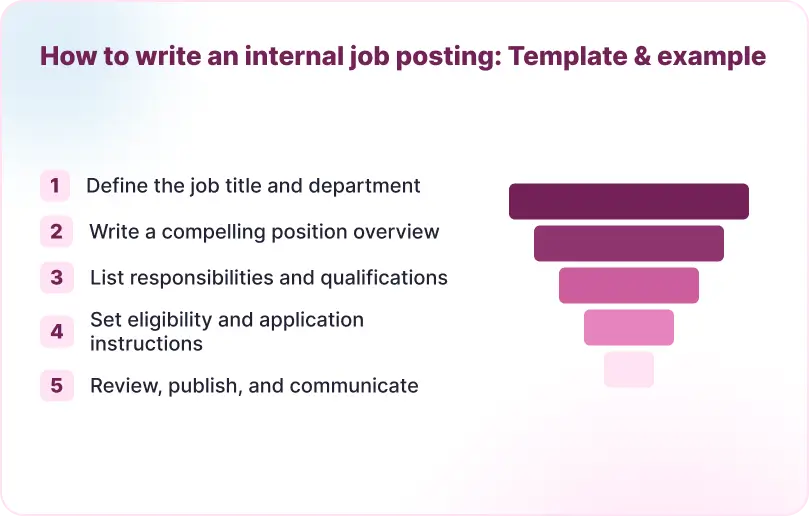
Enter the exact job title and department. The job title department combination should immediately tell employees what the role is. Avoid vague titles that do not reflect function or seniority.
Before publishing an internal role, HR teams can also compare the position with similar jobs to make sure the role is appropriately defined and positioned. Salary.com's Job Matching helps organizations match jobs with comparable market positions, supporting more consistent job and compensation decisions.
Internal job postings should be as compelling as external postings. Highlight the job's strategic importance and what makes this a real career advancement opportunity. A strong overview helps cultivate internal talent by generating genuine interest.
Clarity around responsibilities and qualifications is critical for internal candidates. Break out the role's primary responsibilities into bullets focused on daily duties and outcomes. Separate required from preferred qualifications so applicants can self assess quickly.
Define relevant eligibility criteria including minimum tenure and performance benchmarks. Spell out how HR handles internal applications, what to submit, and whether there is a manager notification policy in place. The selection process for internal candidates should be transparent to ensure fairness.
Setting eligibility requirements is only part of preparing an internal role. HR teams should also make sure the position's compensation is aligned with the market and the organization's pay practices. CompAnalyst® helps HR professionals benchmark jobs against compensation market data, providing insights that can support competitive salary ranges and informed pay decisions.
Have the hiring manager and HR team review for accuracy. Publish the internal job advertisement on your internal HR portal or internal job board and send an internal job posting email to relevant teams. Make the posting visible to all eligible employees.
According to LinkedIn's 2024 findings reported by HR Dive, internal mobility has increased 30% since 2021, showing that more organizations recognize the value of cultivating internal talent. For managers stepping into newly posted internal roles, pairing the transition with a 30 60 90 day plan for managers can help them hit the ground running.
Here are the frequent questions about internal job posting template:
Start with your standardized template and swap out the job title, key responsibilities, and qualifications. Templates can be adapted for various internal roles simply by adjusting the specifics while keeping the structure intact.
Use a structured document with sections for job title, location, role overview, responsibilities, required skills, and application instructions. Keep it scannable with headers and bullet points.
Publish on your internal HR portal, company intranet, or internal job board. Distribute through internal job posting email or collaboration tools like Slack to increase visibility.
Most internal job postings stay active for 5 to 14 business days. This gives eligible employees enough time to review, discuss with their current manager, and submit a thoughtful application.
Yes. Internal job postings work for lateral moves, cross departmental transfers, and other internal positions. A clear internal job posting policy should cover all types of internal mobility to ensure fairness regardless of direction.

The latest research, expert advice, and compensation best practices all in one place.
Blog
Bringing trusted compensation intelligence and seamless planning to even more ADP users.

Blog
Learn how to train managers for effective pay conversations and build trust.

Blog
Total rewards package flexibility lets employees choose what matters - pay, perks, and benefits tailored to their needs.