

Blog
Get Pay Right on ADP Workforce Now® Next Gen™
Bringing trusted compensation intelligence and seamless planning to even more ADP users.
Written by Salary.com Staff
November 6, 2026
Performance reviews can feel uncomfortable. Managers often put them off, and employees worry about what to expect. Too often, the whole thing boils down to a rating on a form, with no real explanation of what it means or what happens next.
But a review should be more than a score. It should show employees what they're doing well, where they can grow, and how to move forward. It also gives managers a clearer picture of how their team members are doing and where those teams need support.
So what is the purpose of a performance review? Here's what it's meant to do, who it helps, and how to get it right.
A performance review is a conversation between a manager and an employee about the employee's job performance over a set period, such as a quarter or a year. It looks at what went well, what needs to improve, and what to focus on next.
A good performance review should:
Keeping a record also helps managers give fair and consistent feedback. It provides a reference when making decisions about pay, promotions, or performance improvement.
But a useful review takes more than a meeting at the end of the year. Managers need to track goals and share ongoing feedback throughout the year.
SalaryTalent™ Performance keeps this information in one place. That makes it easier to base reviews on the employee's work over time rather than on memory alone.
Most workers want to know how they are doing. A performance review helps answer that.
Employees should leave a performance review knowing:
Without clear and timely feedback, employees are left to guess. Some may think they are doing well when they are not. Others may worry about problems that do not exist. A direct conversation clears things up.
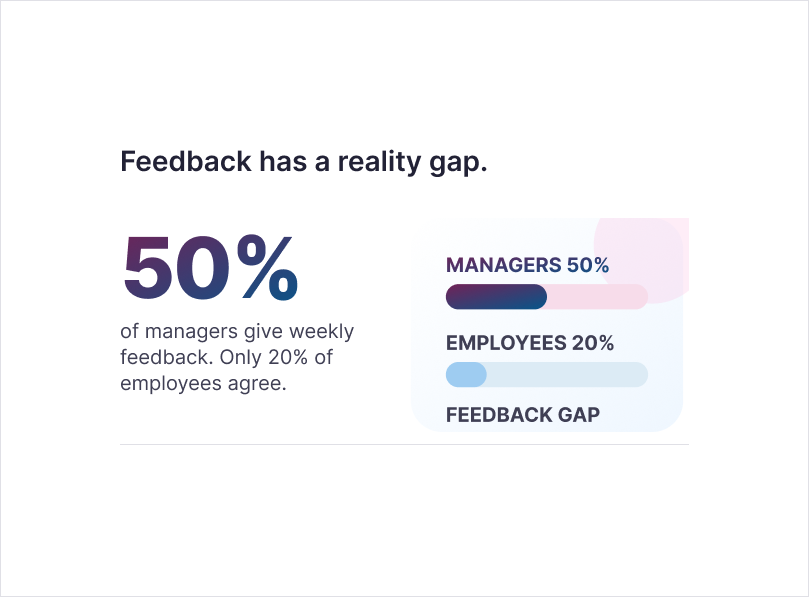
Not to mention, managers and employees don't always see things the same way. In fact, Gallup found that 50% of managers strongly agree they give their employees feedback every week. Yet only 20% of employees strongly agree that their managers do the same.
This gap shows that giving feedback isn't enough. Managers also need to make sure employees understand their own performance.
Performance reviews let managers spot strengths, flag what needs work, and find the people who are ready for more responsibility. When managers conduct performance reviews, they also:
Reviews are a chance to listen, too. When managers ask their direct reports about challenges and what support they need, they can fix problems that affect the whole team.
When every manager follows the same performance review process, leaders get a reliable view of talent across the company. That helps the business in a few ways:
Retention matters most here. People often leave because they feel stuck or ignored.
A formal evaluation process shows them the company is paying attention. That also supports employee engagement and job satisfaction.
For many employees, the review is where pay and promotions start to feel real. That makes fairness a big deal. When performance ratings are vague or uneven, trust drops fast.
Fairness is hard to deliver, though. SHRM found that 41% of talent management executives said getting managers to give objective, constructive feedback was a challenge in 2025.
A clear and effective performance review process helps because it gives managers evidence to back up their decisions. Strong results can lead to raises, bonuses, or new roles. Performance gaps lead to coaching and support. When workers can see how performance connects to rewards, they understand why decisions are made.
Still, doing all this by hand is slow, and bias can creep in. Writing reviews, summarizing feedback, and pulling data from different tools can eat up hours.
Salary.com's AI Agents can take on much of that work. They gather performance data and surface insights, so managers spend less time on admin and more time talking with their people.
The goal is not to replace human judgment. It is to give managers better information and more time to use it well.
Even with good intentions, performance assessments can miss the mark. Watch for these five mistakes:
Most of these mistakes share one cause. The review is treated as a yearly task instead of part of an ongoing conversation.
Small changes make a big difference. Try these six best practices when conducting performance reviews:
The purpose of a performance review is to help workers and organizations do better work. Employees get clarity and recognition. Managers get a clearer view of their teams. The business gets the insight it needs to plan, grow, and keep its best people.
When reviews are honest, specific, and ongoing, they stop feeling like a chore. They become one of the most useful tools a company has.
Ready to make reviews simpler and fairer? See how SalaryTalent™ Performance helps you track goals, collect feedback, and run reviews in one place, so every review leads to smarter next steps.

The latest research, expert advice, and compensation best practices all in one place.
Blog
Bringing trusted compensation intelligence and seamless planning to even more ADP users.

Blog
Learn how to train managers for effective pay conversations and build trust.

Blog
Total rewards package flexibility lets employees choose what matters - pay, perks, and benefits tailored to their needs.
