Blog
Get Pay Right on ADP Workforce Now® Next Gen™
Bringing trusted compensation intelligence and seamless planning to even more ADP users.
Written by Salary.com Staff
September 04, 2026

Human resources and compensation department professionals know that job descriptions and contracts govern only part of the employee's expectations. The psychological contract governs the employee's engagement, satisfaction, and morale in the workplace. Understanding these contracts allows the parties involved in the employee relationship to build a stronger relationship in the workplace.
This guide will help HR professionals understand the psychological contract in the employment relationship. Specifically, it will provide steps that HR departments can use to build and protect the positive contract between the employer and employee in the workplace.
A psychological contract is the unwritten agreement between an employer and an employee. It consists of the beliefs that each party will receive from and provide to the other. These beliefs are formed through the interaction between the two parties and based on job and company responsibilities and cultures. Unlike a written contract, there is no formal agreement between the two parties involved in the employment relationship.
Both the employee and the employer hold beliefs regarding the terms of the contract. These beliefs are formed through the perception of how the employee is treated by the company and how the company responds to the concerns of its employees.
Both parties have clear expectations in the employment relationship. Employees expect fair pay for their hard work and loyalty, while employers expect commitment and good performance. CompAnalyst® helps employers meet these expectations by offering market data and tools to set fair and competitive pay.
The psychological agreement matters because it directly shapes employee engagement, job satisfaction, and the quality of the employment relationship.
When the contract is fulfilled, employees exhibit higher levels of commitment and bring new ideas to the workplace.
A positive psychological contract will allow employees and employers to build a relationship based on mutual respect that lasts for the employees' careers, improving team dynamics at the workplace.
A breach of the contract or a broken psychological contract has the power to create negative workplace morale and performance metrics. Performance metrics can be used to assess the health of the psychological agreement.
HR professionals have the power to assist in creating a healthy psychological agreement for employees by creating a supportive workplace that encourages a work-life balance and provides employees with fair pay.
When employees feel that they are not paid fairly, it may weaken the psychological contract. A competitive compensation strategy may help organizations set fair pay and meet employee expectations. CompAnalyst® helps organizations build competitive compensation plans and make better pay decisions.
Psychological agreement falls into two main types that describe different forms of employer employee relationships.
Transactional contracts focus on the short term and specific elements of the contribution of employees to the company and the metrics of their performance.
Relational contracts and the relational psychological contract focus on the long term, loyalty, the development of skills in the employees, job security, skill development, and the psychological environment in the workplace.
Balanced or hybrid contracts/psychological agreement allow the companies to adjust to changes in the organization while maintaining the elements that create a strong psychological agreement and performance metric for the employees.
Psychological contract examples appear in everyday workplace dynamics and show how employees expect certain support in return for their efforts.
A prospective employee may expect career growth after hearing about advancement during interviews.
Employees agree to perform at a high level for the job security and pay offered by the company.
Offering flexible hours for employees who produce strong results agrees to a work-life balance that reinforces the contract between the two parties.
Organizations that promise recognition for extra effort will receive more contributions from employees while building a positive relationship and contributing to better performance metrics.
Building strong psychological agreement requires a proactive approach that aligns employee expectations with organizational realities through open communication and mutual respect. There is no single devised plan that works for every company, but these steps provide a clear path.
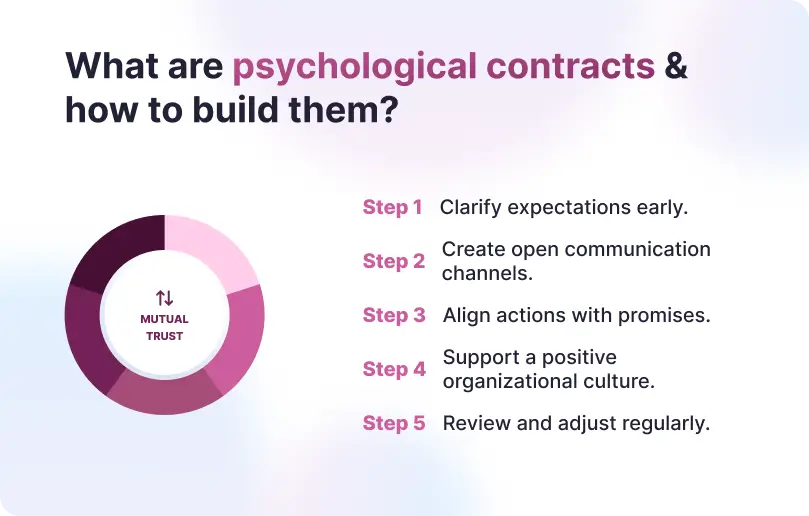
Share the job descriptions and talk openly about what the company is offering employees in terms of compensation, development, and support. Listening to what employees need, both parties can start with an understanding of what the other requires. This will eliminate any concerns from the employee and provide better performance metrics for the company.
Encourage feedback from employees to ensure that they feel heard and that the company takes necessary steps to address their concerns. Effective communication between employees and the company will foster mutual beliefs and prevent any misconceptions regarding informal duties. HR leaders can facilitate this communication and use performance metrics to assess the success of such efforts.
Commitments regarding training, pay, and work-life balance must be delivered. Such actions demonstrate that employees are treated fairly and improve the employment relationship and metrics overall.
When pay is part of those commitments, CompAnalyst® offers merit modeling, salary structure design, and analytics to help organizations create a consistent approach to employee pay.
Promote a culture of respect and support amongst team members. Avoid management styles that are potentially damaging to the relationship between managers and team members. A good company culture can improve the company's performance metrics.
Review the performance metrics and employee feedback to assess the level of alignment. Adapt the psychological agreement during changes within the organization. Regularly reviewing the performance metrics will ensure that the contract remains strong for the organization and its employees.
HR professionals monitor and strengthen psychological agreement by watching employee perceptions and taking early action to keep the employer employee relationship healthy.
Track employee engagement surveys and listen for employee concerns about job security or fair compensation to spot early signs of strain.
Provide regular feedback and open communication so employees feel valued and mutual obligations stay clear.
Train managers to avoid emotional contagion from negative behaviors and to support positive team dynamics.
Address organizational changes with transparent updates so employees perceive fairness and maintain overall workplace morale.
Apply critical evaluation after events like the global pandemic to rebuild trust and reduce strong resistance while monitoring performance metrics.
HR leaders review performance metrics often to protect the psychological agreement.
Here are some FAQs for better understanding.
How do you terminate a contract?
Ending a formal legal contract follows legal notice rules and company policy. For the psychological contract, open and respectful communication helps reduce emotional reactions and protect remaining workplace relationships. Clear process and support during exit maintain mutual respect and protect overall performance metrics.
What's the difference between a contract and an agreement?
| Aspect | Legal contract | Psychological Agreement |
|---|---|---|
| Form | Written and legally binding | Unwritten, based on mutual beliefs and perceptions |
| Content | Formal duties, pay, and job descriptions | Informal obligations, employee expectations, and workplace relationship |
| Enforcement | Courts and law | Trust, social exchange, and employee behavior |
| Focus | Specific terms both parties sign | How employees perceive fairness and support |
A psychological agreement breach occurs when one of the parties to the contract, usually the employee, feels that the other party has failed to meet their obligations to the employee or vice versa. The breach of this can lead to a lower level of job satisfaction, engagement, and morale within the workplace.
Recent studies and articles in European journal publications confirm the link between the psychological agreement of breach and employee engagement, requesting further details on how companies can recover from such a breach. Also, the impact of a breached psychological agreement on the company's performance metrics is another area of growing concern.

The latest research, expert advice, and compensation best practices all in one place.
Blog
Bringing trusted compensation intelligence and seamless planning to even more ADP users.

Blog
Learn how to train managers for effective pay conversations and build trust.

Blog
Total rewards package flexibility lets employees choose what matters - pay, perks, and benefits tailored to their needs.