Blog
Get Pay Right on ADP Workforce Now® Next Gen™
Bringing trusted compensation intelligence and seamless planning to even more ADP users.
Written by Salary.com Staff
April 30, 2025

Identifying potential candidates and acquiring them successfully are the key duties of a hiring team. To do that, a structure must be in place to ensure that the business needs and talent management are effectively met.
Recruitment team configuration is a framework where a specific team is responsible for the entire recruitment process. It can either be through a recruitment process outsourcing, where third-party specialists are involved, or through an in-house recruitment team.
With this, a good hiring strategy involves building a strong recruitment team structure to find the most suitable candidates for important job roles in the company. Learn more about how to establish an efficient hiring team in this article.
A recruitment team is a group of people responsible for managing the entire hiring process for open positions in a company. Here are the key responsibilities of a recruitment team structure:
Sourcing: They attract potential candidates through job boards, social networking sites, or recruitment events.
Communicating: They build relationships with potential candidates to keep them engaged and connected.
Evaluating: They conduct screenings, interviews, and assessments to identify qualified candidates and offer jobs.
Hiring: They present job offers and collaborate on pre-boarding activities for a smooth transition towards HR processes.
Recruitment teams have evolving hiring responsibilities as the job market continues to grow. Having tools like Real-Time Job Posting Salary Data is useful in giving insights on market shifts, job postings, and competitive offers to help recruiting teams attract high quality candidates for hiring success.
The size of a recruitment team depends on the company. Small businesses usually only have their founders and CEO actively involved in the hiring. However, larger organizations will need a team to optimize their entire process.
Here are appropriate team sizes depending on how massive your organization is:
| Company Size | Recruitment Team Size | Recruitment Team Members |
| Small businesses and startup companies | 1 | Founder or CEO |
| Medium-sized companies | 3 to 4 | Recruiter, HR generalist, Recruitment Manager |
| Fast-growing companies | 4 to 5 | Dedicated specialists for every function; Recruitment Head, Specialized Recruiter, Sourcer, Recruiting Manager |
| Large companies | 7 or more | Fully fledged recruiting team for all key roles, Several recruiters and sourcers, Recruitment Head, Recruitment Manager, Recruitment Marketing Manager |
To quantify your recruitment efforts, assess efficiency, identify areas of improvement, and create informed decisions in your recruitment team structure, here are key performance indicators (KPIs) you can use:
This measures the duration between a job application to a job offer acceptance.
This measures the overall financial cost of hiring a new employee.
This measures the performance and value of a new hire.
This identifies the best-performing channels for top talent.
This measures an applicant's experience of the hiring process.
A recruiting team structure must have defined roles and responsibilities for it to effectively function. Here are the key roles and their responsibilities that must be present in your hiring team:
Proactively search for and attract potential candidates
Screen applications, assess qualifications, and conduct interviews
Serve as the main contact of candidates
Coordinate and arrange the hiring process
Engage with passive candidates
Organizes updated documents and forms for candidates and employees
Crafts job descriptions and ensures their accuracy and compliance
Arranges compensation and benefits for new employees
Gives job offers to the accepted candidates
Leads and oversees the talent acquisition team
Regulates talent acquisition strategies and manages resources
Coordinates with departments for talent needs
Makes the final hiring decisions
Gives team support with administrative tasks
Sets interview schedules
Coordinates communication with candidates
Inform the hiring team of vacancies that need to be filled
Define job qualifications and conduct candidate interview process
Provide feedback to the talent acquisition team about new hire performance
Conduct onboarding for new hires
Collect and analyze hiring data for trend assessment
Quantify the efficiency of the recruitment team structure
Impart insights on areas of improvement
Optimizes the organization’s career page for strong employer branding
Draft brand materials
Manages social media platforms
Organizes job opening events to attract potential candidates
Ensures positive candidate experience
Giving AI-powered tools, like Real-Time Job Posting Salary Data, a role in your recruitment team structure is a win. Have a view on competitive compensation trends, advance job matching, access key job metrics, and see what the market is currently hiring to benchmark your entire recruitment process.
Here are the benefits of having a recruitment team structure:
More efficient hiring: A designated team and members with specific roles and responsibilities will lead to a faster hiring process.
More collaboration: The team members have different backgrounds and perspectives, giving way to well-rounded discussions and decisions.
Better candidate experience: An organized hiring team and streamlined process give convenience for potential candidates, attracting them more to fill the position.
Improved quality hires: With a collaborative team, the most vital skill sets are identified, and the hiring is more focused on the best-suited talents for the role.
Here are the challenges of having a recruitment team structure:
Conflict in schedules: Having team members from different departments with various schedules can be a hurdle in conducting regular team meetings and decisions, leading to a potential delay in the recruitment process.
Differences in opinions: Diverse team members have diverse perspectives that can lead to indecision and impasses.
Communication errors: Miscommunication is inevitable when there are no clear channels for updates and documents, which results in delays and conflicting candidate evaluations.
Unclear roles: If there is no proper outline of responsibilities, the entire hiring process can be confusing for candidates, and crucial recruiting steps can be overlooked.
Although a talent acquisition team has multiple individuals making it work, it is still better to have a robust structure so that the recruitment runs according to strategies and objectives.
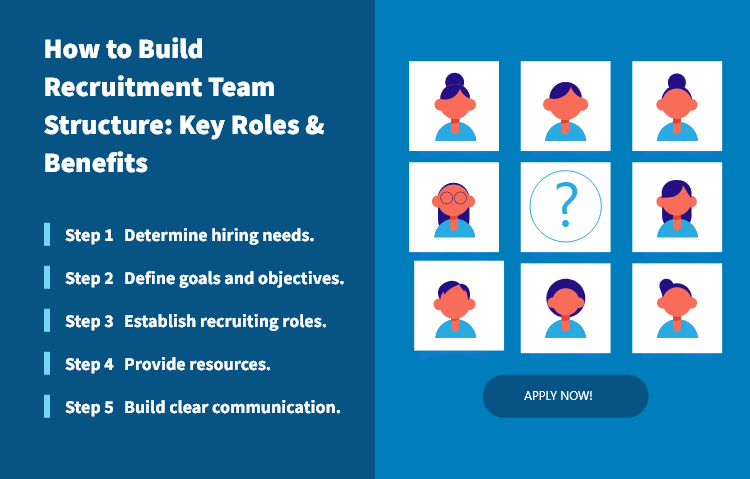
Here is how you can build a talent acquisition team structure:
Determine your company's size and the hiring volume needed. Align these with the individuals you are building in the team, including skills and experience. Consider the areas of improvement when it comes to talent and recruitment.
Outline what milestones and improvements you want to see in your talents and acquisition. Align these with the recruitment strategy and key metrics, such as quality of hire and candidate experience.
Identifying hiring roles leads to a smoother and more accountable recruiting process. Make sure that the team members’ responsibilities are clearly outlined to avoid missteps and inconsistency.
Leveraging technology in your recruitment team makes the process more efficient. Applicant tracking systems, recruitment software, and data and analytics are some of the resources you can implement. These tools help in gaining insights into the latest talent trends and promote objective recruitment.
Also, continuous training and development for hiring team members can improve their expertise in talent acquisition, such as interview skills, DEI management, and communication techniques.
The hiring team must have an uncomplicated stream of communication. It is direct and effective to avoid delays in recruitment, regularly done to remain updated in the hiring development, and candidate-friendly to attract and successfully hire talents.
Building a recruitment team structure that aligns with company objectives gets easier if you have competitive intelligence that understands the latest market and talent demands. With Real-Time Job Posting Salary Data, it’s never been easier to make data-driven hiring decisions, plan an agile recruiting team, and streamline your talent acquisition.

The latest research, expert advice, and compensation best practices all in one place.
Blog
Bringing trusted compensation intelligence and seamless planning to even more ADP users.

Blog
Learn how to train managers for effective pay conversations and build trust.

Blog
Total rewards package flexibility lets employees choose what matters - pay, perks, and benefits tailored to their needs.