Blog
Get Pay Right on ADP Workforce Now® Next Gen™
Bringing trusted compensation intelligence and seamless planning to even more ADP users.
Written by Salary.com Staff
June 06, 2025

New hire turnover is a growing issue in many industries. With up to 20% of employees leaving within the first 45 days and more than one-third quitting within their first year, it's critical for organizations or hiring managers to monitor this trend.
Calculating the new hire turnover rate can uncover patterns, identify areas for improvement, and guide retention strategies. But how do you calculate it?
This guide explains how to calculate the new hire turnover rate in simple steps, explores common reasons for early departures, and provides calculation examples to help you understand the process.
A new hire turnover rate refers to the metric that shows the percentage of new employees who leave a company within a given period, usually within their first year or less than a year. This metric also indicates how effective the company’s onboarding and hiring processes are.
Key insights to consider:
A high turnover rate among new hires suggests problems with recruitment, onboarding, or employee engagement.
A low rate means the company's hiring and effective onboarding processes are working well, resulting in better retention.
Organizations calculate and analyze this metric to pinpoint areas for improvement in their talent acquisition and early integration processes.
The formula for calculating new hire turnover rate is: (Number of new hires who leave / total number of new hires) x 100. For example, if 3 out of 30 new hires leave within the first year, the first year turnover rate would be 10%.
A lack of career growth is one of the major causes of turnover. Organizations can address this by creating a roadmap for career progression conversations. Salary.com consultants can help achieve this goal and build a framework that supports development and retention.
Experts suggest that a turnover rate of 10 % or less is a good indication of effective employee retention practices and is considered acceptable. However, every company should recognize that turnover is a normal phenomenon that happens in all organizations. It only becomes a concern when there’s a pattern of frequent departures.
Also, the turnover rate among new hires can vary depending on industry, company size, and other factors, which will be discussed in detail in the next section.
As mentioned, there are factors that can cause new employees to leave soon after joining. Here are some common reasons for high turnover among new hires.
Unrealistic job expectations: New hires may leave if the job is not what they were promised. Misleading job descriptions or unclear expectations can cause frustration and early resignation.
Inadequate onboarding and training: Poor onboarding or lack of training can leave new hires feeling unsupported and unprepared. This leads to dissatisfaction and a higher chance of leaving.
Poor company culture fit: New hires who don’t fit with the company culture or struggle to adjust may leave. Differences in values, communication, or teamwork can make them feel disconnected.
Lack of career development opportunities: As mentioned earlier, if new hires don't see chances to grow or advance, they may feel stuck and seek other jobs. Clear career paths and development programs help keep employees.
Inadequate compensation and benefits: When employees feel their pay and benefits, like health insurance, are not competitive or meet their expectations, they may leave for better pay growth opportunities. Fair pay, bonuses, and benefits are key to keeping them long-term.
For guidance on competitive salary for new hires, Salary.com experts will show you how to market-price jobs and create a process for confident pay decisions, boosting retention and improving hiring.
Tracking new hire turnover helps organizations see what’s working and what’s not in their hiring and onboarding process. With proper tracking, they can:
Avoid expensive recruitment costs
Hiring a new employee comes with costs like job ads, recruiter fees, background checks, interviews, onboarding, and training. If new hires leave quickly, the company must redo the process, increasing expenses.
Research shows replacing an employee can cost 50% to 200% of their salary. Tracking these turnovers helps cut these costs by spotting patterns and fixing issues early.
Identify issues in hiring and onboarding
A high turnover rate among new hires may point to issues in recruitment, job fit, or onboarding. It may mean candidates were misled about the role or not properly integrated.
Tracking this valuable information helps HR identify trends, like early departures, and find the cause, such as poor hiring, training, or unclear expectations. Monitoring the hire retention rate can offer useful insights.
Improve employee retention
Tracking new hire turnover also helps spot retention issues early. If employees leave too soon, keeping employees engaged and building long-term commitment becomes harder. Turnover data can improve onboarding, manager training, and culture, helping new hires stay and succeed.
Protect employer brand
High turnover can hurt an organization's reputation. Employees leaving may post negative reviews, discouraging top candidates. It also shows a lack of stability or professionalism and may signal low job satisfaction.
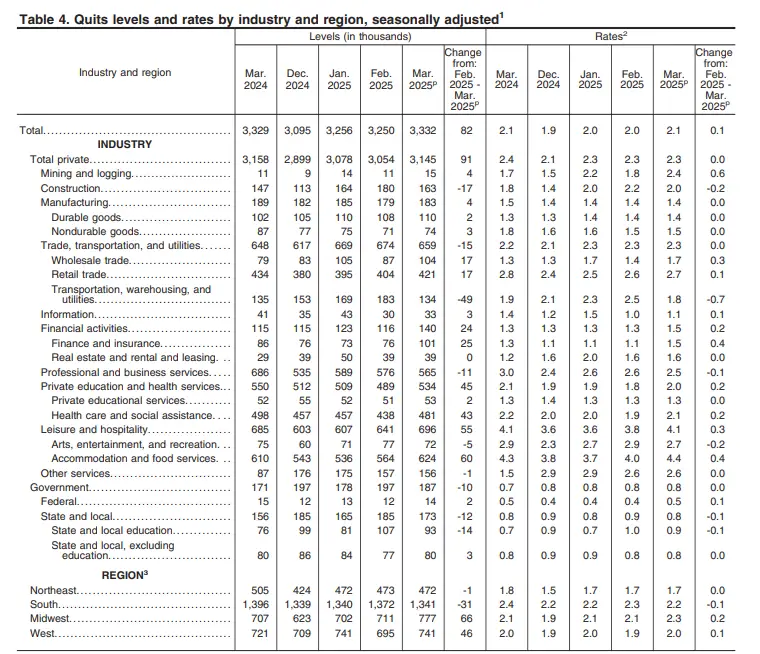
While the BLS doesn’t track new hire turnover rates by industry, it provides data on quits or separations, which are critical for understanding overall turnover trends.
As of March 2025 , there were 3.3 million quits, or a 2.1% rate, with the leisure and hospitality industry having the highest quits rate at 3.6%, which is 0.6% higher than the 3.0% rate in February 2025.
Below are the turnover rates by industry as of March 2025, based on labor statistics:
Some organizations use a new hire turnover rate calculator to make things easier. For those who do not have one, it is still simple if you know the formula. Here’s how to calculate it using the formula shared earlier:
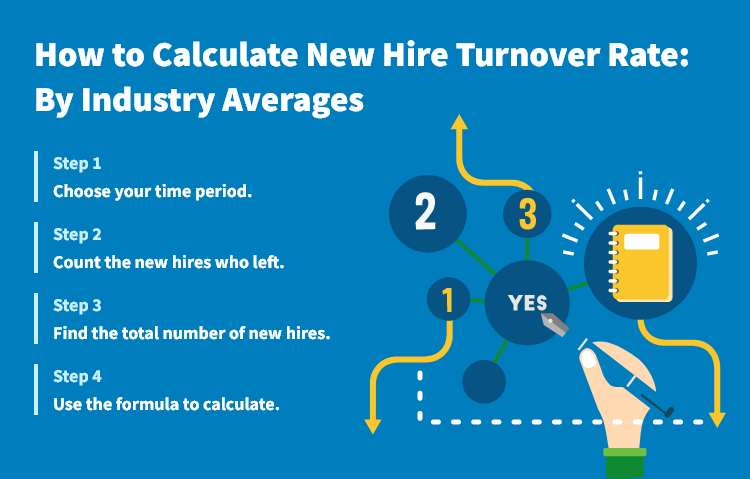
Choose the time period you want to measure, such as 30, 60, or 90 days, or even the first year. For this example, let's use 30 days.
Count the number of new hires who left the company during the same time period, including those who resigned or were terminated. For example, let's assume 4 new hires left in 30 days.
Count the total number of new hires during the same time. This is how many people were hired during the period you're measuring. For example, let’s say 20 new hires were made in 30 days.
As mentioned earlier, the rate is calculated using this formula: (Number of new hires who leave / total number of new hires) x 100. This gives the percentage of new hires who left the company during the chosen time period.
In this example, if 4 new hires left and there were 20 new hires in total: (4/20) x 100. So, the turnover rate would be 20%.
A 20% turnover rate is quite high. If your organization experiences this level of turnover, chances are there are underlying issues with onboarding, job fit, or company culture. Consult with the experts to identify the root causes and improve retention strategies.
To fully understand how to calculate it, here are some example calculations that demonstrate how it works in real situations:
Scenario 1
A growing customer service company hired 30 new call center agents in March to support an increase in client demand following the launch of a new product line. The new hires underwent a two-week training program and were assigned to various shifts. By the end of April, five employees had resigned.
To calculate, divide the number of new hires who left (5) by the total number of new hires (30), then multiply the result by 100. This gives an employee turnover rate of 20%.
Turnover rate = (5/30) × 100 = 0.1666 ~ 16.66%
Scenario 2
A retail company wants to know the turnover rate for its seasonal sales associates hired during the holiday rush. In November, the company brought on 50 new employees to help manage increased customer traffic. By the end of January, 12 of these new hires had left the organization due to poor employee experience and lack of support.
To calculate, the company divides the number of employees who left (12) by the total number of new hires (50) and multiplies the result by 100.
Turnover rate = (12/50) × 100 = 0.24 ~ 24%
With the right retention strategies and HR metrics, organizations can improve how they keep employees and make better decisions. Salary.com experts help review your current metrics, set benchmarks, and offer a model to track progress over time.
No company wants employee turnover, whether it’s new hires or long-term staff. It’s important to spot the signs early, as turnover can lead to higher costs, lower productivity, and challenges in human capital management.
If your organization is facing high turnover, talk to the experts to find out why and what to do next. Salary.com experts can support you in everything from pay transparency to workforce planning.

The latest research, expert advice, and compensation best practices all in one place.
Blog
Bringing trusted compensation intelligence and seamless planning to even more ADP users.

Blog
Learn how to train managers for effective pay conversations and build trust.

Blog
Total rewards package flexibility lets employees choose what matters - pay, perks, and benefits tailored to their needs.