Blog
Get Pay Right on ADP Workforce Now® Next Gen™
Bringing trusted compensation intelligence and seamless planning to even more ADP users.
Written by Salary.com Staff
October 09, 2026

Employers, human resources (HR) leaders, and HR professionals use the promotion rate to understand how well their company promotes employees to higher-level positions within the company.
This metric reflects the percentage of the workforce that advances within a specified timeframe, such as a fiscal year. Companies use this to understand where they need to focus on their efforts by hiring, retaining, and promoting their employees.
Promotion rate is the percentage of employees who move into higher level roles during a given time frame. It counts only those who receive a new title with greater responsibility and often more pay. Leaders use it to see if the company supports career growth from within. This number helps determine if the organization builds talent for future needs.
HR teams calculate it over a financial year or fiscal year to match planning cycles. A good promotion rate supports internal mobility and reduces the need for outside hires. It also signals to the workforce that performance leads to advancement.
CompAnalyst® helps HR teams match organizational jobs with appropriate compensation survey sources. Accurate job matching helps HR distinguish genuine upward movement from lateral job changes when reviewing promotion activity.
A strong promotion rate builds a ready pool of talent for open positions and higher-level roles.
Research shows that tracking the promotion rate helps HR leaders spot gaps in career development and keep top performers from leaving for better opportunities elsewhere.
Based on APQC findings, organizations with steady internal promotion rates see higher employee engagement because people know they can advance without changing companies.
Research from WorldatWork shows that companies expecting to promote about 10 percent of their workforce invest in development and improve overall productivity and retention. Details are at
A low promotion rate can raise job dissatisfaction among high performers and force the company to fill more roles from outside at higher cost.
CompAnalyst® helps companies match price jobs. Market pricing can help HR evaluate whether compensation for newly promoted roles is competitive.
Many factors shape the promotion rate inside an organization, and leaders must watch them to keep numbers healthy.
The company size industry and structure change the average promotion rate, and it can vary by business and by circumstances such as size, industry, growth stage, and structure. Flatter organizational structures usually post lower rates because there are fewer management levels and fewer promotion opportunities.
The number of open positions and the readiness of internal talent directly affect how many people get promoted in a given fiscal year. High turnover can also raise or distort promotion frequency depending on whether roles are backfilled internally.
Employee performance scores career development programs and budget limits for more pay all play roles in promotion decisions.
Location department needs and the total number of high performers ready for advancement also influence whether the rate stays high or drops. In customer service and other frontline-heavy sectors, a high number of moves can put rates around 12 percent, while manufacturing and nonprofit sectors are often near 6 percent; manufacturing tends to run lower because of stable hierarchies and operational processes, and healthcare and education often post moderate to low rates because strict credential requirements limit movement by grade.
CompAnalyst® helps organizations build salary structures, move jobs between ranges, expand contract ranges, and forecast costs associated with compensation changes. Organizational salary structures can influence how many levels employees can move through and how promotions are financially managed.
Based on standard methods outlined in SHRM benchmarking reports, HR leaders follow clear steps to calculate promotion rate, so the number stays accurate and useful for planning.
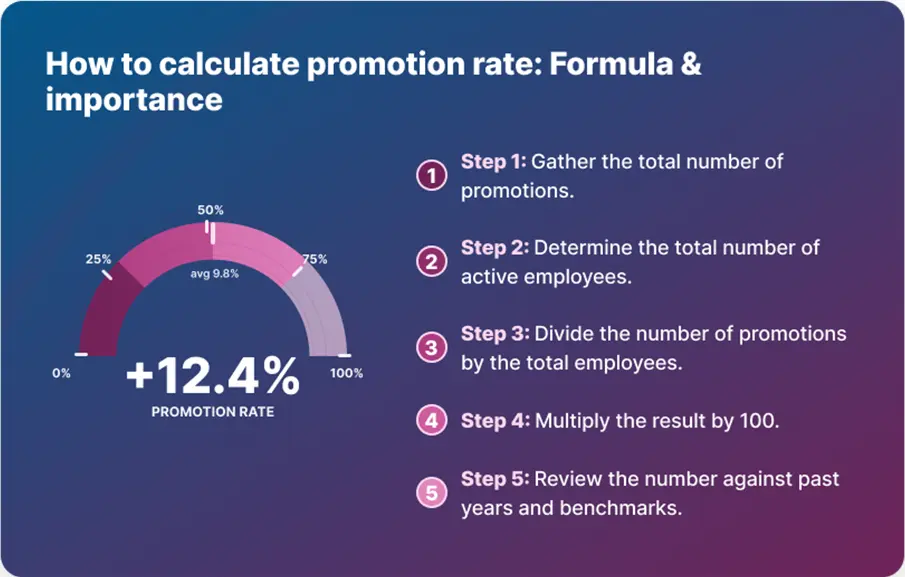
Count every employee who moved to a higher-level role with a new title and greater responsibility during the chosen period, such as the last financial year. Make sure to include only true advancements and not lateral moves.
Use the headcount at the start of the period or the average for the year. This base figure lets you compare promotions against the full workforce size.
Take the promotion count and divide it by the employee total. This gives the basic ratio that shows how often advancement happens.
Convert the ratio into a percentage so leaders can read it easily as the promotion rate. For example, if 50 people advanced in a group of 1000 the rate equals 5 percent.
Compare the current rate to last year and industry averages. This step helps HR leaders see if the rate is good or need to focus on better internal mobility. Formula guidance aligns with the SHRM Talent Management.
According to APQC guidance, HR leaders need a set of related numbers to understand the full picture of promotion activity and workforce health.
The average rate of advancement must sit next to the selection rate and the share of high performers who advance so leaders can judge fairness and may need to break the data down by department or job line. A high promotion rate can reflect strong talent development but may also point to rapid restructuring.
Tracking internal promotion rate and the percentage of open positions filled by people promoted internally to measure true internal mobility.
Promotion metrics should be reviewed alongside performance metrics, employee performance scores, and career development participation to help predict future success and retention.
Watch the rate for underrepresented groups from time to promotion and the pay change that comes with a new title, so the process stays fair across the organization.
Based on SHRM findings, companies can raise their rate of advancement by building clear paths and supporting people who are ready to advance.
Leaders who invest in skills training and regular performance reviews create more candidates ready for higher level roles and lift the overall rate.
Posting open positions first to internal talent and giving high performers stretch assignments increases the number of people promoted from within.
Setting target rate of advancement for each department and reviewing them each fiscal year keeps the process focused and improves employee engagement.
Offer more recognition for strong results and link advancement to clear career growth plans, so top performers stay, and the company fills more roles internally.
Here are some FAQs for better understanding.
Employers often expect some discussion around pay when they promote someone. The new role usually brings greater responsibility, so the package should match market rates for that level.
HR leaders prepare a fair range based on internal data and external benchmarks before the talk begins. Clear talks help keep high performers happy and reduce the chance they look elsewhere after the move.
A dry promotion gives an employee a new title and more responsibility without extra pay. Companies sometimes use it when budgets are tight, yet they still need to recognize strong work.
From the employer's view, it can keep talent in place for a short time, but it often leads to lower engagement if the lack of more pay continues. Leaders should plan to adjust pay as soon as the financial year allows.
Some employees leave after a promotion because the new role brings unexpected stress, or the support falls short. Others find the pay increase does not match the added work and feel job dissatisfaction.
Employers who track promotion outcomes and offer coaching after the effective date can lower this risk. Strong onboarding into a higher role helps people succeed and stay with the organization longer.

The latest research, expert advice, and compensation best practices all in one place.
Blog
Bringing trusted compensation intelligence and seamless planning to even more ADP users.

Blog
Learn how to train managers for effective pay conversations and build trust.

Blog
Total rewards package flexibility lets employees choose what matters - pay, perks, and benefits tailored to their needs.