Blog
Get Pay Right on ADP Workforce Now® Next Gen™
Bringing trusted compensation intelligence and seamless planning to even more ADP users.
Written by Salary.com Staff
September 24, 2026

HR professionals do more than manage people and workplace policies. They help employees succeed, solve workplace problems, and support business goals. To do this well, they need strong HR skills and competencies.
Our Skills Library helps with skills-based pay by quickly grouping similar jobs with the same skills.
Building these helps HR teams make better decisions, improve the employee experience, and support the success of the organization. Below are the core HR skills and competencies, along with practical steps to develop them in the workplace.
HR skills and competencies are the knowledge, abilities, and behaviors that help HR professionals support employees and achieve business goals. They are used across many HR functions, including recruitment, onboarding, employee development, performance management, and workforce planning.
For example, communication, active listening, and onboarding help HR professionals build strong relationships with employees, support new hires, and create a positive workplace.
At their core, HR competencies fall into three major categories:
Technical skills: Technical knowledge allows HR practitioners to manage systems and tools efficiently. This includes working with HR technology, handling data analytics, and staying informed about labor laws to ensure compliance.
Soft skills: Essential interpersonal qualities like communication skills, active listening, empathy, and conflict resolution help HR professionals resolve employee concerns and promote strong employee relations. These abilities contribute to a positive work environment and a healthy organizational culture, forming a critical part of every HR expert's toolkit.
Strategic acumen: HR professionals also develop the capacity for long-term planning. HR business partners use strategic thinking to address workforce challenges, support organizational change, and plan for future talent needs. This means being able to align HR strategies with larger organizational goals, support workforce planning, and create systems that enable continuous improvement and organizational growth.
Together, these competencies allow HR professionals to recruit talent, improve employee performance, strengthen workplace culture, support compliance, and align people strategies with business goals.
Automation can simplify routine work, but HR professionals still need strong judgment and decision-making skills. Creating a strong HR skills structure starts with defining key roles and required competencies. Salary.com's Skills & Competency Model provides the blueprint to develop those foundational abilities across HR functions.
HR professionals use a wide range of skills to support employees and help organizations achieve their goals. Below are examples of the most important HR skills used in the workplace.
Data analytics: Data analytics allows HR teams to identify patterns and create strategies for improvement. Metrics on turnover, satisfaction, and diversity inform better hiring and retention decisions. It also fuels evidence-based HR strategies that impact the bottom line.
HR technology: Smarter systems like self-service portals, LMS platforms, and HRIS make work more efficient. With streamlined HR processes, HR teams can focus on strategy rather than repetitive tasks. Mastering HR technology ensures smoother workflows and better reporting.
Performance coaching: Performance coaching helps employees improve their skills, meet goals, and grow in their roles. HR professionals use feedback, goal setting, and regular check-ins to support employee development and improve performance.
Workforce planning: Workforce planning helps HR prepare for future hiring and skill needs. By identifying talent gaps and forecasting workforce demands, HR can build teams that support changing business goals.
Business acumen and strategy: Strong business acumen allows HR to think beyond compliance. Understanding budgets, long-term growth plans, and workforce needs enables HR to address organizational challenges and contribute meaningfully to business success.
Embedding organizational values in HR strategies, such as compensation and benefits, employee engagement, and promoting inclusive cultures, ensures alignment with broader company objectives. Salary.com's Skills Taxonomy maps skills for each position, enabling focused upskilling and better job alignment.
Below are examples of core HR competencies used in the workplace.
Strategic thinking: Looking beyond daily tasks to support long-term business goals and workforce planning.
Relationship management: Building positive relationships with employees, managers, and business leaders through trust, collaboration, and effective communication.
Ethical practice: Following labor laws, protecting employee information, and making fair, responsible decisions.
Leadership: Guiding teams, supporting organizational change, and helping employees achieve shared goals.
Consultation: Working with managers and business leaders to solve workforce challenges and improve organizational performance.
Change management: Helping employees and leaders adapt to new processes, technologies, and organizational changes.
Communication: Sharing information clearly, listening actively, and promoting open communication across the organization.
Critical thinking: Evaluating employee concerns and workplace data to choose the best solution for the organization.
Building strong HR skills and competencies helps HR teams support employees, improve HR processes, and achieve business goals. Here's how:
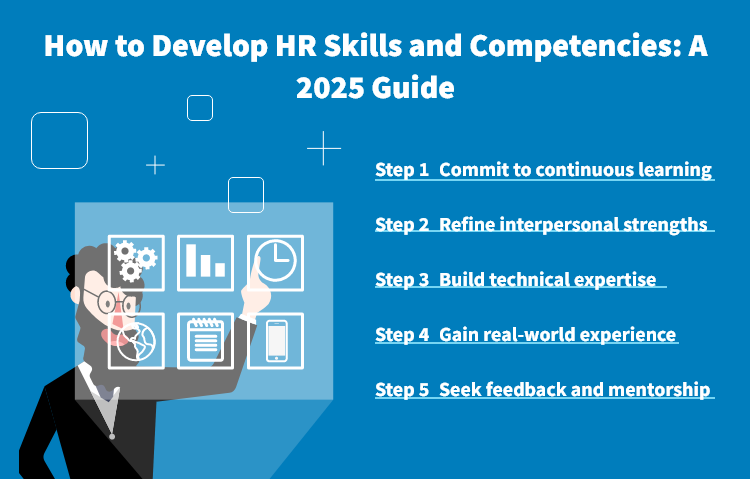
Encourage HR professionals to stay informed on evolving practices in human resource management. Provide access to training programs, webinars, HR certifications, and industry research. Skills like project management, digital onboarding, HR analytics, and diversity training are increasingly important as workplaces evolve.
Develop communication, active listening, empathy, and conflict resolution skills across the HR team. These interpersonal strengths help HR professionals build trust, resolve workplace issues, and maintain positive employee relations.
Equip HR teams with the knowledge to use HR information systems (HRIS), applicant tracking systems (ATS), learning management systems (LMS), and other HR technologies. Strong technical skills improve efficiency, support compliance, and enable better data-driven decision-making.
Give HR professionals opportunities to participate in recruitment, onboarding, performance management, policy development, compensation projects, and employee engagement initiatives. Practical experience strengthens problem-solving, decision-making, and leadership skills.
Add skills and competency data from our Skills Library to attract the right candidates.
Create opportunities for HR professionals to receive regular feedback and learn from experienced mentors. Mentorship and constructive feedback help strengthen core competencies, identify development opportunities, and prepare future HR leaders.
Supporting these development efforts starts with defining the right skills for every role. Salary.com's Skills Library + JobArchitect® helps organizations build competency frameworks, create consistent job descriptions, and support hiring and employee development with a standardized skills taxonomy.
Organizations that invest in HR skills and competencies build stronger teams, improve employee experiences, and adapt more easily to changing business needs. By developing technical, interpersonal, and strategic capabilities, HR professionals can create lasting value for both employees and the organization.

The latest research, expert advice, and compensation best practices all in one place.
Blog
Bringing trusted compensation intelligence and seamless planning to even more ADP users.

Blog
Learn how to train managers for effective pay conversations and build trust.

Blog
Total rewards package flexibility lets employees choose what matters - pay, perks, and benefits tailored to their needs.