Blog
Get Pay Right on ADP Workforce Now® Next Gen™
Bringing trusted compensation intelligence and seamless planning to even more ADP users.
Written by Salary.com Staff
May 15, 2026

Incentive plan design is about finding the best way for HR to provide rewards to employees based on the results they achieve for the company. Incentive plans can be very effective at creating a sense of motivation within employees.
To help create such a plan, follow the steps discussed in this article.
An incentive plan is a system that allows a company to reward employees by providing them with extra money when they achieve certain targets. Companies use incentive plans to increase the productivity of their employees and to improve the quality of their employer branding.
These incentive plans are so important because they allow a company to achieve excellent results. One recent study found that organizations that had built their incentive programs specifically to support their employees saw significant improvements in the accomplishment of their goals.
There are two main types of incentive plans: short-term and long-term.
The following table provides a quick comparison of these two types.
| Type | Focus Area | Typical Duration | Common Examples |
|---|---|---|---|
| Short Term Incentives | Immediate results | One year or less | Annual bonuses, spot awards |
| Long Term Incentives | Sustained growth | Three years plus | Stock options, performance shares |
Short term incentives are used to reward employees for the results they achieve quickly. Many companies use this incentive plan, and in 2025, 99 percent of surveyed public companies offered them.
Long term incentives are offered to reward employees for the achievements they accomplish over a more extended period. Public companies reported that 93 percent of them used these incentive plans and offered a three-year vesting period.
To better manage bonus incentives and ensure accurate payouts, organizations often explore solutions like Bonus Planning, which helps structure and administer incentive rewards.
The metrics that you use in determining the success of your incentive plans are essential. If you use the wrong metrics, you will get the wrong behavior from your employees. The metrics should be objective and something that the employee can control.
For example, providing monetary incentives to a factory worker based on the value of the company’s global stock is not going to be very effective; the worker has little control over that outcome.
HR departments should use a variety of different performance metrics. Some of the most common include:
Revenues and sales
Profitability measures
Customer satisfaction
Individual and team goals
Operational metrics
Focus on no more than two or three metrics. One recent survey found that profitability was the leading performance metric.
The best way to ensure that incentive plans are aligned with the objectives of the organization as a whole is to ensure that every performance metric is linked to those organizational objectives.
This involvement from leadership is also beneficial when reviewing these metrics at the beginning of each new plan cycle.
The design of the payout that is offered to employees when they achieve the targets will be discussed in this section. This includes determining how much money each employee can win. This also determines the budget for the incentive plan.
When designing incentive payout strategies, HR teams often need to test multiple scenarios to understand financial impact. Solutions such as Merit Modeling allow organizations to simulate different reward outcomes before implementing their plans.
The target opportunities for incentive awards are usually set as a percentage of an individual’s base salary. For example, executives might be targeted at 60 to 100 percent, while managers might be targeted at 20 to 30 percent.
Payout curves are graphical representations of what percentage of target awards the employees will earn. In most cases, the top limit on a payout curve is 150 or 200 percent of the target award.
In most companies, incentive plans use threshold, target, and maximum structures. The threshold is the minimum performance that employees must achieve to receive any awards. Companies typically set the threshold at 75 percent of the goal.
The target award is the percentage of the target award that employees will win at 100 percent of the goal. The maximum is the total percentage of the target award that the best performing employees will win, typically 200 percent.
The following table shows an example of TTM structures in action.
| Performance Level | Payout Percentage of Target | Typical Goal Achievement |
|---|---|---|
| Threshold | 50 percent | 75 percent of goal |
| Target | 100 percent | 100 percent of goal |
| Maximum | 200 percent | 150 percent of goal |
Creating an effective incentive plan design requires collaboration from HR, Finance, and the business leadership team. A well-defined structure of the incentive plan ensures that the employees feel it is fair and beneficial to the company.
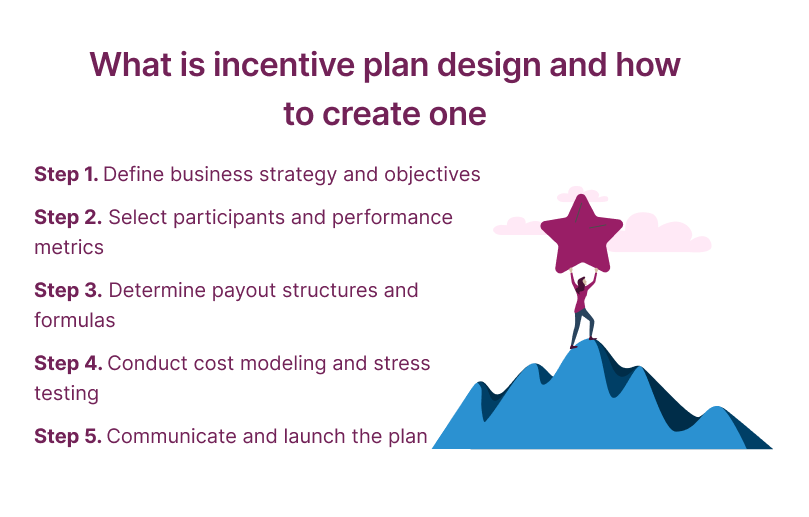
The first step is to determine what the company and its employees need to achieve. If the company is focused on rapid growth, for example, the objectives for employees will be different from those focused on improving operational efficiency.
To build competitive and data-driven incentive plans, many HR teams use tools like Compensation Software to benchmark rewards against the market and design effective compensation strategies.
This involves determining the performance metrics for the different roles within the company. For example, members of the warehouse might focus on operational metrics, whereas the executives will focus on achieving higher stock values and higher profits.
Determining how much each role can win and what the thresholds are for awards. For example, if a company determines that individual tasks will be rewarded, it can create a more detailed payout structure.
This step involves determining the financial health of the plan by comparing it to past financial data. Using both "best case" and "worst case" scenarios, the financial and operational health and capacity of a company can be established.
The most vital step in launching an incentive plan is effective communication with all staff members. If employees do not understand what they are supposed to do to earn incentives, they will not feel motivated to do it.
To properly design your incentive plan, you must understand the cost of the plan and how it compares with market values. Understanding the market and the cost of the incentive plan will ensure that your "Target" is competitive and attractive enough to discourage employees from leaving the company.
To benchmark effective incentive plans, use the following approach:
Gather data from industry surveys of other companies in a similar business environment.
Compare performance metrics between your company and the surveyed organizations.
Identify areas where you can improve your current incentive plans.
Adjust the targets for incentive plans to ensure that you are competitive in terms of employee compensation.
Public data shows that the median budget for short term incentives in public companies is around six percent of operating income.
Creating a simple spreadsheet that calculates the estimated costs of the incentive plan is the first step in cost modeling. Using the best case, target, and worst case scenarios will allow you to accurately forecast the cost of the plan to the organization. From the data collected, most organizations will spend between 5 and 6 percent of their operating income on STI and LTI.
Here are some common questions about the incentive plan design:
Include roles that directly influence key results, such as executives, managers, and sales staff first. Broaden to salaried professionals when budget allows. Data shows 97 percent of public companies cover executives and managers while 49 percent reach hourly workers.
Avoid unclear goals, mid year changes, or targets outside employee control. Do not skip employee input or fail to communicate details. These issues reduce motivation and can lead to unfair outcomes.
Review annually at minimum and adjust after major business shifts. Many companies tweak measures or targets each cycle to stay aligned with current conditions.
Yes, when plans include human capital metrics like engagement and retention scores. A 2026 global study found these people focused measures in 71 percent of North American executive plans, helping boards address talent risks directly.
Mix 60 to 70 percent short term focus with 30 to 40 percent long term to reward both quick wins and sustained growth. Use cash for STI and equity for LTI where possible. This combination supports immediate motivation while building ownership over time.

The latest research, expert advice, and compensation best practices all in one place.
Blog
Bringing trusted compensation intelligence and seamless planning to even more ADP users.

Blog
Learn how to train managers for effective pay conversations and build trust.

Blog
Total rewards package flexibility lets employees choose what matters - pay, perks, and benefits tailored to their needs.