Blog
Get Pay Right on ADP Workforce Now® Next Gen™
Bringing trusted compensation intelligence and seamless planning to even more ADP users.
Written by Salary.com Staff
June 21, 2024

Sales compensation is an effective strategy designed to incentivize top sales talent and ensure that sales teams work towards the organization's success.
With Salary.com's Consulting Services, you can gain access to industry experts that help you structure sales compensation plans that fit your organization.
A sales compensation plan is a framework that shows how much money sales reps can earn, including base salary, commission, incentives, and benefits. It is essential for motivating the sales team to meet sales quotas, achieve revenue targets, and contribute to the organization's sales compensation strategy.
Sales compensation programs are designed to drive the sales team's performance and align their efforts with company goals. Structuring these sales management plans based on budget, business objectives, and sales cycle, companies can improve sales performance and ensure consistent achievement of sales quotas.
Salary.com's Consulting Service can streamline the sales compensation development process through innovative and efficient data-driven solutions.
While creating a sales compensation program may sound straightforward, it actually contains several components, each designed to serve different purposes. These include:
Base salary
A base salary is a fixed amount paid to sales representatives regardless of their sales performance. This component ensures financial stability for employees that helps them cover essential living expenses and is an important part of any well-structured compensation structure for sales professionals, especially in less competitive markets.
Commission and incentives
Commissions are performance-based earnings from sales programs, often calculated as a percentage of sales, that motivate sales reps to achieve higher targets. This is usually coupled with various incentive structures, such as flat rate commissions or rate-based commissions.
Bonuses
Bonuses serve as additional incentives for sales reps who meet or exceed predefined goals. Structured as year-to-date bonuses, ranking bonuses, or bonuses on multiple quotas.
Accelerators
Accelerators increase commission rates for sales reps who surpass their targets and reward high performance with higher earnings. These can be structured as accelerated rate tiers or accelerators with multipliers that provide long-term incentives and encourage sales reps to continually push their limits.
Sales compensation plans are not one-size-fits-all. They are customized to suit an organization's and their sales team's specific needs. Common types of sales compensation programs include:
Salary + commission sales plan
This popular plan combines a base salary with extra earnings from commissions. It attracts driven salespeople and offers a reliable income, plus the potential for higher earnings based on sales performance.
Commission-only sales plan
A salesperson’s variable pay is entirely based on a percentage of their sales, making it a high-risk, high-reward setup. It's simple to administer and appeals to top talent seeking unlimited earning potential.
Territory volume sales plan
Sales teams are compensated based on the total sales volume of their assigned region, with earnings split equally among reps. This profit-sharing plan develops a collaborative team environment and motivates collective achievement within specific territories.
Tiered commission structure
Salespeople receive increasing commission rates as they surpass sales targets, which incentivizes them to consistently exceed goals. This structure helps companies maintain control over commission rates while encouraging peak performance.
Profit margin sales plan
This plan rewards sales reps based on the profitability of their sales, rather than just the sales amount. It encourages reps to prioritize high-margin products and helps companies avoid excessive discounting that erodes profit margins.
Before you develop your organization’s sales compensation framework, you'll need to understand these common terms and concepts that you will encounter in the process. A few common sales compensation terms include:
Sales quota: A target number of sales that a salesperson must achieve within a certain time frame, such as a month or a quarter. For example, a salesperson with a $150,000 quarterly quota needs to generate at least that much in sales.
Sales accelerators: Boost a salesperson’s commission rate once they surpass their sales quota. For instance, a rep might normally earn a 6% commission, but this could increase to 8% on sales exceeding the quota by 25%.
Sales decelerators: Reduce the commission rate if a salesperson doesn’t meet their minimum sales quota. For example, if a salesperson only reaches 70% of their quota, their commission might drop from 4% to 2%. This helps balance executive compensation and performance management.
Clawbacks: Require a salesperson to return a portion of their commission under certain circumstances. For instance, if a rep earns commission on a sale that the customer returns within 60 days, the sales rep still must return the commission, ensuring fairness in executive compensation consulting.
On-target earnings (OTE): The total expected earnings for a salesperson who meets their sales targets, including both base salary and commissions. For example, a top sales manager role with an OTE of $90,000 per year means the rep should earn this amount if they achieve their sales goals, supporting competitive executive pay and retaining key employees.
Sales performance incentive fund (SPIF) or sales contests: These sales incentives are short-term incentives to motivate salespeople. A company might offer a SPIF bonus for the first five salespeople who reach a specific target within a month, such as a $1,000 bonus for selling a new service package, enhancing executive compensation packages.
Commission vs. bonus: Commission is based on a percentage of sales made, while a bonus is a fixed reward for reaching specific goals. For example, a 7% commission on a $2,000 sale equals $140, whereas a $300 bonus might be awarded for signing up 15 new customers, irrespective of sales value, aiding in compensation planning for senior executives and other employees.
Sales is a critical component of any business that drives revenue targets and contributes significantly to overall business success. The high-stress nature of sales roles and the pressure to meet sales quotas often lead to high turnover rates within sales teams.
High turnover in sales roles can be costly, with companies spending between $10,000 and $15,000 to hire a new sales representative. Implementing effective sales compensation strategies, such as a mix of base salary, commissions, and bonuses, to pay employees can help reduce turnover rates by motivating sales reps to stay and perform at high levels.
Employee Incentive Plan can be used to design long- and short-term incentive programs that inspire employees to achieve stretch goals and deliver results.
A successful sales compensation plan allows organizations to retain key employees and keep them motivated to perform at high levels. Here are the simple steps to help you set up a sales compensation plan that fits your needs and goals:
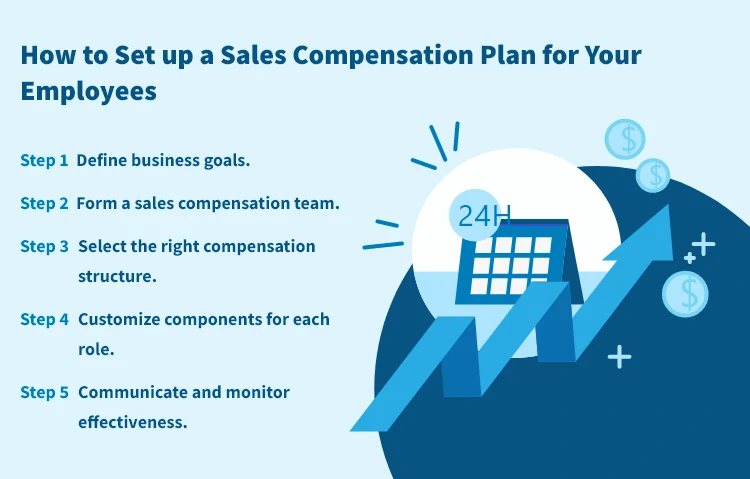
Understand and prioritize the goals of your organization. Whether it's boosting sales, reducing turnover rates, or expanding revenue from current customers, your plan should incentivize behaviors that drive these outcomes. For instance, if upselling is a focus, consider incorporating bonuses for successful upsells into the plan.
Bring together a diverse team including members from finance, sales, and operations to design your sales compensation framework. Involving multiple departments ensures a balanced and trusted total compensation plan that aligns with company objectives and industry standards. Don't forget to include sales reps in the process to ensure their understanding and buy-in.
Choose a sales compensation plan that balances stable base salaries with performance-based incentives. Whether it's a fixed salary, plus commission, bonuses, or profit-sharing, ensure the plan is sustainable and realistic for your industry. Regularly review and adjust targets to maintain fairness.
Salary Structure Building can help model competitive salary structures, compose salary ranges, and audit job levels to assign to appropriate ranges.
Customize incentives to individual sales roles to ensure achievable targets and fair rewards. Consider incorporating team goals to develop teamwork but prioritize recognition of individual contributions. Keep the plan simple and transparent to ensure understanding and motivation.
Regularly communicate the details and rationale behind the compensation plan to your sales team. Remember, transparency builds trust. Monitor performance metrics and gather feedback to make necessary adjustments to keep the plan relevant and motivating for all employees.
Salary.com's Pay Transparency can help communicate pay and develop transparency to prevent bias and close wage gaps.
The high-stress nature of sales jobs and the pressure to meet sales quotas often lead to high turnover rates for a sales position. To address this issue, organizations use a sales compensation program to drive the sales team's performance and incentivize them for their contributions. By following these simple steps utilizing Salary.com's Consulting Services, you can solve your sales compensation challenges through innovative and efficient data-driven solutions.

The latest research, expert advice, and compensation best practices all in one place.
Blog
Bringing trusted compensation intelligence and seamless planning to even more ADP users.

Blog
Learn how to train managers for effective pay conversations and build trust.

Blog
Total rewards package flexibility lets employees choose what matters - pay, perks, and benefits tailored to their needs.