

Blog
Get Pay Right on ADP Workforce Now® Next Gen™
Bringing trusted compensation intelligence and seamless planning to even more ADP users.
Written by Salary.com Staff
October 30, 2026

Knowing how to measure employee productivity takes more than counting hours worked, emails sent, or time spent online. A useful approach connects work inputs with meaningful outputs while recognizing that productivity differs across roles and work arrangements.
Our Skills Library helps with skills-based pay by quickly grouping similar jobs with the same skills.
The right measures also depend on quality, not just visible activity. Choosing the right metrics, formula, and methods creates a more reliable view of employee performance.
Employee productivity is the relationship between work produced and the time, labor, effort, or resources used to produce it. Productivity is commonly understood as output relative to labor input, rather than hours worked alone.
Outputs may include tasks completed, projects delivered, revenue generated, goals reached, or customer outcomes. To measure workplace productivity meaningfully, organizations should consider quantity and quality because productive work looks different across roles.
Hours logged, messages sent, or physical presence do not automatically show progress toward organizational goals. Clear role expectations make productivity measures more useful, especially when outcomes and quality matter more than units produced.
JobArchitect® Max helps HR teams structure job descriptions, clarify responsibilities, and align roles with the skills your organization requires. This foundation makes role-specific productivity measures easier to define.
No single productivity measure works for every employee. A practical process starts with the role, connects measures to meaningful goals, balances quantity with quality, and reviews results over time.
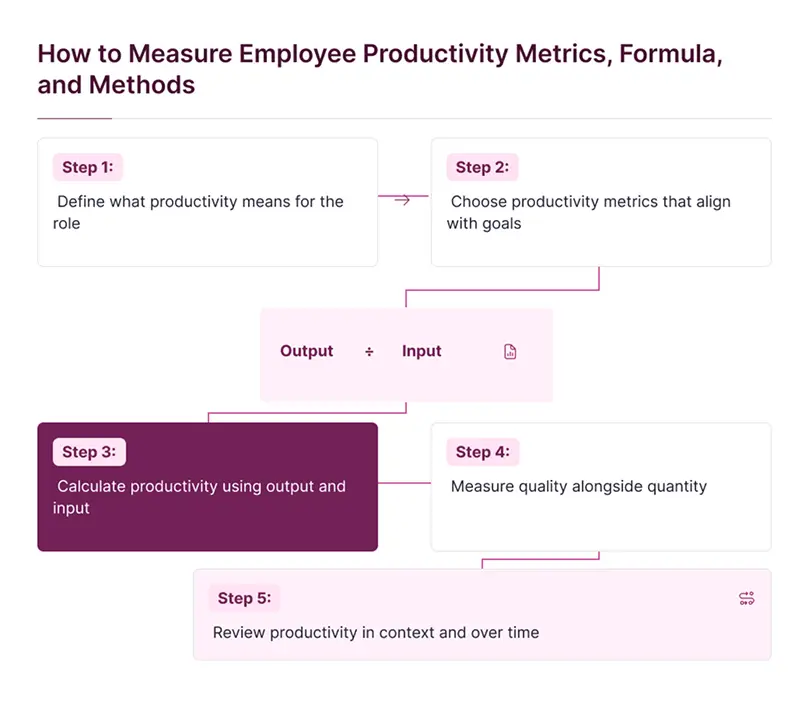
When deciding how to measure productivity of employees, start with the outcomes each role should produce. Manufacturing may focus on units, a sales team on revenue or qualified opportunities, customer service on resolved cases, and project roles on deliverables.
Knowledge work may require goals, quality, and business outcomes instead of activity counts. For individual employees, keep measures tied to responsibilities and results they can influence.
Salary.com's Skills and Competency Library helps HR teams map job-specific competencies, proficiency requirements, and observable behaviors to individual roles. Structured expectations make successful performance easier to define.
A key part of how to measure employee productivity is choosing a small set of productivity metrics tied to team goals and organizational goals. Combining output, efficiency, quality, goal achievement, and customer outcomes gives a fuller view of team performance than relying on one productivity KPI.
Useful key performance indicators should be relevant and within the employee's influence, not chosen simply because they are easy to track.
A simple productivity formula provides a useful starting point:
Employee productivity = Total output ÷ Total input
Output might mean units, tasks completed, projects completed, or revenue generated, while input could include hours worked, labor cost, employees, or other resources.
This follows the broader output-to-input approach used in productivity measurement. Knowledge-based roles usually need qualitative measures and outcome data alongside the calculation.
High output can look impressive until accuracy or service quality falls. Pair volume with error rates, rework, customer satisfaction, compliance, or 360-degree feedback where appropriate.
Closing more customer tickets does not necessarily mean stronger performance if complaints rise or issues remain unresolved. Balancing quantity with quality of work prevents volume from becoming the only definition of productive work.
Avoid judging performance from one day, week, or isolated result. Regularly measuring results helps HR teams track productivity, identify trends, and understand changes in overall productivity.
Consider workload, role complexity, team dependencies, technology, the work environment, and employee ramp-up. These key insights can reveal low productivity, development needs, or process barriers and support data-driven decisions.
Employee feedback can explain performance changes and guide development initiatives. Regular check-ins and performance management best practices can also help managers connect feedback with clearer expectations and ongoing improvement.
Different roles call for different productivity metrics. Measures may reflect output, efficiency, quality, goals, customer outcomes, or business performance.
Add skills and competency data from our Skills Library to attract the right candidates.
Output per hour can measure worker productivity by comparing output with hours worked. It works best where units, cases, or transactions can be measured consistently rather than roles driven mainly by judgment or creativity.
Task or project completion rate
Task completion rate shows the percentage of assigned tasks or deliverables finished within an expected period. Project milestone completion tracks longer projects, while cycle time measures how long specific work takes from start to finish.
Quality of work
Quality measures whether work meets expected standards. Accuracy, error rates, rework, compliance, customer complaints, and quality ratings should often be paired with an output measure.
The Skills and Competency Library provides defined competencies, proficiency levels, and observable behaviors that add structure when HR teams evaluate performance quality.
Revenue per employee
Revenue per employee compares organizational revenue with workforce size. Treat it as a workforce productivity or business performance indicator because industry, pricing, technology, and market conditions also affect revenue.
Goals completed or percentage of goals reached
Goal achievement tracks progress against KPIs or OKRs. Goals should be realistic, role-specific, clearly defined, and connected to business goals before managers use them to evaluate performance.
Customer satisfaction
For customer-facing roles, customer satisfaction can show whether employees create useful service outcomes. Satisfaction scores, service ratings, resolution outcomes, and retention measures can also reveal opportunities to improve customer satisfaction.
Employee engagement
Employee engagement is not a direct output measure, but it provides context for team productivity, employee satisfaction, and company performance. Gallup's 2024 Q12 meta-analysis found engagement was associated with productivity and other business outcomes.
Effective tools, employee development, and efforts to automate repetitive tasks can help teams improve efficiency and boost productivity without more activity monitoring.
Knowing how to measure productivity of employees also means recognizing misleading data. Productivity measures lose value when organizations track what is easiest to observe instead of meaningful results.
Measuring activity instead of outcomes
Hours logged, emails sent, messages, mouse movement, and time online may show activity, but they do not necessarily show valuable output. Focus on completed work, goals, quality, and value created instead of treating productive hours or time spent online as proof of results.
Using the same metrics for every role
Different roles create value in different ways, so one productivity KPI rarely fits everyone. A measure useful in sales, manufacturing, or customer service may say little about professional, technical, or creative work.
Focusing on quantity without quality
Volume-based measures can encourage rushed work, errors, rework, and poor customer outcomes. Pair output with quality standards so higher volume does not reduce actual value.
Over-monitoring employees
Constant tracking can generate activity data without showing whether important outcomes are being achieved. A U.S. GAO review of workplace surveillance found stakeholders raised concerns that monitoring may not accurately measure productivity.
A consistent approach measuring employee productivity should help managers understand results and improve efficiency rather than simply observe behavior. Better measurement can improve employee productivity without confusing surveillance with performance management.
A few common questions clarify how to measure employee productivity across roles and work arrangements.
Calculate employee productivity by dividing total output by total input: Employee productivity = Total output ÷ Total input. Output may mean units, tasks, projects, or revenue, while input may include hours worked or labor resources; some roles also need qualitative measures.
A fair approach to measuring the productivity of employees combines role-specific expectations, relevant output measures, quality standards, and context. Apply consistent criteria to comparable work, use employee feedback where appropriate, and account for factors employees cannot reasonably control.
A clear performance management framework can help managers connect goal setting, ongoing feedback, and evaluation in a more consistent process.
When deciding how to measure productivity of employees in remote or hybrid teams, focus on goals, tasks or projects completed, quality, customer outcomes, and relevant efficiency measures. Online time, meeting hours, or physical presence should not automatically equal productivity.
Measuring productivity starts with clear roles and meaningful expectations. JobArchitect® Max and Skills and Competency Library help HR teams connect job responsibilities with the skills and competencies employees need to succeed.

The latest research, expert advice, and compensation best practices all in one place.
Blog
Bringing trusted compensation intelligence and seamless planning to even more ADP users.

Blog
Learn how to train managers for effective pay conversations and build trust.

Blog
Total rewards package flexibility lets employees choose what matters - pay, perks, and benefits tailored to their needs.
