Blog
Get Pay Right on ADP Workforce Now® Next Gen™
Bringing trusted compensation intelligence and seamless planning to even more ADP users.
Written by Salary.com Staff
October 09, 2026

Creating an HR budget allows companies to control their costs and support their growth. Data revealed that the median HR budgets across different companies increased by 9.1 percent from the previous year.
The U.S. Bureau of Labor Statistics also keeps track of the costs that companies face in paying their employees. Having a budget in place allows the finance and HR departments to plan the company's finances and meet their goals.
An HR budget forecasts human capital costs for a year and sets out the planned spending for all human resources activities in a fiscal year. It covers the money set aside for the HR department to run daily work and special projects, helping HR leaders, finance teams, and other decisionmakers align spending with business strategy and staffing needs.
Inside the larger company budget, the HR budget works at a company-wide level to guide decisions on employee salaries, benefits, hiring, training, and programs. It helps HR and finance teams track real-time spending against historical data, controls rising personnel costs, and avoids unexpected overruns. Most organizations review it each year to adjust for market trends and anticipate changes in the job market.
CompAnalyst® product salary structure modeling, helping organizations understand the potential cost of pay structures before making budget decisions.
A solid HR budget protects the organization from unexpected HR costs and keeps people from programs on track.
According to the SHRM CHRO Metrics report, organizations that track the HR expense to operating expense ratio gain clearer control over spending and improve overall performance.
Based on recent BLS employer cost data, rising costs for health insurance and retirement plans make careful workforce budget planning essential to avoid overruns that affect the entire company during the budgeting process.
Research from APQC's study on HR spending shows that companies with structured workforce budget management report better alignment between HR initiatives and the organization's goals.
CompAnalyst® helps organizations match and price jobs, create market composites, and review pricing concerns, supporting more accurate compensation budgeting.
The HR department budget includes several key components, with payroll typically the largest share and spending across people's work.
According to SHRM benchmarking findings, recruitment costs often take a sizable portion of the total and include advertising, background checks, and agency fees for new hires; that matters because talent costs can account for 50 to 70% of operating expenses.
Based on KFF's Employer Health Benefits Survey, employee benefits such as health insurance form a major budget item that employers must forecast carefully each year.
Research shared by APQC highlights that HR technology, including HRIS and payroll software expenses, training and development, compliance and legal costs such as labor law compliance and legal consultations, and employee relations programs round out the typical human resources budget for most organizations and broader HR operations.
CompAnalyst® helps organizations build and adjust pay ranges while forecasting the cost of changing employee pay, making it useful for payroll and compensation budgeting.
Preparing an effective workforce budget starts with clear steps that link people's spending to the organization's goals.
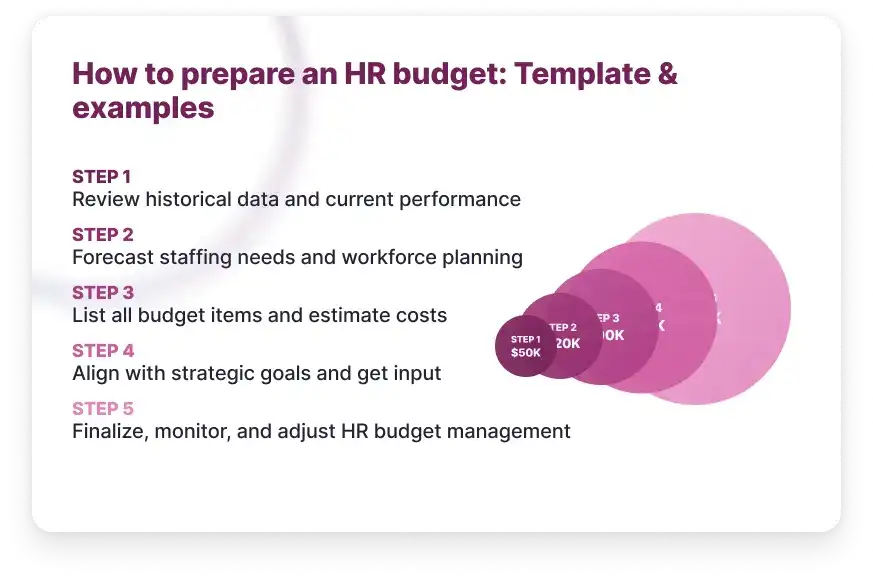
Pull numbers from previous years on employee compensation, turnover rates, and operating expenses. Meet with the finance team to understand the full company budget picture. Use this base to spot trends in HR costs and staffing needs.
Look at business strategy and growth plans for the upcoming year. Estimate new employees required and any reductions. Factor in market trends so the HR team can allocate resources for the hiring process and talent management, especially as competition for top talent makes it important to budget recruitment carefully.
Break down employee salaries, development costs, training and development expenses, including onboarding and leadership programs, health insurance, retirement plans, and HR technology, which typically requires 5 to 10% of the workforce budget. Training costs average $1,888 per employee for small businesses. Include legal fees and costs for specific projects. Add a buffer for anticipated changes, so the plan stays flexible and, with the right tools, easier to track.
Share the draft with key stakeholders in leadership and the HR department. Check that funds support employee engagement, employee morale, and critical areas like training. Adjust so the plan matches the overall strategic plan.
Set the final numbers for the fiscal year and track real-time data and HR performance data. Review quarterly with the finance team. Update for new software or other measures as needed to keep the workforce budget management strong.
The following proven practices help employers build a competitive HR budget that delivers value.
According to the SHRM data, organizations that raise the HR to employee ratio and invest steadily in the function see stronger support for talent and higher productivity.
Based on BLS compensation reports, tracking costs related to benefits and salaries against industry averages keeps the average HR budget realistic and competitive, with the average HR budget per employee ranging from $1,350 to $3,800.
Research from APQC's HR spending study shows that linking the workforce budget to clear performance data and business results improves how leaders allocate workforce budget across teams while comparing industry benchmarks and other strategies.
A simple template helps employers organize the human resources budget by major categories and track spending through the year.
According to SHRM benchmarks, a basic template lists lines for recruitment costs, employee benefits, training and development, HR technology, legal fees, and contingency so leaders can compare planned versus actual amounts.
Based on insights from the KFF survey, employers often set health insurance as a separate large line item because premiums continue to rise and form a major part of HR costs.
Research noted by APQC recommends adding columns for previous years and the upcoming year, so the template supports easy comparison and better workforce budget planning for the entire company.
Here are some FAQs for better understanding.
HR expenses include every cost tied to managing people in the organization. These cover employee salaries for the HR team, recruitment costs for new hires, health insurance, retirement plans, training programs, and HR technology. Employers also count legal fees, background checks, and costs for employee relations or specific projects. Tracking these expenses helps control the overall HR department budget and supports better decisions for the company.
The 70-10-10-10 budget rule is a simple way to divide funds into four parts. In personal finance, it often means 70 percent for daily living costs, 10 percent for savings, 10 percent for investments, and 10 percent for debt or growth.
Employers can adapt the idea for workforce budget planning by putting the largest share toward core operating expenses like salaries and benefits, then splitting smaller shares for training, technology upgrades, and contingency.

The latest research, expert advice, and compensation best practices all in one place.
Blog
Bringing trusted compensation intelligence and seamless planning to even more ADP users.

Blog
Learn how to train managers for effective pay conversations and build trust.

Blog
Total rewards package flexibility lets employees choose what matters - pay, perks, and benefits tailored to their needs.