Blog
Get Pay Right on ADP Workforce Now® Next Gen™
Bringing trusted compensation intelligence and seamless planning to even more ADP users.
Written by Salary.com Staff
October 17, 2025

Retaining skilled employees is a top priority for employers and HR professionals in today’s competitive job market. One practical approach is the use of retention incentive pay, a financial reward offered to key employees in exchange for their commitment to stay with the organization during critical or transitional periods. This strategy helps reduce turnover, maintain productivity, and protect institutional knowledge.
According to SHRM, retention compensation plans help stabilize the workforce during pivotal moments by linking pay to continued employment, proving their effectiveness in retaining essential talent.
In this guide, we will explain what retention incentive pay is, explore how it works, highlight its benefits, and show how to calculate the retention incentive percentage rate for eligible employees.
A retention incentive pay, also known as a retention bonus or a retention package, is a targeted financial reward designed to retain key employees during critical periods such as major projects, mergers, or restructuring.
These rewards may be given to:
a current employee,
an eligible group, or,
in certain federal contexts, members of the Senior Executive Service or law enforcement officers.
Retention incentives can take different forms, including:
a single lump sum payment, or
a series of retention incentive installment payments.
The common percentage rate for retention incentives often falls between 10% and 25% of an employee’s annual base pay. However, the employer or agency determines the precise figure based on unique qualifications, market competition, and the importance of the employee’s role to the organization.
To calculate retention incentive pay, use the formula: Retention incentive pay = (Employee’s annual base pay × retention incentive percentage rate)
For example, if an employee earns $70,000 annually and qualifies for a retention incentive rate of 15% for a full service period, the incentive annually would be: Retention incentive pay = $70,000 × 0.15 = $10,500
To maximize effectiveness, many organizations use Compensation Planning Software to design, administer, and track retention programs. This ensures each bonus program not only meets immediate retention needs but also aligns with broader workforce and financial strategies.
Retention incentives are not tied to individual job performance but serve as financial rewards to encourage employees to stay with the organization. In most cases, these incentives are formalized through a written service agreement that specifies the required service period established by the employer or an authorized agency official.
The agreement also outlines the:
conditions under which the incentive may be paid,
repayment rules if the employee leaves the company or federal service early,
the calculation of the retention incentive rate.
When setting the amount, employers first consider the purpose behind offering it. If the goal is to prevent an employee from leaving for a competitor, the competitor’s salary often influences the figure. If the aim is to retain employees through a challenging project, the calculation may factor in the additional workload and the project’s overall importance.
Employers also assess financial resources to determine whether payment will be made at once or spread over time. A final installment payment may be issued as a lump sum after the completion of the full service period, and all payments are tied to the pay period structure outlined in the service agreement.
The main benefits of a retention bonus include:
Increased productivity: While not directly tied to performance, retention bonuses encourage employees to remain focused and motivated by the prospect of an additional reward.
Greater loyalty: Employees who commit to staying for a defined period demonstrate stronger dedication to the organization.
Workforce stability: Incentives help maintain a reliable workforce during critical times, reducing disruptions and supporting consistent operations.
Improved morale: Providing incentives signals that employee contributions are valued, which strengthens morale and engagement.
Confidence for stakeholders: Retaining leadership and key staff conveys stability to investors and business partners.
Cost savings: Retention bonuses are usually one-time payments, making them less expensive than permanent salary increases while still offering a strong reason to stay. These incentives are calculated based on the employee's rate of basic pay and specifically exclude additional pay, making them a targeted and cost-effective tool.
Retention of skills: Incentives help preserve employees with critical training or specialized expertise, preventing competitors from gaining that knowledge.
To ensure transparency, consistency, and compliance, HR teams should address the following points when drafting a retention incentive pay agreement:
Eligibility criteria: Define which employees qualify for the incentives. These criteria may include position, tenure, skill set, or involvement in critical projects. Eligibility can apply to individual employees with high or unique qualifications or extend to an entire unit through a group retention incentive when retaining multiple employees is essential to meet organizational or agency objectives.
Bonus structure: Specify the incentive amount and how it will be calculated. Options include a fixed sum, a single retention incentive rate expressed as a percentage of the employee’s rate of basic pay, or a formula linked to specific business outcomes.
Payment schedule: Clarify when the incentive will be paid. This could be a one-time payment at the end of the retention period, phased payments tied to milestones, or a final lump sum payment after a transition period or project completion.
Clawback provisions: Outline the circumstances under which the retention bonus must be repaid, such as voluntary resignation or termination for cause before the end of the agreed timeframe specified in the service agreement. Employers should also define the conditions that allow them to terminate the retention service agreement, such as unacceptable performance or organizational restructuring.
Legal and tax considerations: Collaborate with legal and financial advisors to ensure the agreement complies with regulations and addresses the tax obligations of both employer and employee.
With Incentive Compensation Software, HR teams can define eligibility, set bonus structures, manage payment schedules, and ensure compliance, providing a clear and effective framework for retaining key employees.
Now that you have a comprehensive overview of the retention bonus, here are some straightforward steps to calculate the retention incentive percentage rate correctly:
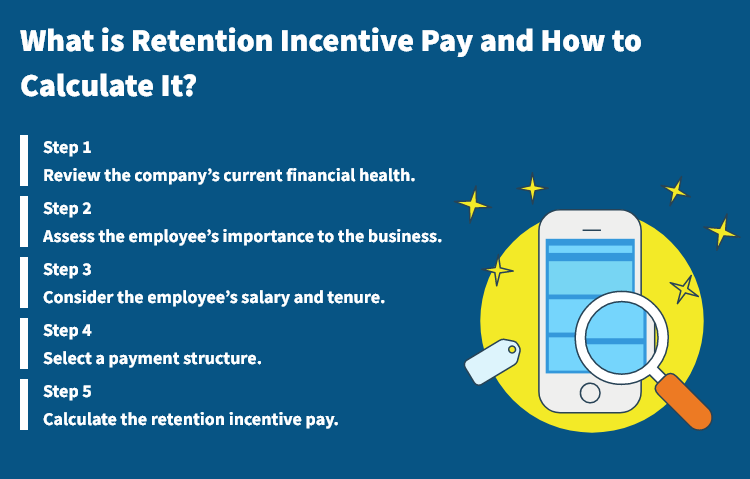
Begin by thoroughly examining your company’s current financial condition. Since retention bonuses are often offered during challenging periods, it is important to determine whether providing such payment aligns with your strategic goals and budget. This step ensures you make informed decisions before proceeding.
Once you understand your company’s financial capacity, consider the employee’s role and contributions. Ask whether the employee holds a critical position, possesses specialized skills essential to major projects, or serves as a senior leader whose retention significantly benefits the organization. This will help you prioritize which employees should be considered for a retention bonus.
After evaluating the employee’s contributions to the organization, review their compensation and length of service. Retention bonuses are based on the employee’s rate of basic pay and a percentage that reflects factors such as tenure, technical expertise, involvement in key projects, and overall value to the company.
As mentioned above, companies pay a retention bonus ranging from 10% to 25%, though this may be adjusted based on individual circumstances.
Decide how to deliver the incentive, either as a final lump-sum payment or as multiple retention incentive installment payments. The selected payment structure must be consistent with the retention incentive authorization granted by your organization or agency. Consider how your choice will affect cash flow, timing, and the overall impact on your retention strategy.
To calculate retention incentive pay, determine a percentage of the employee’s annual rate of basic pay, excluding overtime or additional pay. Use the following formula:
Retention incentive pay = (Employee’s annual base pay × retention incentive percentage rate)
For example, if an employee earns $80,000 annually and qualifies for a retention incentive rate of 25% for a full service period, the incentive annually would be:
Retention incentive pay = $80,000 × 0.25 = $20,000
This amount may be issued as installment payments across each biweekly pay period or as a lump sum payment at the end of the completed service period.
To streamline this process, you can leverage Compensation Planning Software to simplify calculations, model different scenarios, and ensure that retention incentives align with both employee value and the company budget.
Here are some questions about retention incentive payments:
The difference between a sign-on bonus and a retention bonus is that the former is offered to entice a prospective employee to accept a job offer, whereas the latter is intended to encourage a current employee to stay with the organization. Sign-on bonuses are awarded at the start of employment to attract talent in competitive industries, while retention bonuses are granted after a period of service to recognize ongoing commitment. Retention bonuses are often tied to a defined timeframe in the service agreement, and employees may be required to repay the bonus if they leave before the end of the agreed term.
You should expect a retention bonus to range from 5% to 25% of your base salary, with 10% to 15% being most common. The exact amount depends on factors such as industry, job role, individual contribution, market trends, and the organization’s budget.
No, a retention bonus is not automatically paid every month. It may be issued in installments after completing specified service periods within the full service term, such as biweekly, monthly, or quarterly, or as a single lump-sum payment upon fulfilling the full service period required by the agreement. The employer determines the payment structure, which is detailed in the employee’s retention bonus contract.

The latest research, expert advice, and compensation best practices all in one place.
Blog
Bringing trusted compensation intelligence and seamless planning to even more ADP users.

Blog
Learn how to train managers for effective pay conversations and build trust.

Blog
Total rewards package flexibility lets employees choose what matters - pay, perks, and benefits tailored to their needs.