Blog
Get Pay Right on ADP Workforce Now® Next Gen™
Bringing trusted compensation intelligence and seamless planning to even more ADP users.
Written by Salary.com Staff
July 11, 2025

Knowing how to properly manage every employee’s current skill set is the secret to creating a happier, more dedicated workforce. After all, studies have shown that 3 out of 5 employees are more than likely to leave their companies because they feel like their preexisting skill sets are being underutilized by their current companies.
Thus, most companies should have an effective competency framework in place to ensure that every employee can perform at an ideal pace while still utilizing their skill set. This can then help significantly boost a company’s overall performance metrics.
Thus, continue reading to learn more about competency frameworks, the benefits that they can bring to a company, along with the steps on how to create one.
A competency framework is a job analysis system that HR professionals use to measure the success of every employee with their core competencies and manual skill set within their particular role. Think of it as a way for companies to set reasonable performance expectations for particular job titles. Its main goal is to help organizations properly outline what they need for their current workforce, along with helping them hire qualified candidates at a smoother pace in the long run as well.
The right framework setup also allows companies to communicate what they need for their employees. This can then provide employees with the right mindset that’s needed to drive their company to succeed.
Due to its complex nature, it’s highly suggested for companies to look for a third-party skill library that can help them sort out employee skill sets. The right tool can even help create a robust job structure as well, which effectively kills two birds with one stone.
The competency framework is important for companies because it allows companies to align their employees’ current skill sets companies needs. Additionally, it can also help companies create better leadership strategies and help create leadership training moving forward. This is because a competency model framework allows company leaders to focus on key skill sets rather than just the broad idea of the skill set a future business leader should have.
A good competencies framework also helps create a more robust communication model for companies in the long run as well. This is because there are sets of common language and clear expectations for both the employees and the employers, which lessens overall communication time and creates collective effectiveness when it comes to communication methods.
Simple – competency model frameworks can help companies easily create business outcomes centered around an employee's workload. These can then help address overall skill gaps, and can even help an employee's job career advancement, essentially being a net win for the company moving forward. This can then help them create a smoother overall working process and aid with an employee's professional development, which can help boost productivity for everyone within the company.
Not only that, but the framework can also help companies create better assessments of their employees as well. This is because the framework provides an image of what skill level each employee should have after joining the organization.
The framework can also help with an employee’s internal mobility within the company since it can help identify leadership skills and provide basic communication skills to be considered for the role in the first place.
Since a competency framework can be used for plenty of reasons, it’s highly suggested to use an effective skills library tool that can help companies properly manage the framework. The right tool can even help them properly track specific metrics that the company might look for in the long run and help with financial management.
The 4 key competencies are listed below:
Planning and organizing
Problem-solving
Communication
Adaptability
These 4 key competencies help companies create a more competitive edge versus their competitors as well as help drive organic growth, monitor personal development, and help with personal performance in the long run as well as address skills gaps. The key elements also enable companies to deliver stellar services that are unique from the rest of their competitors on top of ensuring that every employee has the interpersonal skills needed.
Listed below are steps that companies can take if they want to start creating their own competency framework for their employees.
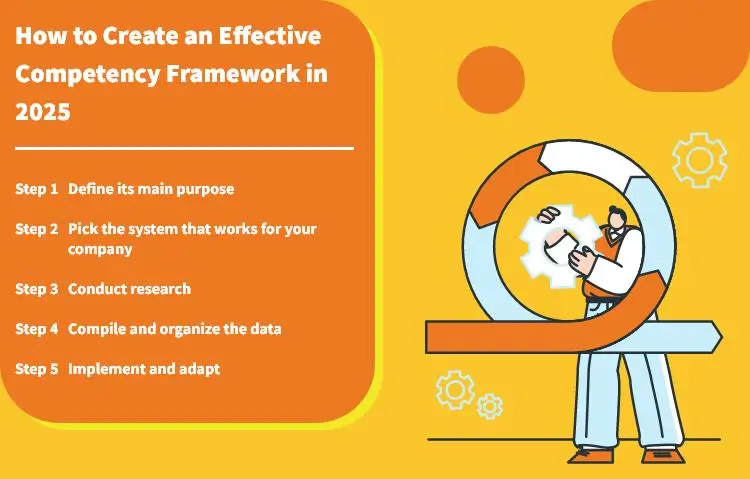
The first step to create a framework is to define what its main purpose is going to be. Since the competencies framework can do multiple jobs at once, it’s important to define its main purpose to ensure that it can track the specific metrics that the company specifically needs.
For example, a competency framework that aims to minimize hiring costs by knowing what skills a future employee should have would have significantly different metrics compared to one that’s designed to identify future leaders.
Similarly, not every competency model framework can work for every company – thus, it’s important to choose the right system that will work for your company. Whether it’s for core competencies, leadership competencies, or job-specific competencies, it’s important to choose the right system to ensure that the system will properly function and can be used to track the right metrics.
Though the right skills library tool can help companies with the burden of choosing which system will work best for a company at any given moment, it’s still highly suggested for companies to have a basic knowledge of which framework to use at any given moment. This can help create a smoother overall process.
The next step is to conduct proper research on the entire organization and gather data on how the model should be structured, and which employees should be monitored with the model. For this, it’s important to know several factors, including the following:
Readily available information: This includes knowledge of current business plans and goals for both the present and future, as well as functional competencies for every employee. This ensures that the framework is future proof and can withstand changes within the company.
Key workforce data: Having access to the current workforce data like retention key performance indicators (KPIs), engagement rates, meta competencies, and even organizational performance can help companies create a rough picture of how the framework should be structured.
It's also important to take note of team members' observable behaviors, as well as performance reviews gathered over time.
Current job descriptions: A company’s current descriptions offer a clear insight into a company’s current roles on top of helping them prepare for their hiring process as well.
For this process, the right skills library tool can help companies track the right factors as well as keep notes of competencies that should be considered with each factor.
Next, companies should properly compile and organize the data that was gathered. This includes everything from the company’s current competencies to the actions and behaviors of each employee, and competencies required to reach them.
For this step, it’s important to sort the data properly using pre-existing tools. Any tool that can sort the data, like SharePoint, Google Drive, or other similar HR tools, can be used to help companies with this step as it allows them to have a set of clear expectations and gain a better understanding of the framework and the factors involved.
The last step is to implement the competency model and continuously monitor its progress. For the implementation process, it’s important to keep a checklist of things to look out for, which is listed below.
Relevance
In line with the company’s objectives
Easy to measure and manage
It’s also important to note that, much like anything else, the framework’s key components should be flexible and fit the company culture and the organization's values. Continuously adapting to change is the name of the game when it comes to the business world and adapting the framework to the changes in both the business and the world around it as well.
In conclusion, the competency framework is all about talent management and ensuring that every employee that goes through company doors possesses the skills required to ensure easier succession planning to reach their organizational goals.
Having a reliable skills library tool can help manage the framework better, help keep track of the competencies needed for success, andhelp with everything that the competency framework offers to help it keep up with today's standards as well as ensure better business strategies moving forward.

The latest research, expert advice, and compensation best practices all in one place.
Blog
Bringing trusted compensation intelligence and seamless planning to even more ADP users.

Blog
Learn how to train managers for effective pay conversations and build trust.

Blog
Total rewards package flexibility lets employees choose what matters - pay, perks, and benefits tailored to their needs.