


Blog
Get Pay Right on ADP Workforce Now® Next Gen™
Bringing trusted compensation intelligence and seamless planning to even more ADP users.
Written by Salary.com Staff
May 23, 2025
HR operations are the backbone of any successful organization, ensuring that the human resources department runs smoothly while promoting a positive work environment.
According to a report, key HR focus areas for 2025 include leadership development, cultural alignment, workforce planning, change management, and HR technology optimization
This comprehensive guide dives into the essentials of human resources operations in 2025, covering its definition, roles, responsibilities, and goals to provide a clear understanding for HR professionals and businesses alike.
HR operations, often referred to as HR ops, encompass the day-to-day processes and systems that support the HR department in managing an organization’s workforce. It focuses on executing HR processes efficiently, ensuring legal compliance, and enhancing employee satisfaction.
Unlike strategic HR, which deals with long-term planning, human resource operations handle tactical tasks like payroll processing, employee data management, and benefits administration. These functions are critical for maintaining operational efficiency and supporting a positive organizational culture.
Key aspects of HR operations include:
Payroll management: Ensuring timely and accurate salary disbursements.
Employee data management: Maintaining secure and organized HR data in human resource information systems (HRIS).
Recruitment process: Supporting hiring by coordinating interviews and onboarding.
Compliance with labor laws: Adhering to local labor laws and workplace regulations.
Training programs: Facilitating employee development to boost employee performance.
Managing these HR functions, HR operations teams create a foundation for seamless employee management and organizational success. HR Technology Integration supports seamless integration of HR systems, ensuring employee data is automatically updated, accurate, and centralized.
An HR manager and HR ops serve distinct but complementary roles within the human resources department.
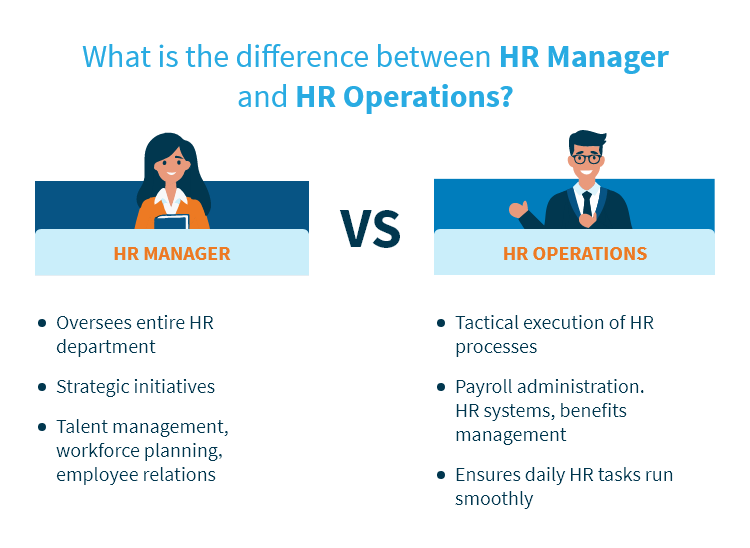
An HR manager oversees the entire HR department, focusing on strategic initiatives such as talent management, workforce planning, and employee relations. They shape the organization’s long-term HR vision and align it with business goals.
While an HR ops manager focuses on the tactical execution of HR processes, the HR operations manager oversees tasks like payroll administration, HR systems, and benefits management, ensuring that daily HR tasks run smoothly.
Customizable Dashboard helps HR operations managers with a real-time, personalized view of key HR metrics, ensuring efficient tactical execution.
An HR operations specialist or HR operations manager is tasked with optimizing human resource processes to support the HR team and the broader organization. Their role involves leveraging HR technology, ensuring compliance with labor laws, and improving employee engagement. A typical human resource operations job description includes:
Managing payroll processing and benefits administration, including health insurance and retirement plans.
Maintaining accurate employee data in human resource information systems.
Supporting the recruitment process by streamlining hiring and onboarding.
Ensuring legal compliance with local labor laws and regulations.
Implementing HR policies to promote workplace safety and a positive work environment.
In 2025, HR tech management is a critical component, with human resource operations roles increasingly relying on HR software and learning management systems to automate manual tasks and enhance organizational efficiency.
The HR ops department handles a wide range of responsibilities to ensure the HR department operates effectively. A dedicated HR ops team aligns various HR functions with the organization’s goals, supporting both employees and management. Key human resource operations responsibilities include:
Employee management: Overseeing onboarding, offboarding, and employee relations to maintain a cohesive workforce.
Data management: Securing and organizing HR data to support decision-making and legal compliance.
Payroll and benefits: Managing payroll administration and benefits management to ensure employee satisfaction.
Compliance: Monitoring labor laws to maintain compliance with labor laws.
Technology integration: Utilizing HR technology, such as management systems, to streamline HR tasks.
Workplace safety: Collaborating with employee relations specialists to promote a safe and positive work environment.
These responsibilities ensure that HR ops support employee retention and drive organizational efficiency. Compensation Software serves as the core platform for all compensation-related HR ops, offering centralized control and optimization.
Here are the common questions about HR ops:
HR ops is a specialized function within the human resources department that intersects with broader business operations. While HR ops support operational goals through tasks like payroll management, employee data management, and compliance with labor laws, it primarily focuses on HR-specific processes. This makes it distinct from general business operations but integral to organizational efficiency.
HR ops manage the daily HR tasks that keep the HR department running efficiently. This includes payroll processing, employee data management, benefits administration, and supporting the recruitment process. Additionally, HR operations teams ensure legal compliance, implement HR policies, and leverage HR technology to automate administrative tasks, contributing to a positive organizational culture.
The goals of HR ops are to enhance operational efficiency, improve employee engagement, and ensure legal compliance. Streamlining HR processes, managing employee data, and supporting HR functions, HR ops promote employee retention and a positive work environment. Ultimately, HR ops roles aim to create a seamless employee experience while aligning with the organization’s strategic initiatives.
Analytics helps achieve operational goals by identifying gaps, tracking engagement trends, and improving compensation-related outcomes.

The latest research, expert advice, and compensation best practices all in one place.
Blog
Bringing trusted compensation intelligence and seamless planning to even more ADP users.

Blog
Learn how to train managers for effective pay conversations and build trust.

Blog
Total rewards package flexibility lets employees choose what matters - pay, perks, and benefits tailored to their needs.
