

Blog
Get Pay Right on ADP Workforce Now® Next Gen™
Bringing trusted compensation intelligence and seamless planning to even more ADP users.
Written by Salary.com Staff
November 6, 2026
A successful talent acquisition strategy is an ongoing effort tied to business goals and organizational success, not just a way to fill open roles.
Workforce planning comes first, helping the talent acquisition team decide which roles to fill and when.
Sourcing works best when you mix job boards, referrals, and recruitment agencies for specialized skills to reach both active and passive candidates.
Effective talent acquisition depends on candidate experience: fast replies, a clear process, and respect, even for rejections.
Onboarding is part of the robust talent acquisition strategy framework, not a separate step.
Filling an open role is easy to start and hard to get right. A rushed hire can leave you with a bad fit, a frustrated team, and the same job posted again six months later.
Talent acquisition takes a longer view. It is the ongoing work of finding, attracting, assessing, hiring, and onboarding the people your organization needs. It is a talent strategy, not a single task.
Here are the 8 key components of talent acquisition and how they fit together for HR teams.
Strong talent acquisition starts before a job is posted. Workforce planning asks a simple question: what roles will we need and when?
Teams look at growth plans, turnover, and future staffing needs. They also identify skill gaps and then decide which roles to fill first.
Once hiring needs are clear, the next step is talent sourcing. This means finding active job candidates, along with passive candidates who are open to new opportunities. Common sources include:
Job boards and company career pages
Employee referrals
Past applicants and talent pools
Professional networks and social platforms
Career fairs and industry events
Recruitment agencies, especially for specialized skills
Pay matters, too. There is little point in contacting candidates if their salary expectations are beyond the budget. SalaryTalent™ Candidate Sourcing helps recruiters find candidates and review estimated market pay in their reports.
The platform's Match Score shows how well each person fits based on skills, experience, role scope, and autonomy. Recruiters can also revisit past applicants and referrals before spending time searching for new candidates.
Candidates often research a company before applying. Your employer brand is what they learn about you, from your reputation and company culture to employee reviews and job descriptions.
A strong employer brand gives candidates an honest picture of the job and workplace. That helps attract top talent. It can also keep people interested until they are ready to apply.
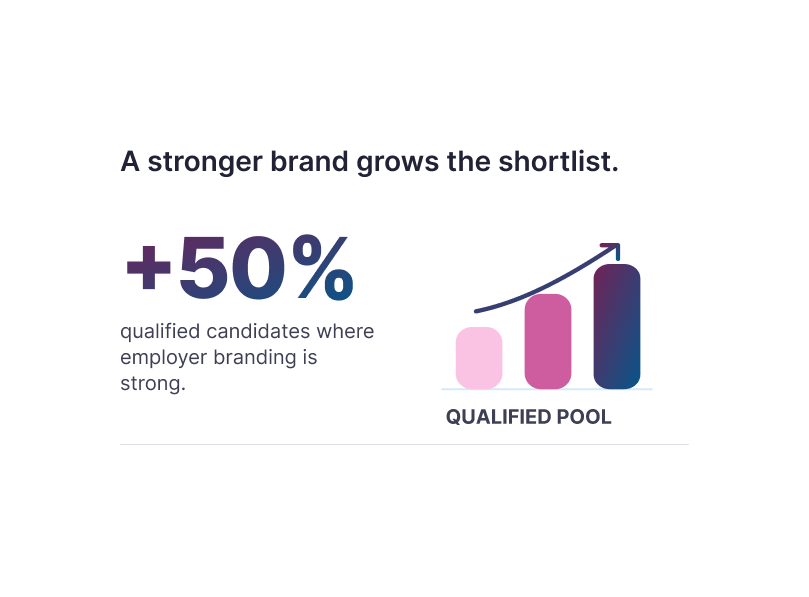
In fact, companies with strong employer branding see a 50% increase in qualified candidates. Plus, investments in employer branding result in a 28% reduction in turnover.
Candidate experience is how people are treated throughout the talent acquisition process, from applying to getting a decision. Candidates care about:
How easy it is to apply
How quickly you respond
How clear the recruitment process is
How respectfully you treat them, even if they are rejected
Most people who accept an offer had a strong candidate experience first, according to Gallup. In fact, two in three people hired in the past year rated their candidate experience as very good or exceptional. Those who rated it exceptional were also twice as likely to say the job matched what they were promised.
Not every good candidate is ready to jump right away. And that's okay.
Talent pipelining is about staying in touch with people who might be a great fit down the road. Think past applicants, referrals, and people who weren't job hunting at all.
Don't forget to look inside your own company, too. Your current employees may already have the skills for that open role.
When internal jobs are easy to find, people can see a path to grow, and you get more options to choose from. Not to mention, promoted employees tend to stick around, with a 70% retention rate after three years.
A few simple habits can help you build a strong talent pipeline:
Organize candidates by skills and the potential roles they could fill.
Share company news and open jobs on a regular basis.
Follow up after interviews, even when someone isn't selected.
Ask your employees to refer people they know.
Once you have a pipeline, you need a clear process to move people through it. Start with the job itself. A clear job description and a defined pay range keep everyone aligned.
Screening and the interview process come next. Recruiters review applications, hold first conversations, and pass strong candidates to hiring managers. For fair candidate assessment, good teams use:
Clear, job-related criteria
Structured interviews with the same core questions
Skills assessments where they fit the role
Input from more than one interviewer
It's easier to manage each step when everything lives in one place, not across spreadsheets and separate applicant tracking systems.
SalaryTalent™ Recruiting brings requisitions, job postings, candidate pipelines, interviews, offers, and onboarding together. It also requires a salary range from the start, which helps job postings meet pay transparency rules where they apply.
An offer is more than a number. It is a compensation decision. Base pay, bonus, commission, equity, and benefits can all play a part.
Benefits matter more than many teams assume, since 84% of employers believe benefits packages attract top talent. The offer should reflect the market and stay fair compared to what current employees earn.
Onboarding finishes the job. It helps new employees get set up, meet their team, and understand what is expected. A solid onboarding process usually includes:
Paperwork and system access
Role and goal setting
Introductions to the team and key contacts
Check-ins during the first weeks and months
Good onboarding is about more than paperwork and meet-and-greets. New hires need clear guidance, time to learn, and real support as they settle in. Don't pile too much on them at once, and make sure they feel welcome.
Onboarding belongs inside talent acquisition, not after it. When new hires feel supported from day one, they feel better about the company. That helps you retain talented employees and improve employee retention over time.
What you do not measure, you cannot improve. Talent acquisition teams track data to see what works. Common measures include:
Time to fill: How long a role stays open
Cost per hire: The total spent to fill a role
Source of hire: Where successful candidates came from
Offer acceptance rate: How many offers get a yes
Quality of hire: Often judged by performance and retention
Candidate satisfaction: How people felt about the hiring process
For a benchmark, SHRM found that the median time to fill is roughly a month and a half for both executive and nonexecutive roles.
Review your own numbers on a regular schedule. If offers keep getting declined, look at pay and speed. If one channel brings your best hires, invest more there.
Larger companies often have a talent acquisition department. A talent acquisition manager sets the direction, and talent acquisition professionals handle the day-to-day work.
This is also where talent acquisition vs. recruiting becomes clear. Recruiters fill open roles, while the wider team plans for future hiring needs.
On the other hand, smaller companies may not have a full department. Some use recruitment process outsourcing (RPO) to handle sourcing and screening, while one in-house lead keeps the talent strategy on track.
Either way, strong talent acquisition efforts give you a competitive edge and support business success.
A talent acquisition strategy works when every part supports the others. Planning shapes sourcing. Brand supports candidate experience. A clear process leads to fair selection. Strong offers and onboarding turn a yes into a lasting hire.
Pay plays a role at every stage. It affects who you can reach, who you can hire, and who stays. But when workforce, pay, and market data sit in separate systems, hiring teams can't see the full picture.
With SalaryTalent™, pay becomes part of every step. It's an AI-powered, compensation-first talent management platform that brings workforce context and real-time market data into recruiting, performance, and pay. Your team can see what a hire will cost before anyone commits.

The latest research, expert advice, and compensation best practices all in one place.
Blog
Bringing trusted compensation intelligence and seamless planning to even more ADP users.

Blog
Learn how to train managers for effective pay conversations and build trust.

Blog
Total rewards package flexibility lets employees choose what matters - pay, perks, and benefits tailored to their needs.
