Building Trades Welfare Salary

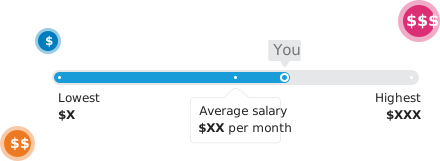
As of August 2026, the average hourly salary for employees at Building Trades Welfare in the United States is $42. This translates to an approximate annual wage of $88,150. Salaries at Building Trades Welfare typically range from $37 to $49 hourly, reflecting the diverse roles and experience levels within the company.
How accurate does the salary look to you?

Is Building Trades Welfare’s Pay Competitive? Salary Benchmarking Analysis

How does Building Trades Welfare's compensation stack up against the industry and its key competitors? Our salary benchmarking analysis provides a clear comparison. The chart below visualizes this comparison alongside select peer companies.
Competitor / Benchmark Avg. Salary Variance Primary Market Influence Factor & Explanation
Sequoyah Regional Library System $43
+1.7%
Confirms Sequoyah Regional Library System is a direct competitor vying for the exact same talent pool.
Demopolis Board of Education $40
-4.7%
Demopolis Board of Education likely leverages performance bonuses over the high base salary shown here.
Saraland Board of Education $40
-5.9%
Reflects market rates for standard general contracting, differing from specialized roles.
Chatfield Elementary School - Grand $43
+0.3%
Suggests Chatfield Elementary School - Grand utilizes a highly similar base-plus-benefits compensation model.
Edu., Gov't. & Nonprofit Industry $56
+30.8%
Pay variances are driven by organizational scale, specialized skill requirements, or geographic cost-of-living factors.
Need More Granular Data? The analysis above provides a high-level market overview. To benchmark specific job codes, adjust for real-time cost-of-living changes, or access verified HR-reported datasets, upgrade to Salary.com for Business. Precision matters when building your compensation strategy.

Employee Reviews: Working at Building Trades Welfare

Considering a career at Building Trades Welfare? Explore authentic employee reviews to learn about the work environment, career growth opportunities, pay transparency and benefits. These first-hand insights can help you set realistic compensation expectations and make informed career decisions.
Projects are consistent but occasionally lack innovation or variety to stay engaging. Meaningful work that directly impacts the community in a positive way. What I enjoy most about this job is the consistency. The meaningful public service work instills pride and purpose in daily responsibilities. Collaboration across departments is effective.
Resources are allocated thoughtfully, and innovation is encouraged. Leadership encourages open dialogue and collaboration, while wellness and recognition programs help maintain high morale. Despite its workforce, there’s a profound sense of purpose in contributing to public good and shaping future generations. Knowing that our work is consistently governed by fundamental principles of fairness, eq...
The impact of working at s profoundly rewarding. No ambiguity. Not ideal for fast-paced personalities, but dependable for long-term employment. Resources are allocated equitably across schools. Innovation is minimal, and change takes time.
it’s purposeful and well-run. Leadership is approachable, and I’ve found opportunities to advance internally. It’s a comfortable and secure environment for professionals who value structure. The leadership actively promotes equity and access, which aligns well with the organization’s mission.

Building Trades Welfare Overview

Website
Data pending, update soon.
Founded In
Data pending, update soon.
Employees
50 - 100 employees
Industry
Edu., Gov't. & Nonprofit
Headquarter Address
69100 Bayberry Dr Saint Clairsville Ohio OH 43950
Revenue
$5 Million - $10 Million
Phone Number
+1 7406951774
Social Media
About Building Trades Welfare
Building Trades Welfare is a company that operates in the Construction industry. It employs 51-100 people and has $5M-$10M of revenue. The company is headquartered in Saint Clairsville, Ohio.

What Benefits Does Building Trades Welfare Offer Beyond Salary?

A competitive compensation package is more than just a salary. Building Trades Welfare offers a comprehensive benefits package designed to support your health, financial future, and overall well-being. Below are the most common key benefits:
Social Security
401(K)
Disability
Healthcare
Pension
Time Off (days)
Work at Building Trades Welfare?
Share your experience
How Much Should You Be Earning?

Get an estimated calculation of how much you should be earning and insight into your career options.

illustration

What Is the Cost of Living Near Columbus?

Understanding the cost of living near Columbus is key to truly evaluating a salary offer or your current compensation at Building Trades Welfare.
Columbus' Cost of Living Index is approximately 86.8 (13.2% less expensive than US average; 4.4% less than OH average). State capital (Ohio State Univ.), growing, affordable. COTA bus. When planning your budget based on a salary from Building Trades Welfare, consider these typical monthly expenses:
Expense Category Estimated Monthly Cost Key Considerations / Notes
Housing (1-BR Apt Rent) $1,000 - $1,500+ A significant portion of Building Trades Welfare salary. Location choices impact this heavily.
Utilities (Basic) $130 - $220 Electricity, Heating, Cooling, Water etc.
Public Transportation $62 (COTA monthly pass) Essential for most commuters; car ownership is costly.
Groceries (Single Person) $380 - $560 Can be higher with more dining out or specialty stores.
Personal & Leisure $350 - $650+ Dining out, entertainment, shopping. Highly variable.
Healthcare (Individual) $360 - $670+ Varies significantly by plan & employer contribution.
Subtotal (Excluding Taxes) $2,282 - $3,602+ This subtotal does not include income taxes (federal, state, local), which can significantly impact your take-home pay.

FAQs of Building Trades Welfare

1. What is the typical salary range (low to high) for most roles at Building Trades Welfare?

The typical salary range for most roles at Building Trades Welfare is approximately from $37 to $49 per hour. It's important to remember that these are overall averages, actual salaries vary significantly based on specific job titles, years of experience, skills, and location.

2. How much does Building Trades Welfare pay compared to Sequoyah Regional Library System?

The average annual salary at Building Trades Welfare is $88,150, or an hourly wage of $42, in comparison to Sequoyah Regional Library System which pays $89,605 per year or $43 per hour.

3. How does experience level affect salary at Building Trades Welfare?

Experience level is a significant factor in determining salary at Building Trades Welfare, as it is with most employers. Generally, employees with more years of relevant experience and a proven track record can command higher salaries. For example, a senior-level role will typically have a higher pay band than an entry-level or mid-career position within the same job family.

4. How can I determine if a salary offer from Building Trades Welfare in Columbus is fair given the local cost of living?

To determine if a salary offer from Building Trades Welfare in Columbus is fair, first compare the gross salary to our data for similar roles at Building Trades Welfare and its competitors (see our similar company salaries section) . Then, critically, use our "Cost of Living Insights for Columbus" to understand its purchasing power.

5. What are the key factors that influence salary levels at Building Trades Welfare?

Several key factors influence salary levels at Building Trades Welfare. These primarily include: 1. Job Role & Responsibilities: More complex roles with greater impact typically command higher pay. 2. Experience & Skills: Your years of relevant experience and specific in-demand skills are critical. 3. Performance: Strong performance can lead to higher raises and bonuses. 4. Location: Office location impacts pay due to varying local market rates and cost of living. 5. Industry Benchmarks: Building Trades Welfare likely benchmarks its salaries against other companies in the Edu., Gov't. & Nonprofit sector. You can explore how these factors play out in our detailed salary data.