


Texas School for the Deaf Salary


How Much Does Texas School for the Deaf Pay for Different Roles?
President
$345 / hour
Salary Range: $262 - $440
Executive

General Counsel
$157 / hour
Salary Range: $133 - $185
Legal
Executive Director
$81 / hour
Salary Range: $72 - $91
Product Development
Director, Business & Operations
$78 / hour
Salary Range: $74 - $82
Operations
Staff Interpreter
$58 / hour
Salary Range: $51 - $63
Optometry
Director, Health Services
$57 / hour
Salary Range: $50 - $66
Healthcare
Athletic Director
$53 / hour
Salary Range: $41 - $71
Higher Education Athletics
Manager, Risk
$52 / hour
Salary Range: $46 - $60
Risk Management
Manager, Accounting
$50 / hour
Salary Range: $45 - $56
Management
Principal
$49 / hour
Salary Range: $43 - $54
School Administration
Manager, Training & Development
$47 / hour
Salary Range: $42 - $53
Human Resources
HR Specialist II
$47 / hour
Salary Range: $42 - $51
Human Resources
 Thanks for your feedback!
Current Job Openings at Texas School for the Deaf
Is Texas School for the Deaf’s Pay Competitive? Salary Benchmarking Analysis
| Competitor / Benchmark | Avg. Salary | Variance | Primary Market Influence Factor & Explanation |
|---|---|---|---|
| Episcopal School of Dallas | $45 |
+1.1%
|
Suggests Episcopal School of Dallas utilizes a highly similar base-plus-benefits compensation model. |
| Dwight-Englewood School | $53 |
+19.2%
|
Reflects structural premiums typical of Dwight-Englewood School's large-cap national operations. |
| Scheck Hillel Community School | $45 |
+1.3%
|
Reflects stabilized pricing equilibrium for commercial construction roles in this region. |
| Wyoming Public Schools | $44 |
-1.0%
|
Indicates identical technical requirements and experience levels between the two firms. |
| Edu., Gov't. & Nonprofit Industry | $56 |
+24.6%
|
Pay variances are driven by organizational scale, specialized skill requirements, or geographic cost-of-living factors. |
Companies Similar to Texas School for the Deaf and Their Hourly Pay Rates
Episcopal School of Dallas
$45 / hour
Salary Range: $39 - $52
Dallas, TX
Dwight-Englewood School
$53 / hour
Salary Range: $46 - $61
Englewood, NJ
Scheck Hillel Community School
$45 / hour
Salary Range: $39 - $52
Miami, FL
Wyoming Public Schools
$44 / hour
Salary Range: $38 - $50
Wyoming, MI
Boston Higashi School
$50 / hour
Salary Range: $43 - $57
Randolph, MA
Patrick County Courthouse
$44 / hour
Salary Range: $38 - $50
Stuart, VA
Episcopal Academy
$50 / hour
Salary Range: $43 - $57
Newtown Square, PA
Redmond School District
$45 / hour
Salary Range: $39 - $52
Redmond, OR
Psychology Clinic-University Of North Texas
$46 / hour
Salary Range: $40 - $52
Denton, TX
Employee Reviews: Working at Texas School for the Deaf
Texas School for the Deaf Overview
What Benefits Does Texas School for the Deaf Offer Beyond Salary?
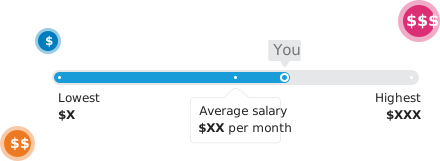
Get an estimated calculation of how much you should be earning and insight into your career options.
What Is the Cost of Living Near Austin?
| Expense Category | Estimated Monthly Cost | Key Considerations / Notes |
|---|---|---|
| Housing (1-BR Apt Rent) | $1,600 - $2,500+ | A significant portion of Texas School for the Deaf salary. Location choices impact this heavily. |
| Utilities (Basic) | $130 - $220 | Electricity, Heating, Cooling, Water etc. |
| Public Transportation | $41.25 (CapMetro monthly pass) | Essential for most commuters; car ownership is costly. |
| Groceries (Single Person) | $440 - $650 | Can be higher with more dining out or specialty stores. |
| Personal & Leisure | $500 - $950+ | Dining out, entertainment, shopping. Highly variable. |
| Healthcare (Individual) | $400 - $750+ | Varies significantly by plan & employer contribution. |
| Subtotal (Excluding Taxes) | $3,111 - $5,071+ | This subtotal does not include income taxes (federal, state, local), which can significantly impact your take-home pay. |
FAQs of Texas School for the Deaf
1. What is the typical salary range (low to high) for most roles at Texas School for the Deaf?
The typical salary range for most roles at Texas School for the Deaf is approximately from $39 to $51 per hour. It's important to remember that these are overall averages, actual salaries vary significantly based on specific job titles, years of experience, skills, and location.
2. How much does Texas School for the Deaf pay compared to Episcopal School of Dallas?
The average annual salary at Texas School for the Deaf is $92,601, or an hourly wage of $45, in comparison to Episcopal School of Dallas which pays $93,613 per year or $45 per hour.
3. Do salaries differ significantly between departments at Texas School for the Deaf?
Yes, salaries often differ between departments at Texas School for the Deaf due to varying market demand for specific skill sets and the nature of the roles. For example, technical roles in Engineering or IT may command different salary ranges compared to roles in Marketing or Human Resources.
4. How does experience level affect salary at Texas School for the Deaf?
Experience level is a significant factor in determining salary at Texas School for the Deaf, as it is with most employers. Generally, employees with more years of relevant experience and a proven track record can command higher salaries. For example, a senior-level role will typically have a higher pay band than an entry-level or mid-career position within the same job family.
5. How can I determine if a salary offer from Texas School for the Deaf in Austin is fair given the local cost of living?
To determine if a salary offer from Texas School for the Deaf in Austin is fair, first compare the gross salary to our data for similar roles at Texas School for the Deaf and its competitors (see our similar company salaries section) . Then, critically, use our "Cost of Living Insights for Austin" to understand its purchasing power.
6. What factors influence salary increases at Texas School for the Deaf?
Salary increases at Texas School for the Deaf are likely influenced by a combination of factors, including: individual employee performance against set goals, overall company performance and profitability, budget availability, changes in the market rate for similar roles (market adjustments), and sometimes cost-of-living increases.
For Employer
The trusted data and intuitive software your organization needs to get pay right.
Explore CompAnalyst ®Enhance your organization's compensation strategy with salary data sets that HR and team managers can use to pay your staff right.
Surveys & Data SetsReal-time global intelligence that empowers you to make competitive pay decisions and align offers with global trends.
SalaryIQTMIf your compensation planning software is too rigid to deploy winning incentive strategies, it’s time to find an adaptable solution.
Compensation Planning