Twin Cities Habitat Salary

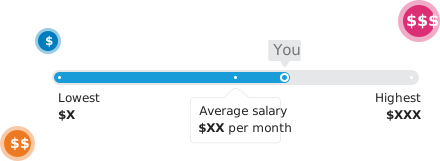
As of August 2026, the average hourly salary for employees at Twin Cities Habitat in the United States is $48. This translates to an approximate annual wage of $100,006. Salaries at Twin Cities Habitat typically range from $42 to $55 hourly, reflecting the diverse roles and experience levels within the company.
How accurate does the salary look to you?

Is Twin Cities Habitat’s Pay Competitive? Salary Benchmarking Analysis

How does Twin Cities Habitat's compensation stack up against the industry and its key competitors? Our salary benchmarking analysis provides a clear comparison. The chart below visualizes this comparison alongside select peer companies.
Competitor / Benchmark Avg. Salary Variance Primary Market Influence Factor & Explanation
The ARRT $48
+0.5%
Confirms The ARRT is a direct competitor vying for the exact same talent pool.
Three Rivers Elementary School $44
-9.0%
Typical compensation structure for smaller regional agencies like Three Rivers Elementary School.
Central Kentucky Community Action Council Inc $41
-15.5%
Central Kentucky Community Action Council Inc focuses strategically on recruiting and training entry-level apprentices.
Jubilee 2000 $45
-5.9%
Jubilee 2000 likely leverages performance bonuses over the high base salary shown here.
Edu., Gov't. & Nonprofit Industry $56
+15.3%
Pay variances are driven by organizational scale, specialized skill requirements, or geographic cost-of-living factors.
Need More Granular Data? The analysis above provides a high-level market overview. To benchmark specific job codes, adjust for real-time cost-of-living changes, or access verified HR-reported datasets, upgrade to Salary.com for Business. Precision matters when building your compensation strategy.

Employee Reviews: Working at Twin Cities Habitat

Considering a career at Twin Cities Habitat? Explore authentic employee reviews to learn about the work environment, career growth opportunities, pay transparency and benefits. These first-hand insights can help you set realistic compensation expectations and make informed career decisions.
This organization fosters a strong sense of community, emphasizing employee growth, collaboration, and professional development. Leadership is visionary yet approachable, always willing to listen to frontline educators. This education system demonstrates what happens when an organization truly values its people. Most tasks follow strict procedures and require multiple levels of approval.
Leadership fosters an inclusive environment where every voice matters. After 15 years in education, joining this organization was a revelation. The culture is rooted in accountability, service, and professionalism. Structure exists without being stifling. The focus on public service and education creates a fulfilling atmosphere. Whether it's a formal award or a simple thank you from a supervisor, ...
There’s good infrastructure for training and development. Leadership is approachable, though promotions tend to move. Training initiatives are regular and relevant, enhancing skills. I’ve had several interactions with this group, and every one has been positive.
Leadership provides clear direction and encourages personal development. Proactive cybersecurity. Extremely courteous and thorough in all interactions.

Twin Cities Habitat Overview

Website
www.tchabitat.org
Founded In
1985
Employees
100 - 200 employees
Industry
Edu., Gov't. & Nonprofit
Headquarter Address
1954 University Ave W Saint Paul Minnesota MN 55104
Revenue
$10 Million - $50 Million
Phone Number
+1 6512071700
Social Media
About Twin Cities Habitat
Twin Cities Habitat is a nonprofit committed to building the quality of life, health and prosperity of the 7-county metro region through the production and preservation of homeownership because homes and families are the foundation of successful communities. This video explains the partnerships we count on to accomplish our mission.

What Benefits Does Twin Cities Habitat Offer Beyond Salary?

A competitive compensation package is more than just a salary. Twin Cities Habitat offers a comprehensive benefits package designed to support your health, financial future, and overall well-being. Below are the most common key benefits:
Social Security
401(K)
Disability
Healthcare
Pension
Time Off (days)
Work at Twin Cities Habitat?
Share your experience
How Much Should You Be Earning?

Get an estimated calculation of how much you should be earning and insight into your career options.

illustration

What Is the Cost of Living Near Saint Paul?

Understanding the cost of living near Saint Paul is key to truly evaluating a salary offer or your current compensation at Twin Cities Habitat.
Saint Paul's Cost of Living Index is approximately 101.5 (1.5% more expensive than US average; 4.5% more than MN average). State capital, slightly more affordable housing than Minneapolis. Metro Transit. When planning your budget based on a salary from Twin Cities Habitat, consider these typical monthly expenses:
Expense Category Estimated Monthly Cost Key Considerations / Notes
Housing (1-BR Apt Rent) $1,300 - $1,900+ A significant portion of Twin Cities Habitat salary. Location choices impact this heavily.
Utilities (Basic) $130 - $230 (Heating significant) Electricity, Heating, Cooling, Water etc.
Public Transportation $120 (Metro Transit monthly pass) Essential for most commuters; car ownership is costly.
Groceries (Single Person) $420 - $620 Can be higher with more dining out or specialty stores.
Personal & Leisure $400 - $750+ Dining out, entertainment, shopping. Highly variable.
Healthcare (Individual) $380 - $700+ Varies significantly by plan & employer contribution.
Subtotal (Excluding Taxes) $2,750 - $4,200+ This subtotal does not include income taxes (federal, state, local), which can significantly impact your take-home pay.

FAQs of Twin Cities Habitat

1. What is the estimated average total compensation at Twin Cities Habitat?

Salary.com estimates that the average total compensation package at Twin Cities Habitat, which can include base salary, potential bonuses, and benefits, is around $48 per hour . Total compensation provides a more holistic view of an employee's earnings.

2. How much does Twin Cities Habitat pay compared to The ARRT?

The average annual salary at Twin Cities Habitat is $100,006, or an hourly wage of $48, in comparison to The ARRT which pays $100,522 per year or $48 per hour.

3. Do salaries differ significantly between departments at Twin Cities Habitat?

Yes, salaries often differ between departments at Twin Cities Habitat due to varying market demand for specific skill sets and the nature of the roles. For example, technical roles in Engineering or IT may command different salary ranges compared to roles in Marketing or Human Resources.

4. What's the typical salary progression for an employee moving from an entry-level to a senior role at Twin Cities Habitat?

Salary progression from an entry-level to a senior role at Twin Cities Habitat can be significant, often involving several promotions and substantial pay increases. For example, an entry-level Analyst might see their salary potentially double or more as they progress to a Senior Manager or Director position over several years, assuming strong performance and development.

5. How can I determine if a salary offer from Twin Cities Habitat in Saint Paul is fair given the local cost of living?

To determine if a salary offer from Twin Cities Habitat in Saint Paul is fair, first compare the gross salary to our data for similar roles at Twin Cities Habitat and its competitors (see our similar company salaries section) . Then, critically, use our "Cost of Living Insights for Saint Paul" to understand its purchasing power.

6. Are promotions at Twin Cities Habitat usually accompanied by a significant salary increase?

Yes, promotions at Twin Cities Habitat are generally accompanied by a salary increase. The amount of the increase typically reflects the greater responsibilities, skills, and scope of the new role. The percentage increase can vary widely depending on the level of promotion and the company's compensation structure.