


Save the Dunes Salary


How Much Does Save the Dunes Pay for Different Roles?
President
$656,962 / year
Salary Range: $499,841 - $837,853
Executive

Executive Director
$155,079 / year
Salary Range: $136,822 - $174,022
Product Development
Program Director
$118,785 / year
Salary Range: $94,320 - $153,703
Program Leadership
Director, Development
$93,537 / year
Salary Range: $75,513 - $120,463
Development and Fundraising Senior Management
Bookkeeper
$34,377 / year
Salary Range: $30,950 - $37,774
Bookkeeping
 Thanks for your feedback!
Current Job Openings at Save the Dunes
Is Save the Dunes’s Pay Competitive? Salary Benchmarking Analysis
| Competitor / Benchmark | Avg. Salary | Variance | Primary Market Influence Factor & Explanation |
|---|---|---|---|
| Grace Bible Fellowship Church | $85,481 |
+0.7%
|
Reflects stabilized pricing equilibrium for commercial construction roles in this region. |
| Southview Christian School | $81,441 |
-4.0%
|
Typical compensation structure for smaller regional agencies like Southview Christian School. |
| Evergreen Church | $93,466 |
+10.1%
|
Influenced by prevailing union wage agreements specific to Evergreen Church's sector. |
| Wiregrass Children's Home | $75,924 |
-10.5%
|
Wiregrass Children's Home likely leverages performance bonuses over the high base salary shown here. |
| Edu., Gov't. & Nonprofit Industry | $115,341 |
+35.9%
|
Pay variances are driven by organizational scale, specialized skill requirements, or geographic cost-of-living factors. |
How Save the Dunes's Salaries Compare to Similar Companies?
Grace Bible Fellowship Church
$85,481 / year
Salary Range: $74,747 - $97,807
Melissa, TX
Southview Christian School
$81,441 / year
Salary Range: $71,219 - $93,186
Statesville, NC
Evergreen Church
$93,466 / year
Salary Range: $81,739 - $106,953
Bothell, WA
Wiregrass Children's Home
$75,924 / year
Salary Range: $66,399 - $86,882
Dothan, AL
Colorodans of Longmont Inc
$88,498 / year
Salary Range: $77,386 - $101,258
Longmont, CO
Defeating Epilepsy Foundation
$89,879 / year
Salary Range: $78,596 - $102,843
Rancho Cucamonga, CA
Mount Shasta Bioregional Ecology Center
$80,260 / year
Salary Range: $70,183 - $91,832
Mount Shasta, CA
Fadp
$77,823 / year
Salary Range: $68,048 - $89,040
Tallahassee, FL
Quaker Earthcare Witness
$101,398 / year
Salary Range: $88,666 - $116,025
Albany, CA
Employee Reviews: Working at Save the Dunes
Save the Dunes Overview
What Benefits Does Save the Dunes Offer Beyond Salary?
Get an estimated calculation of how much you should be earning and insight into your career options.
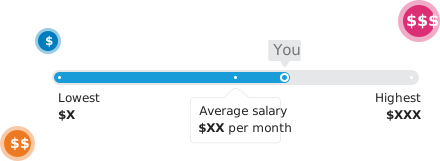
What Is the Cost of Living Near Chicago?
| Expense Category | Estimated Monthly Cost | Key Considerations / Notes |
|---|---|---|
| Housing (1-BR Apt Rent) | $1,700 - $2,600+ | A significant portion of Save the Dunes salary. Location choices impact this heavily. |
| Utilities (Basic) | $140 - $230 | Electricity, Heating, Cooling, Water etc. |
| Public Transportation | $105 (CTA 30-day pass) | Essential for most commuters; car ownership is costly. |
| Groceries (Single Person) | $430 - $640 | Can be higher with more dining out or specialty stores. |
| Personal & Leisure | $450 - $800+ | Dining out, entertainment, shopping. Highly variable. |
| Healthcare (Individual) | $400 - $750+ | Varies significantly by plan & employer contribution. |
| Subtotal (Excluding Taxes) | $3,225 - $5,025+ | This subtotal does not include income taxes (federal, state, local), which can significantly impact your take-home pay. |
FAQs of Save the Dunes
1. What is the typical salary range (low to high) for most roles at Save the Dunes?
The typical annual salary range for most roles at Save the Dunes is approximately from $74,215 to $97,112. It's important to remember that these are overall averages, actual salaries vary significantly based on specific job titles, years of experience, skills, and location.
2. How much does Save the Dunes pay compared to Grace Bible Fellowship Church?
The average annual salary at Save the Dunes is $84,869, or an hourly wage of $41, in comparison to Grace Bible Fellowship Church which pays $85,481 per year or $41 per hour.
3. Do salaries differ significantly between departments at Save the Dunes?
Yes, salaries often differ between departments at Save the Dunes due to varying market demand for specific skill sets and the nature of the roles. For example, technical roles in Engineering or IT may command different salary ranges compared to roles in Marketing or Human Resources.
4. How does experience level affect salary at Save the Dunes?
Experience level is a significant factor in determining salary at Save the Dunes, as it is with most employers. Generally, employees with more years of relevant experience and a proven track record can command higher salaries. For example, a senior-level role will typically have a higher pay band than an entry-level or mid-career position within the same job family.
5. How can I determine if a salary offer from Save the Dunes in Chicago is fair given the local cost of living?
To determine if a salary offer from Save the Dunes in Chicago is fair, first compare the gross salary to our data for similar roles at Save the Dunes and its competitors (see our similar company salaries section) . Then, critically, use our "Cost of Living Insights for Chicago" to understand its purchasing power.
6. Why might an individual's actual salary at Save the Dunes differ from the ranges shown here?
An individual's actual salary at Save the Dunes can differ from our estimated ranges due to various factors. These include their specific years of experience in the role, unique skills or certifications, educational background, performance record, the specific team or department they join, negotiation outcomes, and even the precise timing of when they were hired relative to market fluctuations. Our ranges represent typical compensation.
For Employer
The trusted data and intuitive software your organization needs to get pay right.
Explore CompAnalyst ®Enhance your organization's compensation strategy with salary data sets that HR and team managers can use to pay your staff right.
Surveys & Data SetsReal-time global intelligence that empowers you to make competitive pay decisions and align offers with global trends.
SalaryIQTMIf your compensation planning software is too rigid to deploy winning incentive strategies, it’s time to find an adaptable solution.
Compensation Planning