Blog
Get Pay Right on ADP Workforce Now® Next Gen™
Bringing trusted compensation intelligence and seamless planning to even more ADP users.
Written by Salary.com Staff
October 09, 2026

Managers can spot when performance is off, but the harder question is why. Does a team member need more training, stronger motivation, clearer direction, or simply more room to take ownership?
Our Skills Library helps with skills-based pay by quickly grouping similar jobs with the same skills.
The skill will matrix gives managers a practical way to separate an employee's capability from their willingness to perform a specific task. By looking at skill versus will, you can place employees into four quadrants and adjust your management approach accordingly.
This guide explains the skill vs will matrix, its four quadrants, and a six-step process for using it to support employee performance and development.
A skill will matrix is a 2x2 management and coaching framework that helps managers assess employees based on two factors: their ability to perform a particular task and their motivation to do it. By considering both dimensions, managers can better determine whether someone needs direction, coaching, encouragement, development, or greater autonomy.
Skill reflects the knowledge, experience, and competence needed to complete the task effectively, while will reflects motivation, confidence, engagement, and commitment. Plotting these dimensions creates four quadrants, each pointing to a different management approach rather than treating every performance issue the same way.
Clear skill expectations make these assessments more useful. Salary.com's Skills & Competency Library helps HR teams define job-specific skills, competencies, and proficiency expectations that can support more consistent employee assessment and development.
In a skill vs will matrix, skill asks whether an employee can perform the task, while will asks whether they are motivated and willing to perform it. Managers can consider experience, training, work quality, initiative, persistence, confidence, and engagement when making that distinction.
For example, a highly experienced employee may know exactly what to do but lack motivation, while a new team member may be fully engaged but still need training. Assessing skill and will in relation to the responsibility being considered helps managers avoid assuming that every performance problem is simply a lack of capability.
When skill and will are plotted together, the skill will matrix creates four quadrants that point to different management needs. The goal is not to label employees, but to help managers choose a leadership style that matches the employee's current capability and motivation.
| Quadrant | Employee characteristics | Typical management need |
|---|---|---|
| High skill, high will | Capable and motivated | Delegate, empower, and provide autonomy |
| High skill, low will | Capable but less motivated or engaged | Understand the cause, involve, motivate, and re-engage |
| Low skill, high will | Motivated but still developing capability | Coach, train, guide, and provide practice |
| Low skill, low will | Needs capability development and stronger motivation | Clarify expectations, provide direction, and support closely |
High-skill, high-will employees generally need less direct supervision and may be ready for challenging projects or greater ownership. High-skill, low-will employees need a different response because more training may not address the root cause of lower motivation.
For employees with low skill but high will, coaching, training, and frequent feedback can help build confidence and necessary skills. When both skill and will are low, managers may need clearer expectations, achievable goals, closer support, and regular check-ins as development progresses.
Quadrant placement should not be treated as permanent because skill levels and motivation can change with new responsibilities, experience, and other factors. Clear role expectations also make skill assessment more consistent, and JobArchitect® Max connects job architecture with skills frameworks, role expectations, and career paths to support more structured workforce development.
To use a skill will matrix effectively, start with a clearly defined task or responsibility. Assess skill and will separately before deciding what management approach or development support makes sense.
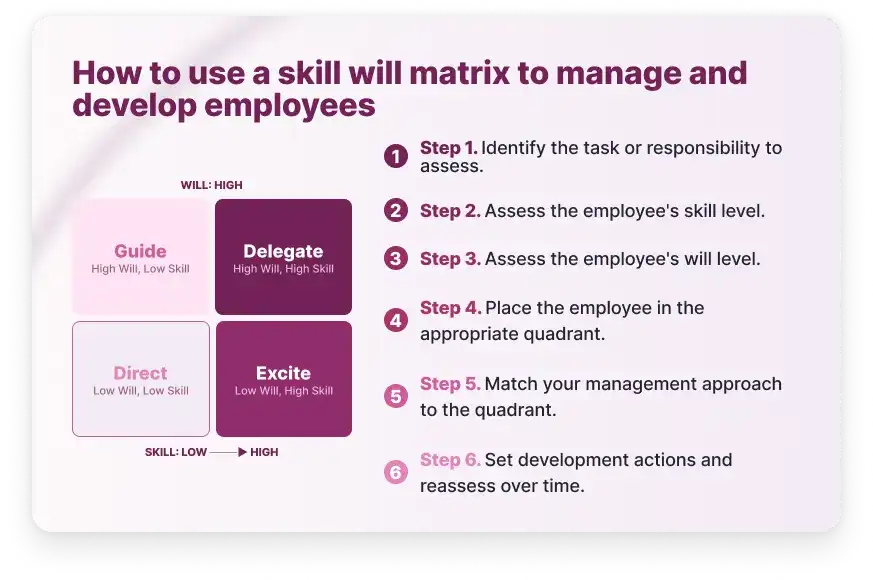
Choose the specific task, project, responsibility, or behavior you want to assess rather than rating the team member as a whole. For example, you might assess their ability to lead client presentations, manage a new project, supervise employees, or use a new system.
Next, clarify what successful performance looks like by setting clear expectations or standards for that responsibility. Keeping the assessment task-specific matters because a highly capable employee in one area may still need support when taking on new responsibilities.
Add skills and competency data from our Skills Library to attract the right candidates.
Evaluate whether the employee currently has the necessary skills to perform the task successfully. Consider recent performance, relevant experience, completed training, job knowledge, work quality, consistency, and how independently they can complete the responsibility.
Use observable evidence and specific examples where possible instead of relying only on manager perception. Salary.com's Skills & Competency Library provides structured competencies, proficiency levels, and behavioral indicators that can help organizations assess skills gaps and development needs more consistently.
Next, assess the employee's motivation, confidence, and willingness to take responsibility for the task. Look for signs such as initiative, interest, persistence, follow-through, enthusiasm, and engagement, keeping this assessment separate from capability.
If will appears low, talk with the employee before deciding why. Unclear expectations, workload concerns, frustration, limited recognition, lack of interest, or low confidence may all be factors worth understanding, and two-way conversations can help managers identify the right support.
Combine your assessments to determine the most reasonable placement: high skill/high will, high skill/low will, low skill/high will, or low skill/low will. Use recent performance evidence and employee conversations to support the decision.
Not every employee will fit neatly into one quadrant, so treat the matrix as a practical management aid rather than a rigid scoring system. Placement can also change as employees gain new skills, take on challenging projects, or experience changes in motivation.
Turn the assessment into action by adapting your management style to what the employee needs. High-skill/high-will employees can receive greater autonomy and stretch opportunities, while high-skill/low-will employees may need barriers addressed or renewed motivation rather than more training.
Low-skill/high-will employees generally benefit from coaching, training, demonstrations, practice, and frequent feedback. For low-skill/low-will employees, provide clearer direction and closer support while identifying whether the root cause involves skills gaps, motivation, role fit, or another factor.
Agree on specific next steps and define what progress should look like. Depending on the employee's needs, actions may include training, coaching, mentoring, practice opportunities, stretch assignments, clearer goals, additional feedback, or greater decision-making responsibility.
Revisit the assessment through regular check-ins and adjust the plan as the employee develops. The skill will matrix works best as part of an ongoing development conversation because employee growth can move someone from one quadrant to another over time.
A skill will matrix is most useful when managers need to decide whether an employee needs capability development, motivational support, greater autonomy, or a combination of these. Common situations include:
Performance conversations: Use the matrix to distinguish whether a performance gap is mainly related to skill, motivation, or both.
Coaching and development: Identify whether an employee needs training, feedback, encouragement, or greater responsibility.
New responsibilities or stretch assignments: Assess whether someone is ready to take ownership or still needs additional guidance.
Onboarding or role transitions: Identify where a new or transitioning team member may need skill development, clearer direction, or confidence-building.
Delegation: Determine when an employee is ready for greater independence and less direct supervision.
Team management: Adjust your leadership style based on individual team members' needs instead of managing everyone the same way.
The matrix should support, not replace, formal performance reviews, objective performance data, structured skills assessments, or employee feedback. Treat each quadrant as a working assessment rather than a permanent label, and discuss the employee's circumstances before deciding on the right intervention.
These common questions clarify the framework's origins, how it differs from related tools, and how managers can use it more effectively for employee development.
The skill will matrix is commonly associated with executive coach Max Landsberg, who presented the framework in The Tao of Coaching. Its underlying approach is also often linked to Paul Hersey and Ken Blanchard's earlier Situational Leadership model.
A skill will matrix considers both capability and motivation to help managers choose an appropriate coaching or development response. A skills matrix primarily maps employees' skills, expertise, and proficiency levels to identify capability coverage and gaps across individuals or teams.
Yes. Managers can use it to identify whether an employee may benefit from training, coaching, mentoring, stretch assignments, additional feedback, or greater autonomy as capability develops.
Repeated assessments can also show how development needs change over time. Employee goals, feedback, and objective performance information should still guide development decisions alongside the matrix.
That variation is normal because skill and will can be task-specific. An employee may be high skill/high will for established responsibilities but low skill/high will when learning a new system.
Assess each important responsibility separately instead of assigning one permanent quadrant to the employee. This keeps the framework focused on the support needed for the task at hand.

The latest research, expert advice, and compensation best practices all in one place.
Blog
Bringing trusted compensation intelligence and seamless planning to even more ADP users.

Blog
Learn how to train managers for effective pay conversations and build trust.

Blog
Total rewards package flexibility lets employees choose what matters - pay, perks, and benefits tailored to their needs.