Blog
Get Pay Right on ADP Workforce Now® Next Gen™
Bringing trusted compensation intelligence and seamless planning to even more ADP users.
Written by Salary.com Staff
June 20, 2025

In 2025, hiring bias continues to impact companies' ability to build diverse, inclusive, and effective teams.
According to a 2024 report, companies in the top quartile for ethnic diversity on executive teams were 36% more likely to outperform their peers on profitability. Yet, implicit bias and recruitment bias still prevent qualified candidates from underrepresented groups from securing jobs they are fully capable of performing.
To improve decision making and reduce turnover, hiring managers and HR professionals must adopt intentional strategies that minimize bias in every step of the hiring process. The steps outlined below will help reduce unconscious bias, improve diversity, and help organizations attract top talent from a wider range of backgrounds.
Hiring bias refers to prejudices or assumptions that influence the hiring decisions of recruiters, HR practitioners, or hiring teams. These biases can be conscious or unconscious, and they often lead to unfair or discriminatory practices during the recruitment process. Biases may emerge during resume screening, the interview process, or even at the final decision stage.
Some common characteristics targeted by bias include:
Race or ethnicity
Gender or gender identity
Age or younger applicants
Sexual orientation
Physical appearance or disability bias
Educational background or socioeconomic status
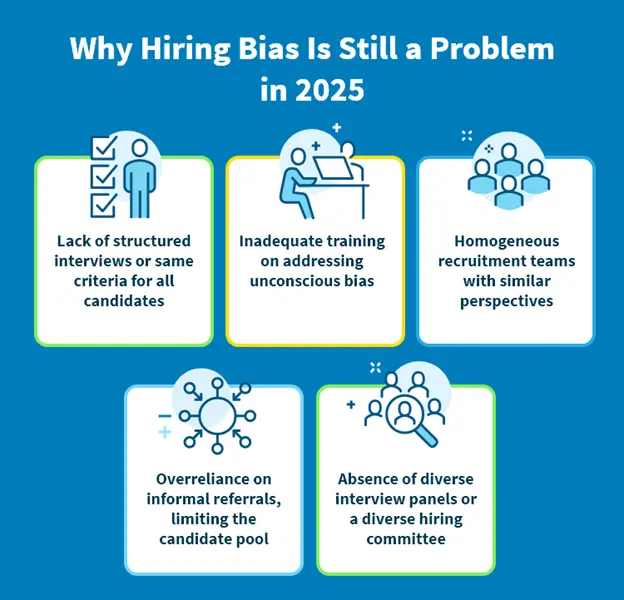
Despite increasing awareness, unconscious bias remains prevalent in today's hiring world. Many companies still rely on outdated methods that prioritize culture fit over actual skills or job requirements. Without structured frameworks, hiring teams often give too much weight to subjective opinions or personal preferences.
Factors contributing to ongoing bias include:
Lack of structured interviews or the same criteria for all candidates
Inadequate training on addressing unconscious bias
Homogeneous recruitment teams with similar perspectives
Overreliance on informal referrals limits the candidate pool
Absence of diverse interview panels or a diverse hiring committee
Understanding the types of bias that infiltrate the hiring process is critical for creating effective strategies to reduce them. These biases manifest in various ways, often without the hiring team’s awareness, and can disproportionately affect underrepresented groups, such as younger applicants or candidates with disabilities.
Gender bias: Assuming certain roles are better suited for specific genders, like favoring men for leadership positions.
Disability bias: Undervaluing candidates with disabilities due to misconceptions about their ability to perform.
Socioeconomic bias: Judging candidates based on their economic background, such as assuming wealthier candidates are more competent.
Affinity bias: Gravitating toward candidates who share similar hobbies, educational backgrounds, or cultural traits.
Confirmation bias: Focusing on information that supports an initial judgment, like giving too much weight to a single positive trait.
Examples of hiring bias highlight its impact on the recruitment process and the need for change. These scenarios demonstrate how biases can exclude qualified candidates and undermine diversity efforts.
Gender bias: A hiring manager assumes a female candidate lacks the assertiveness needed for a sales role, despite her strong track record.
Disability bias: A candidate with a visible disability is overlooked for a role requiring critical thinking, based on assumptions about their capabilities.
Affinity bias: A hiring team favors a candidate who attended the same university, even though another applicant has more relevant experience.
Confirmation bias: During a job interview, an interviewer focuses only on a candidate’s confident demeanor, ignoring gaps in their technical skills.
Socioeconomic bias: A candidate from a less affluent background is judged as less polished, despite having superior writing skills and qualifications.
To reduce bias in the hiring process, organizations must implement structured, evidence-based strategies that prioritize fairness and objectivity. Below are four actionable steps to create a more equitable recruitment process, ensuring all candidates are evaluated based on the same criteria.

Use a structured interview format where all candidates are asked the same questions in the same order. This allows for a fair comparison of candidates’ answers and reduces subjectivity. Create an evaluation rubric based on essential job requirements and allow multiple people on the hiring team to score each candidate.
Utilize online tools to automate scoring
Include work sample tests to assess real capabilities
Align interviews with legal guidelines to avoid discrimination
To streamline the management of structured job descriptions used in interviews, Centralized Command Center provides a single platform for creating, editing, and tracking job descriptions. This ensures that all interviewers access consistent, standardized job requirements, reducing subjectivity in evaluations.
A diverse hiring committee or diverse interview panels help bring different perspectives to the table. This reduces the likelihood of one-sided views affecting the outcome. Diverse teams are more likely to recognize and avoid unconscious bias when reviewing candidates.
Include committee members from different departments
Rotate interviewers to reduce personal bias
Train all hiring managers on diversity best practices
To enhance collaboration among diverse hiring teams, Collaboration Tools allow stakeholders from various departments to share and review job descriptions securely. This ensures diverse perspectives are incorporated into role definitions, reducing affinity bias.
Bias often starts before the interview stage with exclusionary job descriptions. Avoid gender-coded words, jargon, or qualifications that aren't tied to the role. Instead, focus on skills like writing, critical thinking, and real deliverables.
List only essential job requirements
Highlight inclusivity and a welcoming work environment
Mention openness to candidates of all gender identities, socioeconomic statuses, and sexual orientations
To create inclusive job descriptions, AI Writing Assistance uses AI to generate drafts with clear, inclusive language, avoiding gender-coded terms or unnecessary qualifications. This tool ensures job descriptions focus on essential skills and promote a welcoming environment.
Train your recruitment team, HR professionals, and hiring managers in recognizing and reducing unconscious bias. Use real-life scenarios, data, and simulations to build awareness and improve decision making.
Conduct annual refresher training
Use online tools for self-assessment
Encourage open discussions among committee members
To track the progress of job descriptions used in training scenarios, Status Dashboard provides real-time updates on job description workflows, ensuring training materials reflect current, inclusive roles.
Reducing bias in the hiring process is essential for attracting qualified candidates and promoting a diverse, productive workplace. Implementing structured practices and focusing on fairness, hiring managers and HR practitioners can make better hiring decisions and provide equal opportunity to every candidate, regardless of background. In 2025, it's not just about compliance—it's about building an organization that thrives on different perspectives and inclusive values.

The latest research, expert advice, and compensation best practices all in one place.
Blog
Bringing trusted compensation intelligence and seamless planning to even more ADP users.

Blog
Learn how to train managers for effective pay conversations and build trust.

Blog
Total rewards package flexibility lets employees choose what matters - pay, perks, and benefits tailored to their needs.