


Blog
Get Pay Right on ADP Workforce Now® Next Gen™
Bringing trusted compensation intelligence and seamless planning to even more ADP users.
Written by Salary.com Staff
October 23, 2026
Labor forecasting helps employers, HR teams, and finance leaders plan the right number of workers at the right time. It looks at past patterns and current signals to estimate future labor needs, so companies avoid both shortages and excess staff.
At the same time, effective labor forecasting uses historical data, sales data, and customer demand to set staffing levels that support business strategy while controlling overall labor costs. This process is essential for workforce planning and operational efficiency in any industry facing fluctuating demand.
Labor forecasting means estimating the number of workers a company will need in the weeks or months ahead. Employers use it to match staffing levels with projected customer demand and business demand.
The goal is to meet demand without paying too many employees or facing labor shortages that hurt service. As mentioned, it draws on past data, historical sales data, and external factors so leaders can make informed decisions about labor plans and the labor budget.
In simple terms, labor forecasting works by combining historical analysis with current demand signals. HR looks at sales data, customer demand, employee availability, turnover, and staffing levels to predict future labor needs. The result helps HR determine how many employees are needed for each period.
CompAnalyst® can support this plan by helping create market composites for roles and model salary structures. This is useful when a labor forecast identifies additional positions, and leaders need to understand the compensation impact of adding those roles.
Several forecasting methods help employers forecast labor demand with greater accuracy.
According to SHRM, quantitative methods that rely on historical sales and sales data remain the most common starting point for labor demand forecasting because they give clear numbers that finance teams can trust.
Analysis of trends (both current and past) in an industry can provide organizations with insight into long term labor trends and assist in planning future labor requirements.
Workforce forecasting methods that incorporate labor modeling with data on customer demand behavior perform best in situations involving weather delays and demand surges. Such methods leverage demand forecasting and demand-based forecasting.
When market research or complex labor laws indicate the possibility of abrupt changes in labor demand or when there is a lack of historical data, qualitative methods which use knowledge and judgment from department heads and project managers are used.
Many organizations have begun to utilize labor forecasting software or workforce forecasting software that uses the workforce forecasting equation with both real-time demand information and historical data to provide more up to date workforce forecasts.
CompAnalyst® helps organizations price jobs using compensation market data. This supports labor planning when employers need to estimate the compensation cost associated with future staffing requirements.
Workforce forecasting brings clear advantages for employers who want to reduce labor costs and improve operational efficiency while protecting customer satisfaction.
Effective workforce forecasting helps businesses determine the right staffing needs so they can reduce costs and avoid unnecessary labor cost that hurt the cost structure.
Accurate forecasting supports workforce management by aligning required labor with future labor needs and reducing the risk of labor shortages in growing sectors.
Workforce planning shows that strong forecasts lead to more stable schedules, higher employee satisfaction, and better ability to meet customer demand during fluctuating demand.
A common pitfall is relying only on past data without watching external factors or customer demand changes, which can leave teams with too many employees or too few when demand spikes arrive.
Another frequent issue is ignoring labor regulations and complex labor laws when building labor plans, which can create compliance problems and raise overall labor costs.
Employers can raise the quality of workforce forecasting by treating it as an ongoing part of business strategy rather than a one-time task.
Utilize data on past customer traffic, number of employees available, and past sales data on a regular basis to ensure labor forecasts are aligned to current business demand.
Perform quarterly reviews of sales forecasts and market trends to identify customer demand to proactively address labor shortages prior to their occurrence.
Employ workforce forecasting systems or scheduling systems that translate data-driven forecasts into labor plans and assist the workforce forecasting team in determining the amount of labor required.
Enhance overall performance by providing employees with training in historical and data analysis to enable all levels of the organization to detect demand and aid in cost management.
Tie labor forecasts to the labor budget and compare forecasts to actual labor utilization on a periodic basis to maintain integrity and promote an ongoing improvement in labor demand forecasting.
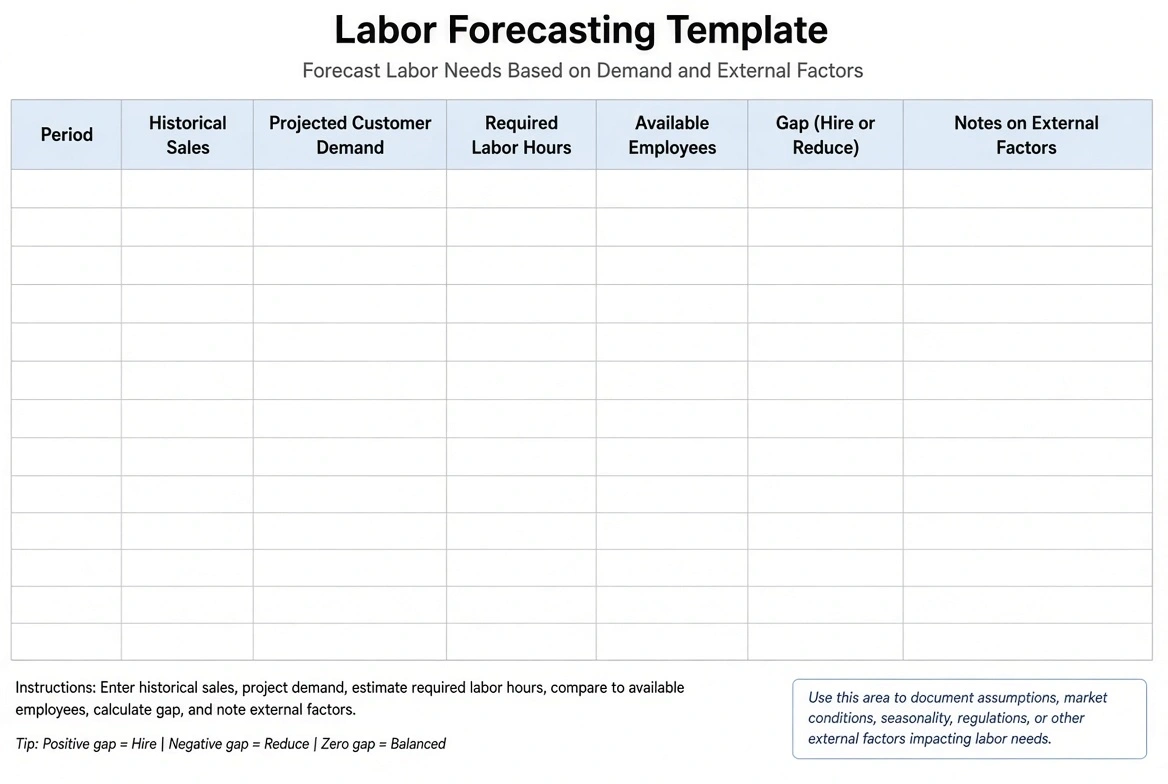
A practical workforce forecasting template used in strategic plans usually includes these columns for each week or month. Use the visual below as you're ready to fill out the template.
Here is a short real world style example for a retail store preparing for a busy season. The visual below shows the filled table.
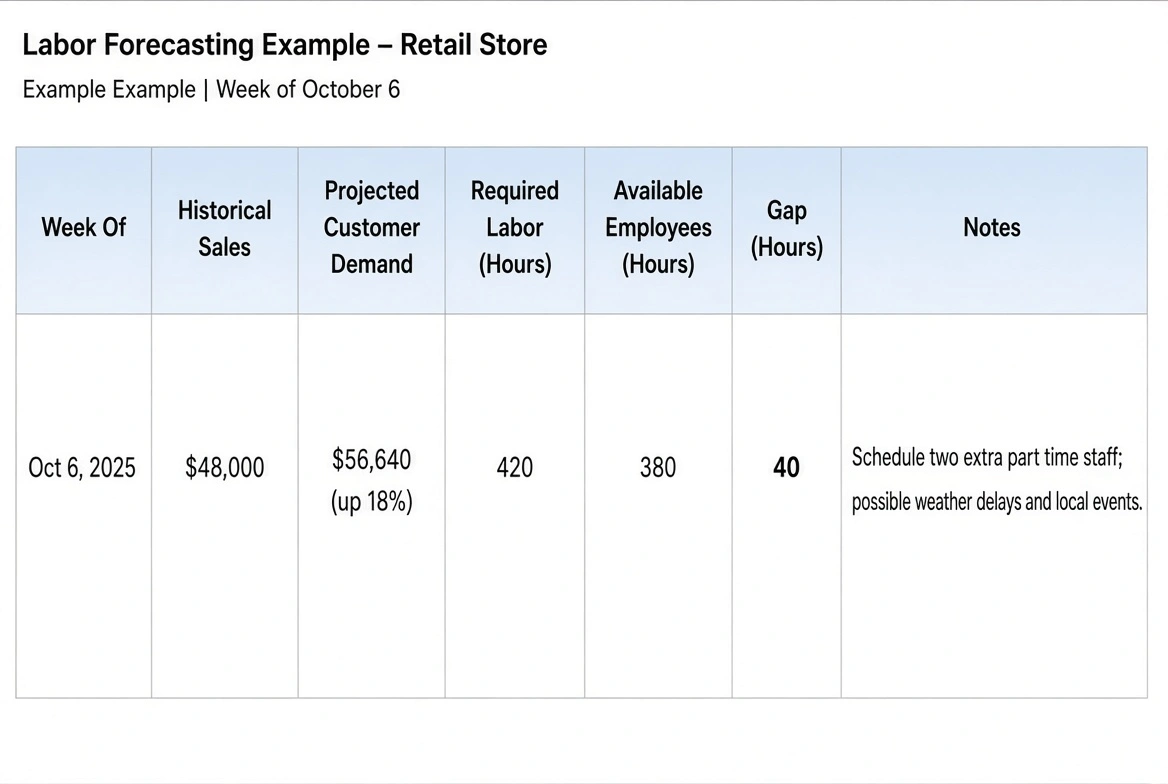
This example shows how workforce forecasting turns numbers into clear staffing decisions that protect operational efficiency and customer satisfaction.
Here are some FAQs for better understanding.
Qualitative forecasting uses managers' knowledge and experience instead of numerical data. In qualitative forecasting, HR managers talk to department managers, look at industry trends, market data, and use their knowledge to predict future staffing requirements.
This type of forecasting is helpful in situations where there are new labor laws that impose restrictions or fast change. It is also helpful when historical data is lacking.
Organizations also require an understanding of labor law, labor modelling, and workforce management. There is a requirement for the ability to translate forecasts into business strategy and to present clear business recommendations to the finance function using sound historical and data analysis.
Forecasting in the workforce is crucial for effectively managing workforce levels in relation to demand in a cost-effective manner. Work force forecasting provides the data needed by scheduling systems and plans to determine the number of workers required.
Effective workforce forecasting allows an organization to respond to changes in the demand for labor while also maintaining high levels of productivity and employee satisfaction. Long-term projections from the Bureau of Labor Statistics provide the need for workforce forecasting within an organization.

The latest research, expert advice, and compensation best practices all in one place.
Blog
Bringing trusted compensation intelligence and seamless planning to even more ADP users.

Blog
Learn how to train managers for effective pay conversations and build trust.

Blog
Total rewards package flexibility lets employees choose what matters - pay, perks, and benefits tailored to their needs.
