Epidemiology Salary

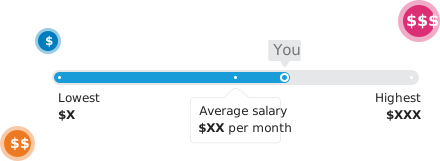
As of September 2026, the average annual salary for employees at Epidemiology in the United States is $93,856. This translates to an approximate hourly wage of $45. Salaries at Epidemiology typically range from $82,069 to $107,392 annually, reflecting the diverse roles and experience levels within the company.

How Much Does Epidemiology Pay for Different Roles?

Explore detailed salary information for specific jobs at Epidemiology. Based on our data, the highest paying job is the Doctor, with an annual salary of $198,563. The table below outlines the annual salary ranges for most popular roles within the company.
How accurate does the salary look to you?

Is Epidemiology’s Pay Competitive? Salary Benchmarking Analysis

How does Epidemiology's compensation stack up against the industry and its key competitors? Our salary benchmarking analysis provides a clear comparison. The chart below visualizes this comparison alongside select peer companies.
Competitor / Benchmark Avg. Salary Variance Primary Market Influence Factor & Explanation
Barack Obama Dba President United States $99,330
+5.8%
Reflects structural premiums typical of Barack Obama Dba President United States's large-cap national operations.
Purpose Prep Inc $85,702
-8.7%
Purpose Prep Inc operates with a leaner overhead structure, impacting base wage offers.
AutoCash Inc $80,386
-14.4%
Typical compensation structure for smaller regional agencies like AutoCash Inc.
Parenting Matters NJ $95,871
+2.1%
Aligns perfectly with prevailing regional benchmarks for this specific job family.
Edu., Gov't. & Nonprofit Industry $115,341
+22.9%
Pay variances are driven by organizational scale, specialized skill requirements, or geographic cost-of-living factors.
Need More Granular Data? The analysis above provides a high-level market overview. To benchmark specific job codes, adjust for real-time cost-of-living changes, or access verified HR-reported datasets, upgrade to Salary.com for Business. Precision matters when building your compensation strategy.

Employee Reviews: Working at Epidemiology

Considering a career at Epidemiology? Explore authentic employee reviews to learn about the work environment, career growth opportunities, pay transparency and benefits. These first-hand insights can help you set realistic compensation expectations and make informed career decisions.
Good intentions, but administrative speed varies. Most tasks follow strict procedures and require multiple levels of approval. Leadership is supportive, coworkers are collaborative, and there's a strong culture of service. Leadership actively listens and communicates openly, creating an environment where employees feel empowered to contribute to impactful public service projects.
Bureaucracy can sometimes delay progress. I’ve always appreciated their thoughtful approach to collaboration and public service. People care about each other here. Leadership fosters a culture of respect, inclusivity, and collaboration. There’s rarely pressure to overperform, but little recognition for going above expectations. An ideal blend of professionalism and empathy. It's a smart career cho...
Work-life balance is moderate but may depend heavily on role and manager. The people are committed to the mission, and the work directly impacts lives. Communication can be inconsistent across offices.

Epidemiology Overview

Website
www.epidemiolog.net
Founded In
1990
Employees
<25 employees
Industry
Edu., Gov't. & Nonprofit
Headquarter Address
3700 Reservoir Rd NW Washington District of Columbia DC 20007
Revenue
<$5 Million
Phone Number
+1 4047852000
Social Media
About Epidemiology
Epidemiology is a journal that publishes original research from all fields of epidemiology. It also welcomes review articles and meta-analyses, novel hypotheses, descriptions and applications of new methods, and discussions of research theory or public health policy. Epidemiology was founded in 1990 and is based in Atlanta, Georgia.

What Benefits Does Epidemiology Offer Beyond Salary?

A competitive compensation package is more than just a salary. Epidemiology offers a comprehensive benefits package designed to support your health, financial future, and overall well-being. Below are the most common key benefits:
Social Security
401(K)
Disability
Healthcare
Pension
Time Off (days)
Work at Epidemiology?
Share your experience
How Much Should You Be Earning?

Get an estimated calculation of how much you should be earning and insight into your career options.

illustration

What Is the Cost of Living Near Washington?

Understanding the cost of living near Washington is key to truly evaluating a salary offer or your current compensation at Epidemiology.
Washington D.C.'s Cost of Living Index is approximately 148.7 (48.7% more expensive than US average). Nation's capital, very high housing costs, extensive public transit (WMATA), high overall expenses. When planning your budget based on a salary from Epidemiology, consider these typical monthly expenses:
Expense Category Estimated Monthly Cost Key Considerations / Notes
Housing (1-BR Apt Rent) $2,200 - $3,300+ A significant portion of Epidemiology salary. Location choices impact this heavily.
Utilities (Basic) $150 - $250 Electricity, Heating, Cooling, Water etc.
Public Transportation $70-200+ (WMATA SmarTrip varies by use) Essential for most commuters; car ownership is costly.
Groceries (Single Person) $450 - $680 Can be higher with more dining out or specialty stores.
Personal & Leisure $500 - $900+ Dining out, entertainment, shopping. Highly variable.
Healthcare (Individual) $400 - $750+ Varies significantly by plan & employer contribution.
Subtotal (Excluding Taxes) $3,770 - $5,880+ This subtotal does not include income taxes (federal, state, local), which can significantly impact your take-home pay.

FAQs of Epidemiology

1. What is the typical salary range (low to high) for most roles at Epidemiology?

The typical annual salary range for most roles at Epidemiology is approximately from $82,069 to $107,392. It's important to remember that these are overall averages, actual salaries vary significantly based on specific job titles, years of experience, skills, and location.

2. How much does Epidemiology pay compared to Barack Obama Dba President United States?

The average annual salary at Epidemiology is $93,856, or an hourly wage of $45, in comparison to Barack Obama Dba President United States which pays $99,330 per year or $48 per hour.

3. Do salaries differ significantly between departments at Epidemiology?

Yes, salaries often differ between departments at Epidemiology due to varying market demand for specific skill sets and the nature of the roles. For example, technical roles in Engineering or IT may command different salary ranges compared to roles in Marketing or Human Resources.

4. How does experience level affect salary at Epidemiology?

Experience level is a significant factor in determining salary at Epidemiology, as it is with most employers. Generally, employees with more years of relevant experience and a proven track record can command higher salaries. For example, a senior-level role will typically have a higher pay band than an entry-level or mid-career position within the same job family.

5. How can I determine if a salary offer from Epidemiology in Washington is fair given the local cost of living?

To determine if a salary offer from Epidemiology in Washington is fair, first compare the gross salary to our data for similar roles at Epidemiology and its competitors (see our similar company salaries section) . Then, critically, use our "Cost of Living Insights for Washington" to understand its purchasing power.

6. Why might an individual's actual salary at Epidemiology differ from the ranges shown here?

An individual's actual salary at Epidemiology can differ from our estimated ranges due to various factors. These include their specific years of experience in the role, unique skills or certifications, educational background, performance record, the specific team or department they join, negotiation outcomes, and even the precise timing of when they were hired relative to market fluctuations. Our ranges represent typical compensation.