Mason Symphony Orchestra Salary

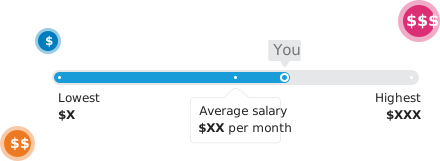
As of July 2026, the average annual salary for employees at Mason Symphony Orchestra in the United States is $94,816. This translates to an approximate hourly wage of $46. Salaries at Mason Symphony Orchestra typically range from $83,232 to $107,562 annually, reflecting the diverse roles and experience levels within the company.
How accurate does the salary look to you?

Current Job Openings at Mason Symphony Orchestra

Ready for your next career move? Explore current job openings at Mason Symphony Orchestra. Use the search tool below to find available positions by title and location and apply directly to start your career.

Is Mason Symphony Orchestra’s Pay Competitive? Salary Benchmarking Analysis

How does Mason Symphony Orchestra's compensation stack up against the industry and its key competitors? Our salary benchmarking analysis provides a clear comparison. The chart below visualizes this comparison alongside select peer companies.
Competitor / Benchmark Avg. Salary Variance Primary Market Influence Factor & Explanation
Peaches Kitchen & Bar $111,598
+17.7%
Supported by Peaches Kitchen & Bar's high-margin contracts allowing higher overhead.
Hotel Compliance $90,787
-4.2%
Hotel Compliance likely leverages performance bonuses over the high base salary shown here.
Shinedown $89,320
-5.8%
Shinedown may offer non-monetary perks in lieu of competitive base salaries.
TNS ENTERTAINMENT GROUP Inc $100,944
+6.5%
Influenced by prevailing union wage agreements specific to TNS ENTERTAINMENT GROUP Inc's sector.
Hospitality & Leisure Industry $122,562
+29.3%
Pay variances are driven by organizational scale, specialized skill requirements, or geographic cost-of-living factors.
Need More Granular Data? The analysis above provides a high-level market overview. To benchmark specific job codes, adjust for real-time cost-of-living changes, or access verified HR-reported datasets, upgrade to Salary.com for Business. Precision matters when building your compensation strategy.

Employee Reviews: Working at Mason Symphony Orchestra

Considering a career at Mason Symphony Orchestra? Explore authentic employee reviews to learn about the work environment, career growth opportunities, pay transparency and benefits. These first-hand insights can help you set realistic compensation expectations and make informed career decisions.
Helps new hires adapt quickly. The workplace culture is positive, with team-building activities that foster strong relationships. Training is adequate, though more hands-on learning would help. This company values its employees and it shows.
Highly recommend for those seeking a supportive and engaging workplace. The compensation is fair, and the schedule is consistent. A steady workplace for long-term employment. A forward-thinking company with great leadership. Leadership here is outstanding—they prioritize staff development and morale. While not the most fast-paced, it’s a secure option in the hospitality industry.
Flexible schedules and good benefits. The company is stable with a structured work environment. A top-tier employer in hospitality. The leadership team is supportive, and the workplace culture is inclusive.
While not cutting-edge, it’s a dependable place for hospitality careers. Love the dynamic environment. Stable job with good perks. This company is a great place to grow professionally. The managers are approachable and encourage open communication.
It’s a good option for those who prefer a steady routine in the leisure industry. My experience at this company has been steady. The company operates efficiently, and the policies are clear. Truly a great employer. The employee benefits, including health coverage, are a big plus.

Mason Symphony Orchestra Overview

Website
www.music.gmu.edu
Founded In
Data pending, update soon.
Employees
50 - 100 employees
Industry
Hospitality & Leisure
Headquarter Location
Revenue
$5 Million - $10 Million
Phone Number
-
Social Media
About Mason Symphony Orchestra
Mason Symphony Orchestra is a company that operates in the Education industry. It employs 51-100 people and has $5M-$10M of revenue.

What Benefits Does Mason Symphony Orchestra Offer Beyond Salary?

A competitive compensation package is more than just a salary. Mason Symphony Orchestra offers a comprehensive benefits package designed to support your health, financial future, and overall well-being. Below are the most common key benefits:
Social Security
401(K)
Disability
Healthcare
Pension
Time Off (days)
Work at Mason Symphony Orchestra?
Share your experience
How Much Should You Be Earning?

Get an estimated calculation of how much you should be earning and insight into your career options.

illustration

FAQs of Mason Symphony Orchestra

1. What is the average salary for employees at Mason Symphony Orchestra?

The average annual total compensation for employees at Mason Symphony Orchestra is approximately $94,816. However, this is an aggregate figure, actual salaries can range significantly, typically from $83,232 to $107,562, depending on factors like job role, experience, and location.

2. How much does Mason Symphony Orchestra pay compared to Peaches Kitchen & Bar?

The average annual salary at Mason Symphony Orchestra is $94,816, or an hourly wage of $46, in comparison to Peaches Kitchen & Bar which pays $111,598 per year or $54 per hour.

3. How does having a professional certification impact salary for relevant roles at Mason Symphony Orchestra?

Professional certifications like PMP (for Project Managers), CPA (for Accountants), or another relevant certification for the industry can often lead to higher salaries and better job prospects at Mason Symphony Orchestra for applicable roles. Certifications demonstrate a verified level of expertise and commitment to a profession, making candidates more competitive.

4. What's the typical process for salary reviews and raises at Mason Symphony Orchestra?

Most companies, likely including Mason Symphony Orchestra, conduct formal salary reviews annually, often tied to performance evaluations. During these reviews, factors like individual performance, meeting goals, company performance, and market adjustments are typically considered for potential salary increases.