Office of Hearing Operations Salary

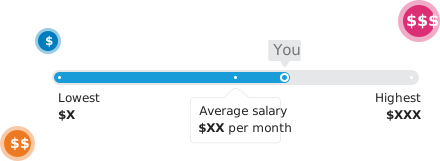
As of August 2026, the average annual salary for employees at Office of Hearing Operations in the United States is $78,540. This translates to an approximate hourly wage of $38. Salaries at Office of Hearing Operations typically range from $68,644 to $89,942 annually, reflecting the diverse roles and experience levels within the company.
How accurate does the salary look to you?

Is Office of Hearing Operations’s Pay Competitive? Salary Benchmarking Analysis

How does Office of Hearing Operations's compensation stack up against the industry and its key competitors? Our salary benchmarking analysis provides a clear comparison. The chart below visualizes this comparison alongside select peer companies.
Competitor / Benchmark Avg. Salary Variance Primary Market Influence Factor & Explanation
The Kentucky Board of Certification $86,536
+10.2%
Data suggests The Kentucky Board of Certification's workforce skews heavily towards veteran, high-tenure roles.
Hypoluxo Group Foundation $91,040
+15.9%
Supported by Hypoluxo Group Foundation's high-margin contracts allowing higher overhead.
Rhodes College $82,644
+5.2%
Reflects structural premiums typical of Rhodes College's large-cap national operations.
Ncs4 $81,747
+4.1%
Driven by niche technical certifications required for Ncs4's specialized projects.
Edu., Gov't. & Nonprofit Industry $115,341
+46.9%
Pay variances are driven by organizational scale, specialized skill requirements, or geographic cost-of-living factors.
Need More Granular Data? The analysis above provides a high-level market overview. To benchmark specific job codes, adjust for real-time cost-of-living changes, or access verified HR-reported datasets, upgrade to Salary.com for Business. Precision matters when building your compensation strategy.

Employee Reviews: Working at Office of Hearing Operations

Considering a career at Office of Hearing Operations? Explore authentic employee reviews to learn about the work environment, career growth opportunities, pay transparency and benefits. These first-hand insights can help you set realistic compensation expectations and make informed career decisions.
This shared commitment builds a strong, positive organizational culture and motivates us to perform our best daily. The meaningful public service work instills pride and purpose in daily responsibilities. Communication is professional and frequent, which helps maintain trust and efficiency across all levels. The culture values diversity and inclusivity, fostering collaboration and mutual respect. ...
Training and advancement opportunities exist, particularly for those proactive about growth. Work is predictable and relatively stress-free. Leadership is transparent and supportive. The work can be repetitive, but it feels worthwhile. There’s a strong culture of inclusion and respect here. While processes can be structured, there's also a willingness to innovate and evolve our services to remain ...
Technology adoption may take time. Leadership genuinely cares about employee well-being, and my team collaborates well. Even during high-pressure periods, the team stays focused and respectful. Not ideal for fast-paced personalities, but dependable for long-term employment.
Creative and inclusive strategies. Strong leadership and cohesive staff made a huge difference. You see the direct results of your efforts in improved educational outcomes or more efficient government operations. I’ve felt truly appreciated here.
Advancement depends more on tenure than skills. Change happens gradually. A positive example of how government and education teams should operate. Employees have access to continuous training and tuition assistance. Schedules are predictable, and vacation time is respected.

Office of Hearing Operations Overview

Website
Data pending, update soon.
Founded In
Data pending, update soon.
Employees
100 - 200 employees
Industry
Edu., Gov't. & Nonprofit
Headquarter Address
1150 S Green St Tupelo Mississippi MS 38804
Revenue
$10 Million - $50 Million
Phone Number
+1 8774705097
Social Media
About Office of Hearing Operations
Office of Hearing Operations is a company that operates in the Business Supplies and Equipment industry. It employs 101-250 people and has $25M-$50M of revenue. The company is headquartered in Tupelo, Mississippi.

What Benefits Does Office of Hearing Operations Offer Beyond Salary?

A competitive compensation package is more than just a salary. Office of Hearing Operations offers a comprehensive benefits package designed to support your health, financial future, and overall well-being. Below are the most common key benefits:
Social Security
401(K)
Disability
Healthcare
Pension
Time Off (days)
Work at Office of Hearing Operations?
Share your experience
How Much Should You Be Earning?

Get an estimated calculation of how much you should be earning and insight into your career options.

illustration

What Is the Cost of Living Near Tupelo?

Understanding the cost of living near Tupelo is key to truly evaluating a salary offer or your current compensation at Office of Hearing Operations.
Tupelo's Cost of Living Index is approximately 79.3 (20.7% less expensive than US average; 7.8% less than MS average). Elvis' birthplace, NE MS, affordable. Limited local transit. When planning your budget based on a salary from Office of Hearing Operations, consider these typical monthly expenses:
Expense Category Estimated Monthly Cost Key Considerations / Notes
Housing (1-BR Apt Rent) $700 - $1,100+ A significant portion of Office of Hearing Operations salary. Location choices impact this heavily.
Utilities (Basic) $150 - $250 Electricity, Heating, Cooling, Water etc.
Public Transportation Car-dependent Essential for most commuters; car ownership is costly.
Groceries (Single Person) $360 - $530 Can be higher with more dining out or specialty stores.
Personal & Leisure $280 - $550+ Dining out, entertainment, shopping. Highly variable.
Healthcare (Individual) $340 - $630+ Varies significantly by plan & employer contribution.
Subtotal (Excluding Taxes) $1,860 - $3,060+ This subtotal does not include income taxes (federal, state, local), which can significantly impact your take-home pay.

FAQs of Office of Hearing Operations

1. What is the typical salary range (low to high) for most roles at Office of Hearing Operations?

The typical annual salary range for most roles at Office of Hearing Operations is approximately from $68,644 to $89,942. It's important to remember that these are overall averages, actual salaries vary significantly based on specific job titles, years of experience, skills, and location.

2. How much does Office of Hearing Operations pay compared to The Kentucky Board of Certification?

The average annual salary at Office of Hearing Operations is $78,540, or an hourly wage of $38, in comparison to The Kentucky Board of Certification which pays $86,536 per year or $42 per hour.

3. How does experience level affect salary at Office of Hearing Operations?

Experience level is a significant factor in determining salary at Office of Hearing Operations, as it is with most employers. Generally, employees with more years of relevant experience and a proven track record can command higher salaries. For example, a senior-level role will typically have a higher pay band than an entry-level or mid-career position within the same job family.

4. How can I determine if a salary offer from Office of Hearing Operations in Tupelo is fair given the local cost of living?

To determine if a salary offer from Office of Hearing Operations in Tupelo is fair, first compare the gross salary to our data for similar roles at Office of Hearing Operations and its competitors (see our similar company salaries section) . Then, critically, use our "Cost of Living Insights for Tupelo" to understand its purchasing power.

5. Are the salaries listed for Office of Hearing Operations on Salary.com pre-tax or after-tax?

All salary figures displayed for Office of Hearing Operations, including average base salary and estimated total compensation, are pre-tax amounts. They do not account for federal, state, or local income taxes, nor deductions for benefits like health insurance or 401(k) contributions.