Blog
Get Pay Right on ADP Workforce Now® Next Gen™
Bringing trusted compensation intelligence and seamless planning to even more ADP users.
Written by Salary.com Staff
June 06, 2025

Incorporating minimum to maximum salary range in job postings is a common thing nowadays. It allows talents to know the monetary compensation for a specific role as it is one of their key motivators in working.
It is important to have a structured pay system where employee pay is transparent and backed with the current market data. To do that, start off by establishing robust salary ranges for job positions.
Read on as we further discuss how to establish salary ranges, their differences from salary bands, types of salary structures, salary range examples and benefits, and best practices in building one.
A salary range is a scope of numbers, which indicates the minimum and maximum amount employees receive as compensation. For example, the salary range for an entry-level accountant in United States is $56,000 to $89,000.
To ensure that pay equity is practiced in a company’s salary structure, range spreads are reported using the minimum, midpoint, and maximum value of the pay rate. A good range spread is usually around 40% to 65% depending on the level and industry.
So, what is the formula for salary range spread? To calculate, you can use: Salary range spread = (Maximum pay – Minimum pay) ÷ Minimum pay
Another way to guarantee an equitable salary is to leverage benchmark pay ranges through Compensation Software. It has a job range wizard feature that maintains specific ranges for each employee, maps with the latest market rate and salary survey data and assesses and model pay changes in your organization.
Pay range and salary bands are often used interchangeably, but they have individual distinctions that both contribute to the organization's compensation strategy. To identify their differences, here is a list of their definition and uses:
| Pay range | Salary band | |
| Definition | Span of compensation values from minimum to maximum that employees get for their job role or position | Broader category where job positions with similar responsibilities and qualifications are grouped, and every band has own pay range |
| Uses | Having pay ranges determine the amount to offer to a new hire or how much salary increase is given for promoted or reviewed employees | Creating salary bands helps in standardizing pay structures and ensuring pay equity in large organization or government agencies |
| Example | The pay range for a tanker driver is between $45,000 to $100,000 per year. The least experienced or new hires will receive a minimum salary of $45,000 while expert drivers can earn as much as $100,000. | The logistics team has salary bands of 1 to 5. Entry-level drivers, checkers, and forwarders belong to Band 1 with the same pay range of $45,000. Managerial positions like warehouse manager and transportation manager belong to Band 4 with the same pay range of $92,000. |
Since there are different kinds of pay structures in an organization, it is better to discuss them first before learning how to establish salary ranges. Here are some of the common types of salary structures:
Traditional salary structure
The salary increases alongside job evaluation and promotion. Employees who moved up to the job hierarchy due to seniority, performance, or experience will experience a boost in their compensation package.
Graded salary structure
Job positions with similar value are categorized into grades. Employees who perform well can advance into higher grades yearly or bi-yearly.
Step salary structure
The employee compensation is based on the years a worker serves the organization. This is usually for careers with little room for advancement, so workers are rewarded for their loyalty and dedication.
Broadband salary structure
More flexible than the traditional structure, broadband salary has fewer pay grades with a broader range, which gives more scope in determining the salary range for workers.
Market-based salary structure
The pay structure is based on the current job market trend of the job position and geographical location. The pay rates are matched with competitors to attract top talents.
Skill-based salary structure
An employee's salary is dependent on their skills and capabilities instead of their job title and level of experience.
Flat salary structure
This promotes equal salary rate for all employees, which means seniority, job position, and experience have no bearing. Incentives may be based on performance, but there is the same base salary for everyone.
Knowing how to establish salary ranges brings value to the organization in a lot of ways. Here are the details of the benefits of salary ranges:
Open company culture
Salary ranges promote pay transparency, which is better in maintaining objective compensation management and an open and accountable company culture.
Easy resource allocation
An overview of the range of compensation given to employees gives companies insights on budgetary needs, which leads to better labor cost forecasting and allocation of resources and expenses.
Competitiveness in the market
With a market-based pay range, the company can keep up with competitors when it comes to attracting job candidates and retaining current employees as the pay strategy aligns with the current talent trends.
Better employee experience
Salary transparency lets employees know they are paid fairly, improving satisfaction. Satisfied employees lead to more engagement, motivation, and productivity.
Opportunities for career growth
A well-defined salary structure helps employees and HR professionals navigate professional development conversations alongside promotion and salary increases.
Part of making sure that your company’s compensation program is aligned with employee management and company goals is knowing how to establish salary ranges. Here are 6 steps you can follow to set a good and equitable pay structure:
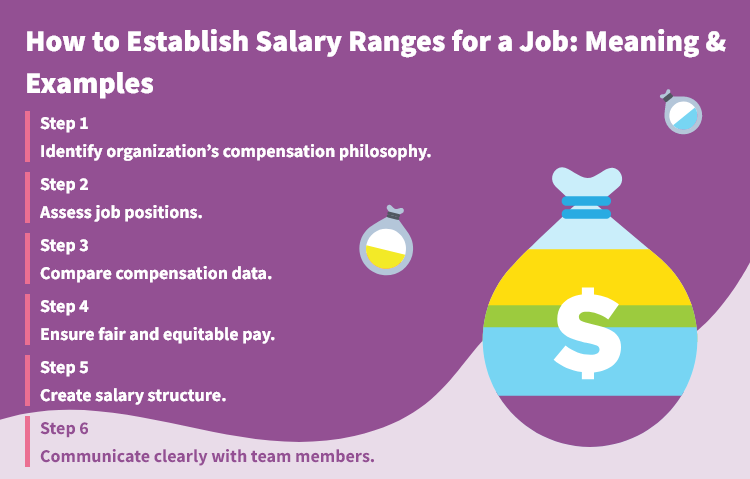
Examine the approach of your compensation structures and how they align with the company goals and values. Compensation philosophy helps businesses make smart pay decisions while maintaining business objectives and employee satisfaction.
Clearly define all job positions and responsibilities in the organization. Analyze the required skills and knowledge for each role. Then, consider job levels like experience, education, and other qualifications. This will help you assign appropriate compensation levels.
Conduct market research on salary ranges from factors like location and industry across companies and competitors. This ensures that your compensation plan has a competitive edge in attracting and retaining the best talents.
Make sure that pay equity is imposed in the making of your company’s salary ranges. Assess if there are pay inconsistencies in every team and employee and analyze how to avoid these disparities. Make salary increases based on performance and experience instead of biases.
Define and create pay grades, pay ranges, and job positions. Outline the minimum, midpoint, and maximum salary levels, administer salary talks, and ensure that the salary structure increases below-earning workers and levels the above-earning ones for fair pay.
Help employees understand the new salary structure. Provide a clear and comprehensive conversation about the salary ranges, present valuable data to support them, and explain how this reflects your compensation philosophy for company and employee growth.
The steps in how to determine salary ranges are made easier with the Market Pricing tool, giving you equitable insights into the latest market trends. It helps you adjust compensable factors like skills and education and customize pay markets with various industries, location, and company sizes globally.
Here are a few salary range examples to give you an overview of what it looks like:
Salary range example 1
Job title: Analytical Chemist
Job level: Entry
Skills: Quality control, spectroscopy, chemical analysis
Salary range: $52,000 - $95,000
Median salary: $68,000
Salary range example 2
Job title: Auditing Manager
Job level: Managers
Skills: Accounting, internal audit, and auditing
Salary range: $102,000 - $158,000
Median salary: $129,000
Establishing defined salary ranges for all the roles in the organization can be a daunting job, especially if the company culture is still in its infant stage. However, there are best practices that you can do to make an effective salary structure. Here are some of them:
Ensure a thorough job analysis to clearly define vital skills, experience, and knowledge for all job positions.
Determine comparable positions and establish a benchmarked salary range.
Promote reward and recognition programs for employees with good performance.
Give training opportunities and support for managers to have an efficient administration of transparent salary ranges and structure.
Ask for constructive feedback from employees on the improvements needed for a better compensation decision in the company.
Ultimately, one of the most effective practices in building competitive salary ranges is by using accurate market data that encompasses a wide array of job titles, industries, and geographies. Establish the right pay range with Compensation Software and build a fair compensation structure for your employee and company success.

The latest research, expert advice, and compensation best practices all in one place.
Blog
Bringing trusted compensation intelligence and seamless planning to even more ADP users.

Blog
Learn how to train managers for effective pay conversations and build trust.

Blog
Total rewards package flexibility lets employees choose what matters - pay, perks, and benefits tailored to their needs.