Space Technology Association at Rutgers (STAR) Salary

How much does the Space Technology Association at Rutgers (STAR) Pay for employees?

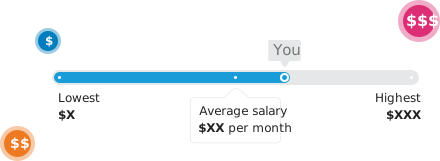
As of October 2026, the average annual salary for employees at Space Technology Association at Rutgers (STAR) in the United States is $99,721. This translates to an approximate hourly wage of $48. Salaries at Space Technology Association at Rutgers (STAR) typically range from $87,200 to $114,098 annually, reflecting the diverse roles and experience levels within the company. Space Technology Association at Rutgers (STAR)’s salaries are influenced by a wide range of factors including job role, department, years of experience, and location.
DISCLAIMER: The salary range presented here is an estimation that has been derived from our proprietary algorithm. It should be noted that this range does not originate from the company's factual payroll records or survey data.

How Much Does Space Technology Association at Rutgers (STAR) Pay for Different Roles?

Explore detailed salary information for specific jobs at Space Technology Association at Rutgers (STAR). The table below outlines the annual salary ranges for popular roles within the company, helping you benchmark potential earnings. Use 'View by Card/Table' option to find the data most relevant to your career path.
DISCLAIMER: The salary range presented here is an estimation that has been derived from our proprietary algorithm. It should be noted that this range does not originate from the company's factual payroll records or survey data.
How accurate does the salary look to you?

Current Job Openings at Space Technology Association at Rutgers (STAR)

Ready for your next career move? Explore current job openings at Space Technology Association at Rutgers (STAR). Use the search tool below to find available positions by title and location and apply directly to start your career.

Is Space Technology Association at Rutgers (STAR)’s Pay Competitive? Salary Benchmarking Analysis

How does Space Technology Association at Rutgers (STAR)’s compensation stack up against the market? This analysis visualizes their annual average salary compared to its industry benchmark and key peer companies.
Peer Company & Industry Benchmarking
120k
100k
80k
60k
40k
20k
0
Average Salary ($/year)
Space Technology Association at Rutgers (STAR)
Edu., Gov't. & Nonprofit
College of Community Association
National University Of Medical Sciences
Industry Comparison
Our data shows that, on average, compensation at Space Technology Association at Rutgers (STAR) is below the average for the U.S. Edu., Gov't. & Nonprofit industry by approximately 14%. This positioning suggests their pay is below the market average within their sector.
Peer Company Comparison
To provide a broader market perspective, we compared Space Technology Association at Rutgers (STAR) average annual salary with several similar companies. Space Technology Association at Rutgers (STAR) average salary of $99,721 is higher than College of Community Association, which has an average salary of $93,645. It is higher than National University Of Medical Sciences, with their average salary at $77,992. This places Space Technology Association at Rutgers (STAR) in a competitive position among its peers.
See Your True Competitors
The companies behind the question marks could be hiring your best people. Don't operate with incomplete data. Unlock your full competitive view with Salary.com for Business to precisely benchmark salaries, benefits, and more against your true competitors.

Employee Reviews: Working at Space Technology Association at Rutgers (STAR)

Considering a career at Space Technology Association at Rutgers (STAR)? Explore authentic employee reviews to learn about the work environment, career growth opportunities, pay transparency and benefits. These first-hand insights can help you set realistic compensation expectations and make informed career decisions.
Professional growth is prioritized through meaningful development opportunities. Colleagues are cooperative and respectful. Clear communication and respectful engagement every step of the way. What makes this education system exceptional is its ability to leverage scale while nurturing individual potential. Career growth can take time, and there’s a preference for internal hiring.
Reliable employment, but innovation is often stifled by red tape. Coworkers are respectful, and management is supportive within defined limits. Benefits and work-life balance are major pluses. The meaningful work we do in public service provides a strong sense of purpose and pride. It’s a good fit for someone looking for long-term stability and it is for those seeking fast-paced challenges or inno...
This combination creates a positive workplace culture focused on both professional growth and meaningful community impact. Team is structured and it is always flexible. It's a smart career choice for stability. Positive workplace culture encourages innovation and creative problem-solving. People care about each other here.

Space Technology Association at Rutgers (STAR) Overview

Website
Data pending, update soon.
Founded In
2017
Employees
<25 employees
Industry
Edu., Gov't. & Nonprofit
Headquarter Address
98 Brett Rd D Wing Piscataway New Jersey NJ 08854
Revenue
<$5 Million
Phone Number
-
Social Media
About Space Technology Association at Rutgers (STAR)
Space Technology Association at Rutgers (STAR) is a company that operates in the Legal Services industry. It employs 11-20 people and has $0M-$1M of revenue. The company is headquartered in Piscataway, New Jersey.

What Benefits Does Space Technology Association at Rutgers (STAR) Offer Beyond Salary?

A competitive compensation package is more than just a salary. Space Technology Association at Rutgers (STAR) offers a comprehensive benefits package designed to support your health, financial future, and overall well-being. Below are the most common key benefits:
Social Security
401(K)
Disability
Healthcare
Pension
Time Off (days)
Work at Space Technology Association at Rutgers (STAR)?
Share your experience
How Much Should You Be Earning?

Get an estimated calculation of how much you should be earning and insight into your career options.

illustration

What Is the Cost of Living Near New Brunswick?

Understanding the cost of living near New Brunswick is key to truly evaluating a salary offer or your current compensation at Space Technology Association at Rutgers (STAR).
New Brunswick's Cost of Living Index is approximately 113.6 (13.6% more expensive than US average; 0.4% less than NJ average). Middlesex County (Rutgers Univ.), housing reflects student/faculty demand. NJ Transit, Rutgers buses. When planning your budget based on a salary from Space Technology Association at Rutgers (STAR), consider these typical monthly expenses:
Expense Category Estimated Monthly Cost Key Considerations / Notes
Housing (1-BR Apt Rent) $1,600 - $2,400+ A significant portion of Space Technology Association at Rutgers (STAR) salary. Location choices impact this heavily.
Utilities (Basic) $140 - $240 Electricity, Heating, Cooling, Water etc.
Public Transportation NJ Transit bus/rail, Rutgers buses free Essential for most commuters; car ownership is costly.
Groceries (Single Person) $440 - $660 Can be higher with more dining out or specialty stores.
Personal & Leisure $400 - $730+ Dining out, entertainment, shopping. Highly variable.
Healthcare (Individual) $400 - $740+ Varies significantly by plan & employer contribution.
Subtotal (Excluding Taxes) $3,020 - $4,770+ This subtotal does not include income taxes (federal, state, local), which can significantly impact your take-home pay.

FAQs of Space Technology Association at Rutgers (STAR)

1. What is the average salary for employees at Space Technology Association at Rutgers (STAR)?

The average annual total compensation for employees at Space Technology Association at Rutgers (STAR) is approximately $99,721. However, this is an aggregate figure, actual salaries can range significantly, typically from $87,200 to $114,098, depending on factors like job role, experience, and location.

2. How much does Space Technology Association at Rutgers (STAR) pay compared to College of Community Association?

The average annual salary at Space Technology Association at Rutgers (STAR) is $99,721, or an hourly wage of $48, in comparison to College of Community Association which pays $93,645 per year or $45 per hour.

3. What is the lowest salary at Space Technology Association at Rutgers (STAR)?

The lowest-paying job at Space Technology Association at Rutgers (STAR) is an Electrical Lead with a salary of $82,390 per year. The lowest- paying job depends heavily on the specific role, location, whether it's an hourly or salaried position, and if it's full-time, part-time, or an internship. Generally, entry-level positions might represent the lower end of the pay scale.

4. How does having a professional certification impact salary for relevant roles at Space Technology Association at Rutgers (STAR)?

Professional certifications like PMP (for Project Managers), CPA (for Accountants), or another relevant certification for the industry can often lead to higher salaries and better job prospects at Space Technology Association at Rutgers (STAR) for applicable roles. Certifications demonstrate a verified level of expertise and commitment to a profession, making candidates more competitive.

5. Does Space Technology Association at Rutgers (STAR) offer cost-of-living adjustments (COLA) for employees in high-cost areas like New Brunswick?

While some companies offer formal COLA, many, including potentially Space Technology Association at Rutgers (STAR), incorporate cost of living considerations into their overall salary structure for different locations rather than as a separate, itemized adjustment. This means their base pay bands for roles in high-cost cities like New York City are generally set higher to account for these local market factors.

6. What's the typical process for salary reviews and raises at Space Technology Association at Rutgers (STAR)?

Most companies, likely including Space Technology Association at Rutgers (STAR), conduct formal salary reviews annually, often tied to performance evaluations. During these reviews, factors like individual performance, meeting goals, company performance, and market adjustments are typically considered for potential salary increases.