Long Hours, Low Economic Output in Some Countries
Written by Salary SpecialistJanuary 23, 2026
The modern war for talent has created unprecedented opportunity and flexibility for experienced job-seekers and current employees. Still, as tech transforms the office and remote workers frolic in exotic locations, most folks are still focused on a simple agenda: put in work and get paid.
But everyone in this evolving workforce deserves a work environment that encourages them to aim for a higher purpose. Whether it’s knowing your individual work contributed to the company’s bottom line or indirectly made some positive difference in a client’s life, there’s power in labor beyond the paycheck. In a wider context, it keeps the economic wheels turning. You’ve seen the oversimplified cycle in movies and political speeches – create jobs, put people to work, stimulate the economy, and create more jobs.
More hours, more productivity, more economic output – right? Unfortunately, it’s not that simple.
Worldwide Look: Hours Worked vs. Gross Domestic Product
People in the United States might be curious where their state ranks according to "hard work". Here, we're widening the playing field and looking at 10 countries across the world, and considering economic output based on two data sets from the OECD:
- average number of hours worked by employees per year
- average gross domestic product generated per one hour of work
Average Hours Worked in 2017
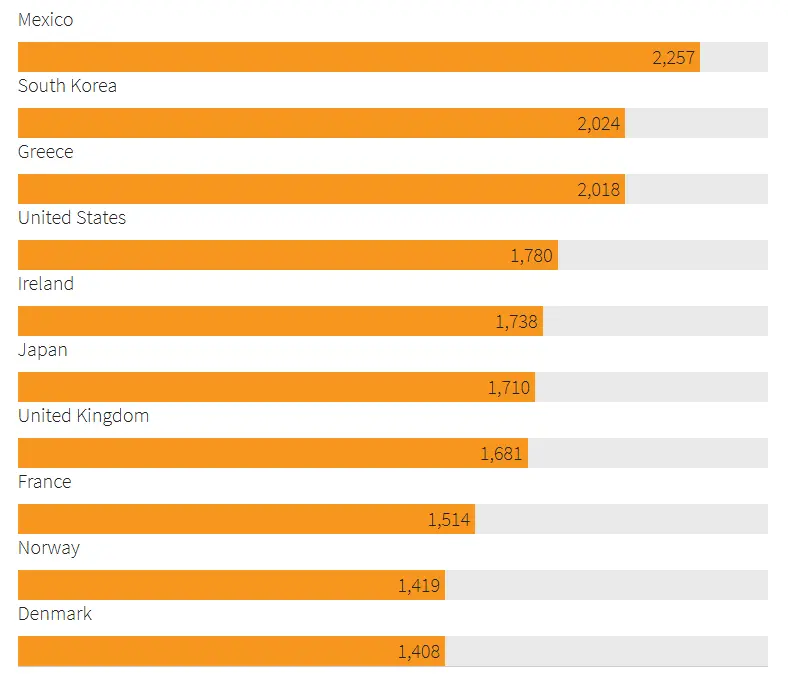
The first aspect of this - hours worked - varies significantly by country. Mexican workers - who rank 1st of all 37 countries for which the OECD tracks data - logged an average of 2,257 hours, or 43.4 hours per week, in 2017. On the other end of the spectrum, Danish folks logged an average of "just" 1,408 hours, or 27.1 per week.
The following chart represents average number of hours worked per employee in various countries in 2017:
Gross Domestic Product per Hour Worked
In our imperfect world, it's impossible for one hour of work to be universally equal. The complex, global market dictates that economic growth in each country will ebb and flow across various industries and at different rates overtime. But in many places, gaining full-time status or making a livable earning means logging a minimum amount of hours.
There's plenty of evidence to suggest that, say, the standard 40-hour workweek, is psychologically inefficient. When comparing the number of hours worked in each country and what each hour contributes to the gross domestic product, it appears the full-time tradition may be economically inefficient as well.
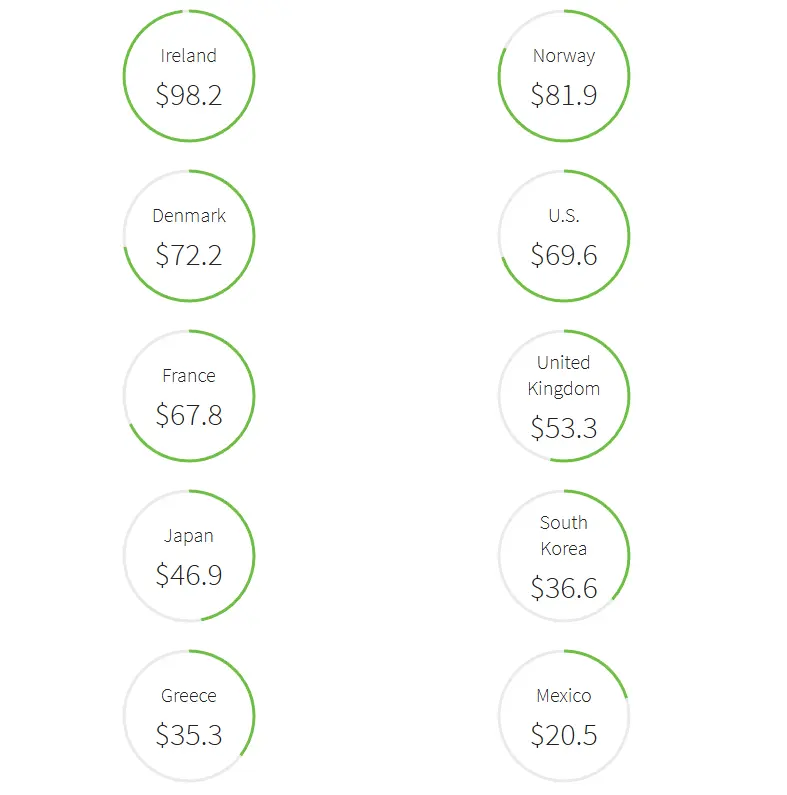
The following chart represents GDP per hour worked in various countries in 2017*, at current prices and purchasing power parity in U.S. dollars:
*2016 data is used for Japan and the United States
Long Hours are Not Necessarily Productive Hours
The inconsistencies here speak for themselves. Perhaps Mexico - which ranks first in hours worked, last in GPD growth at just $20.5 per hour worked, and guarantees just six federally-mandated paid days - raises the most questions about overworked employees and economic productivity.
In Norway, which ranks third-lowest of all 37 countries for hours worked in 2017 (an average of 1,408 or 27.1 hours per week), workers generated $72.2 towards GDP per hour worked - the third-highest on the list.
Some countries are actively aware of these inconsistencies, and are taking steps to decrease hours while increasing productivity. South Koreans, accustomed to a culture of long workweeks, logged an average of 2,024 hours (or 38.9 hours a week) in 2017, but churned out just $36.6 per hour worked to the GDP. Earlier this year, the National Assembly passed legislation which cut the maximum hours down from 68 to 52.
Workers in Japan didn't work quite as many hours (1,710 or 32.9 hours a week), but rank similarly on GDP growth at $46.9. On the backdrop of an aging and shrinking workforce, and with support from the government, many businesses in Japan have adopted the phrase hatarakikata kaikaku or "work style reform", which hopes to build a culture around work-life balance and cut down on overtime. For instance, employers might turn the lights off in the office at a certain time to tell workers that it's time to leave.
A Question of Purpose
The economics behind hours worked and GDP growth are fascinating, but this data raises a lot of questions about how folks, in whichever industry and country they are employed, can maximize their productivity. Even more importantly, how does the full-time landscape and this economic picture impact our sense of purpose? In the modern war for talent, it's never been more important for employees to find a higher calling - whether that has money signs around it or not.
Looking for a job that takes care of you with equitable pay and allows you to contribute to a bigger picture? Know your worth.

Surveillance policies are usually addressed in the onboarding process, but it’s important to be aware of the basic legalities and modern trends involved.

Followers of JOMO - the joy of missing out - say tech and social media can be necessary, but we really don’t need to stay “plugged in” as much as we do.

Ready for a new job? We’ve got all the pointers and relevant trends to help you decide on a great role with competitive pay and modern-day perks.

Has work kept you from the polls? Patagonia is giving its employees paid time off on November 6th so they are able to vote in 2018 U.S. Midterm elections.

Veganism is everywhere these days it seems. Even companies and businesses of every size are starting to see the impact of this trend.
Here is a list of the top 10 richest people in the world. Amazon Founder Jeff Bezos had a nearly 40-billion-dollar net worth increase in a single year.