Performance Scoring Salary

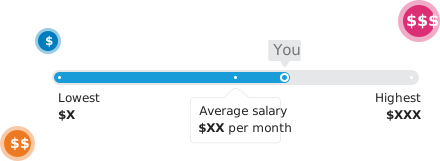
As of April 2026, the average annual salary for employees at Performance Scoring in the United States is $90,797. This translates to an approximate hourly wage of $44. Salaries at Performance Scoring typically range from $80,007 to $102,441 annually, reflecting the diverse roles and experience levels within the company.

How Much Does Performance Scoring Pay for Different Roles?

Explore detailed salary information for specific jobs at Performance Scoring. Based on our data, the highest paying job is the Director, Business Development, with an annual salary of $170,462. The table below outlines the annual salary ranges for most popular roles within the company.
How accurate does the salary look to you?

Current Job Openings at Performance Scoring

Ready for your next career move? Explore current job openings at Performance Scoring. Use the search tool below to find available positions by title and location and apply directly to start your career.

Is Performance Scoring’s Pay Competitive? Salary Benchmarking Analysis

How does Performance Scoring's compensation stack up against the industry and its key competitors? Our salary benchmarking analysis provides a clear comparison. The chart below visualizes this comparison alongside select peer companies.
Competitor / Benchmark Avg. Salary Variance Primary Market Influence Factor & Explanation
Inkin Inc $103,159
+13.6%
Adjusted for higher cost-of-living indices in Inkin Inc's primary metro hubs.
Enguardsystems $88,793
-2.2%
Reflects stabilized pricing equilibrium for commercial construction roles in this region.
OpptyGo $110,712
+21.9%
Influenced by prevailing union wage agreements specific to OpptyGo's sector.
Flipnode $114,382
+26.0%
Data suggests Flipnode's workforce skews heavily towards veteran, high-tenure roles.
Software & Networking Industry $126,859
+39.7%
Pay variances are driven by organizational scale, specialized skill requirements, or geographic cost-of-living factors.
Need More Granular Data? The analysis above provides a high-level market overview. To benchmark specific job codes, adjust for real-time cost-of-living changes, or access verified HR-reported datasets, upgrade to Salary.com for Business. Precision matters when building your compensation strategy.

Employee Reviews: Working at Performance Scoring

Considering a career at Performance Scoring? Explore authentic employee reviews to learn about the work environment, career growth opportunities, pay transparency and benefits. These first-hand insights can help you set realistic compensation expectations and make informed career decisions.
Decent place to gain experience. The company follows a structured approach to operations. There’s a good balance between workload and support. Coworkers are friendly, and managers are fair.
The pay is reasonable, and the benefits meet basic needs. The work environment is dynamic, and no two days are the same. The company values employee feedback and makes meaningful changes. Competitive pay and growth opportunities. The team is professional, and communication flows smoothly. Perks make a difference. The company culture is inclusive, and there are regular team-building activities.
The benefits package is a big plus. Nothing outstanding but no issues either. The office environment is modern and comfortable, enhancing daily productivity.

Performance Scoring Overview

Website
www.performancescoring.com
Founded In
2017
Employees
<25 employees
Industry
Software & Networking
Headquarter Address
1760 S Stemmons Fwy Lewisville Texas TX 75057
Revenue
<$5 Million
Phone Number
+1 8887267315
Social Media
About Performance Scoring
Built for performance management, Performance Scoring is a total organizational employee performance management application and engagement platform delivering real-time, objective data and key results to executives, managers, vendors, and employees; empowering managers to manage better, and employees to know where they are performing well and where they need coaching.

What Benefits Does Performance Scoring Offer Beyond Salary?

A competitive compensation package is more than just a salary. Performance Scoring offers a comprehensive benefits package designed to support your health, financial future, and overall well-being. Below are the most common key benefits:
Social Security
401(K)
Disability
Healthcare
Pension
Time Off (days)
Work at Performance Scoring?
Share your experience
How Much Should You Be Earning?

Get an estimated calculation of how much you should be earning and insight into your career options.

illustration

What Is the Cost of Living Near Dallas?

Understanding the cost of living near Dallas is key to truly evaluating a salary offer or your current compensation at Performance Scoring.
Dallas' Cost of Living Index is approximately 101.6 (1.6% more expensive than US average; 9.2% more than TX average). Major city, corporate hub, housing costs above US avg in desirable areas. DART bus/rail. When planning your budget based on a salary from Performance Scoring, consider these typical monthly expenses:
Expense Category Estimated Monthly Cost Key Considerations / Notes
Housing (1-BR Apt Rent) $1,300 - $2,000+ A significant portion of Performance Scoring salary. Location choices impact this heavily.
Utilities (Basic) $150 - $250 Electricity, Heating, Cooling, Water etc.
Public Transportation $96 (DART monthly regional pass) Essential for most commuters; car ownership is costly.
Groceries (Single Person) $410 - $600 Can be higher with more dining out or specialty stores.
Personal & Leisure $430 - $800+ Dining out, entertainment, shopping. Highly variable.
Healthcare (Individual) $390 - $720+ Varies significantly by plan & employer contribution.
Subtotal (Excluding Taxes) $2,776 - $4,376+ This subtotal does not include income taxes (federal, state, local), which can significantly impact your take-home pay.

FAQs of Performance Scoring

1. What is the average salary for employees at Performance Scoring?

The average annual total compensation for employees at Performance Scoring is approximately $90,797. However, this is an aggregate figure, actual salaries can range significantly, typically from $80,007 to $102,441, depending on factors like job role, experience, and location.

2. How much does Performance Scoring pay compared to Inkin Inc?

The average annual salary at Performance Scoring is $90,797, or an hourly wage of $44, in comparison to Inkin Inc which pays $103,159 per year or $50 per hour.

3. What is the lowest salary at Performance Scoring?

The lowest-paying job at Performance Scoring is a Manager, Graphic Design with a salary of $100,775 per year. The lowest- paying job depends heavily on the specific role, location, whether it's an hourly or salaried position, and if it's full-time, part-time, or an internship. Generally, entry-level positions might represent the lower end of the pay scale.

4. How does having a professional certification impact salary for relevant roles at Performance Scoring?

Professional certifications like PMP (for Project Managers), CPA (for Accountants), or another relevant certification for the industry can often lead to higher salaries and better job prospects at Performance Scoring for applicable roles. Certifications demonstrate a verified level of expertise and commitment to a profession, making candidates more competitive.

5. Does Performance Scoring offer cost-of-living adjustments (COLA) for employees in high-cost areas like Dallas?

While some companies offer formal COLA, many, including potentially Performance Scoring, incorporate cost of living considerations into their overall salary structure for different locations rather than as a separate, itemized adjustment. This means their base pay bands for roles in high-cost cities like New York City are generally set higher to account for these local market factors.

6. What's the typical process for salary reviews and raises at Performance Scoring?

Most companies, likely including Performance Scoring, conduct formal salary reviews annually, often tied to performance evaluations. During these reviews, factors like individual performance, meeting goals, company performance, and market adjustments are typically considered for potential salary increases.