Burley Irrigation District Salary

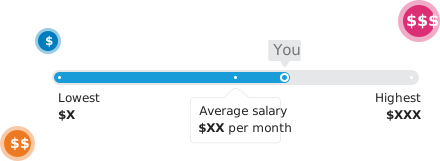
As of July 2026, the average annual salary for employees at Burley Irrigation District in the United States is $79,616. This translates to an approximate hourly wage of $38. Salaries at Burley Irrigation District typically range from $70,138 to $89,796 annually, reflecting the diverse roles and experience levels within the company.

How Much Does Burley Irrigation District Pay for Different Roles?

Explore detailed salary information for specific jobs at Burley Irrigation District. Based on our data, the highest paying job is the Board Member, with an annual salary of $72,435. The table below outlines the annual salary ranges for most popular roles within the company.
How accurate does the salary look to you?

Current Job Openings at Burley Irrigation District

Ready for your next career move? Explore current job openings at Burley Irrigation District. Use the search tool below to find available positions by title and location and apply directly to start your career.

Is Burley Irrigation District’s Pay Competitive? Salary Benchmarking Analysis

How does Burley Irrigation District's compensation stack up against the industry and its key competitors? Our salary benchmarking analysis provides a clear comparison. The chart below visualizes this comparison alongside select peer companies.
Competitor / Benchmark Avg. Salary Variance Primary Market Influence Factor & Explanation
RPC Global Inc $97,759
+22.8%
Driven by niche technical certifications required for RPC Global Inc's specialized projects.
Bountiful Irrigation District $90,818
+14.1%
Adjusted for higher cost-of-living indices in Bountiful Irrigation District's primary metro hubs.
Corbett Irrigation $101,725
+27.8%
Reflects structural premiums typical of Corbett Irrigation's large-cap national operations.
Klamath Irrigation District $87,738
+10.2%
Influenced by prevailing union wage agreements specific to Klamath Irrigation District's sector.
Energy & Utilities Industry $130,148
+63.5%
Pay variances are driven by organizational scale, specialized skill requirements, or geographic cost-of-living factors.
Need More Granular Data? The analysis above provides a high-level market overview. To benchmark specific job codes, adjust for real-time cost-of-living changes, or access verified HR-reported datasets, upgrade to Salary.com for Business. Precision matters when building your compensation strategy.

Employee Reviews: Working at Burley Irrigation District

Considering a career at Burley Irrigation District? Explore authentic employee reviews to learn about the work environment, career growth opportunities, pay transparency and benefits. These first-hand insights can help you set realistic compensation expectations and make informed career decisions.
Tasks are predictable but essential. Most days are routine with few surprises. Interaction is minimal, and creative input isn’t encouraged often. The technology used is functional but outdated in some departments. Management understands the importance of personal time and promotes a healthy working culture.
Flexible scheduling helps employees maintain balance between work and life. Management generally supports staff, but employee input isn’t always acted on. The leadership is highly competent and focused on long-term strategy. Collaborative teams foster innovation and problem-solving. Managers listen and respond thoughtfully. Flexible scheduling options help employees maintain a healthy work-life ba...
Clear mission and commitment to energy efficiency. Tools and tech are modern, and safety is never compromised. Schedules are fixed, and I’ve rarely had issues. Strong peer relationships and dependable management support make this a standout company.

Burley Irrigation District Overview

Website
www.burleyirrigation.org
Founded In
1904
Employees
<25 employees
Industry
Energy & Utilities
Headquarter Address
246 E 100 S Burley Idaho ID 83318
Revenue
<$5 Million
Phone Number
+1 2086782511
Social Media
About Burley Irrigation District
The Burley Irrigation District is a political subdivision of the State of Idaho, organized under State law by the landowners within the District in 1918. The irrigation system operated and maintained by the Burley Irrigation District was built by the United States Bureau of Reclamation commencing in 1905. The District encompasses approximately 48,000 acres of farmland in Cassia County, Idaho. The

What Benefits Does Burley Irrigation District Offer Beyond Salary?

A competitive compensation package is more than just a salary. Burley Irrigation District offers a comprehensive benefits package designed to support your health, financial future, and overall well-being. Below are the most common key benefits:
Social Security
401(K)
Disability
Healthcare
Pension
Time Off (days)
Work at Burley Irrigation District?
Share your experience
How Much Should You Be Earning?

Get an estimated calculation of how much you should be earning and insight into your career options.

illustration

What Is the Cost of Living Near Boise?

Understanding the cost of living near Boise is key to truly evaluating a salary offer or your current compensation at Burley Irrigation District.
Boise's Cost of Living Index is approximately 101.5 (1.5% more expensive than US average; 4.6% more than ID average). Rapidly growing, housing costs have significantly increased. Valley Regional Transit. When planning your budget based on a salary from Burley Irrigation District, consider these typical monthly expenses:
Expense Category Estimated Monthly Cost Key Considerations / Notes
Housing (1-BR Apt Rent) $1,300 - $1,900+ A significant portion of Burley Irrigation District salary. Location choices impact this heavily.
Utilities (Basic) $110 - $200 Electricity, Heating, Cooling, Water etc.
Public Transportation $45 (VRT monthly pass) Essential for most commuters; car ownership is costly.
Groceries (Single Person) $400 - $590 Can be higher with more dining out or specialty stores.
Personal & Leisure $380 - $700+ Dining out, entertainment, shopping. Highly variable.
Healthcare (Individual) $370 - $680+ Varies significantly by plan & employer contribution.
Subtotal (Excluding Taxes) $2,605 - $4,075+ This subtotal does not include income taxes (federal, state, local), which can significantly impact your take-home pay.

FAQs of Burley Irrigation District

1. What is the average salary for employees at Burley Irrigation District?

The average annual total compensation for employees at Burley Irrigation District is approximately $79,616. However, this is an aggregate figure, actual salaries can range significantly, typically from $70,138 to $89,796, depending on factors like job role, experience, and location.

2. How much does Burley Irrigation District pay compared to RPC Global Inc?

The average annual salary at Burley Irrigation District is $79,616, or an hourly wage of $38, in comparison to RPC Global Inc which pays $97,759 per year or $47 per hour.

3. How does having a professional certification impact salary for relevant roles at Burley Irrigation District?

Professional certifications like PMP (for Project Managers), CPA (for Accountants), or another relevant certification for the industry can often lead to higher salaries and better job prospects at Burley Irrigation District for applicable roles. Certifications demonstrate a verified level of expertise and commitment to a profession, making candidates more competitive.

4. Does Burley Irrigation District offer cost-of-living adjustments (COLA) for employees in high-cost areas like Boise?

While some companies offer formal COLA, many, including potentially Burley Irrigation District, incorporate cost of living considerations into their overall salary structure for different locations rather than as a separate, itemized adjustment. This means their base pay bands for roles in high-cost cities like New York City are generally set higher to account for these local market factors.

5. What's the typical process for salary reviews and raises at Burley Irrigation District?

Most companies, likely including Burley Irrigation District, conduct formal salary reviews annually, often tied to performance evaluations. During these reviews, factors like individual performance, meeting goals, company performance, and market adjustments are typically considered for potential salary increases.