District One Salary

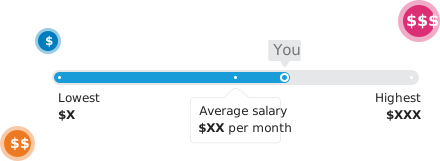
As of April 2026, the average annual salary for employees at District One in the United States is $96,198. This translates to an approximate hourly wage of $46. Salaries at District One typically range from $84,121 to $110,062 annually, reflecting the diverse roles and experience levels within the company.
How accurate does the salary look to you?

Current Job Openings at District One

Ready for your next career move? Explore current job openings at District One. Use the search tool below to find available positions by title and location and apply directly to start your career.

Is District One’s Pay Competitive? Salary Benchmarking Analysis

How does District One's compensation stack up against the industry and its key competitors? Our salary benchmarking analysis provides a clear comparison. The chart below visualizes this comparison alongside select peer companies.
Competitor / Benchmark Avg. Salary Variance Primary Market Influence Factor & Explanation
Tribal Corporations $96,272
+0.1%
Aligns perfectly with prevailing regional benchmarks for this specific job family.
Housing Authority of the Cherokee Nation $75,228
-21.8%
Housing Authority of the Cherokee Nation may offer non-monetary perks in lieu of competitive base salaries.
Quartz Hill Chamber of Commerce $97,126
+1.0%
Suggests Quartz Hill Chamber of Commerce utilizes a highly similar base-plus-benefits compensation model.
Women in Electronics $93,761
-2.5%
Indicates identical technical requirements and experience levels between the two firms.
Edu., Gov't. & Nonprofit Industry $115,341
+19.9%
Pay variances are driven by organizational scale, specialized skill requirements, or geographic cost-of-living factors.
Need More Granular Data? The analysis above provides a high-level market overview. To benchmark specific job codes, adjust for real-time cost-of-living changes, or access verified HR-reported datasets, upgrade to Salary.com for Business. Precision matters when building your compensation strategy.

Employee Reviews: Working at District One

Considering a career at District One? Explore authentic employee reviews to learn about the work environment, career growth opportunities, pay transparency and benefits. These first-hand insights can help you set realistic compensation expectations and make informed career decisions.
Leadership fosters a culture of respect, inclusivity, and collaboration. For an organization of this scale, their efforts to create an environment where all employees feel valued and represented are significant. Extremely resourceful and quick to address concerns. Wellness programs and flexible policies improve work-life balance, while engaging public service work inspires pride and dedication thr...
Collaborative environment with strong support for professional development and continuing education. The stability and comprehensive benefits are excellent, and it’s truly inspiring to see the direct impact of our work on the community and educational outcomes. Decision-making take time during transitions. There’s support from colleagues, though some departments are more responsive than others. Th...
Ready for anything. The culture values diversity and inclusivity, fostering collaboration and mutual respect. Employees feel valued thanks to open communication, supportive management, and recognition programs. Management is transparent about company goals and challenges. Schedules are predictable, and vacation time is respected. Management encourages development, and internal promotions are commo...

District One Overview

Website
www.district1toastmasters.org
Founded In
1972
Employees
<25 employees
Industry
Edu., Gov't. & Nonprofit
Headquarter Address
7166 W Manchester Ave Los Angeles California CA 90045
Revenue
<$5 Million
Phone Number
+1 3236803600
Social Media
About District One
District One is one of more than 80 districts of Toastmasters International® worldwide. Toastmasters is a non-profit educational organization committed to making effective oral communications a reality the world over. Through its member clubs, Toastmasters helps men and women learn the arts of speaking, listening, and thinking vital skills that enhance leadership ability, foster human understandin

What Benefits Does District One Offer Beyond Salary?

A competitive compensation package is more than just a salary. District One offers a comprehensive benefits package designed to support your health, financial future, and overall well-being. Below are the most common key benefits:
Social Security
401(K)
Disability
Healthcare
Pension
Time Off (days)
Work at District One?
Share your experience
How Much Should You Be Earning?

Get an estimated calculation of how much you should be earning and insight into your career options.

illustration

What Is the Cost of Living Near Los Angeles?

Understanding the cost of living near Los Angeles is key to truly evaluating a salary offer or your current compensation at District One.
Los Angeles' Cost of Living Index is approximately 173.3 (73.3% more expensive than US average; 23.9% more than CA average). Driven by extremely expensive housing, high transportation costs, and above-average goods/services. When planning your budget based on a salary from District One, consider these typical monthly expenses:
Expense Category Estimated Monthly Cost Key Considerations / Notes
Housing (1-BR Apt Rent) $2,500 - $3,800+ A significant portion of District One salary. Location choices impact this heavily.
Utilities (Basic) $150 - $250 Electricity, Heating, Cooling, Water etc.
Public Transportation $100 (Metro TAP card varies) Essential for most commuters; car ownership is costly.
Groceries (Single Person) $450 - $700 Can be higher with more dining out or specialty stores.
Personal & Leisure $500 - $1,000+ Dining out, entertainment, shopping. Highly variable.
Healthcare (Individual) $350 - $700+ Varies significantly by plan & employer contribution.
Subtotal (Excluding Taxes) $4,050 - $6,450+ This subtotal does not include income taxes (federal, state, local), which can significantly impact your take-home pay.

FAQs of District One

1. What is the typical salary range (low to high) for most roles at District One?

The typical annual salary range for most roles at District One is approximately from $84,121 to $110,062. It's important to remember that these are overall averages, actual salaries vary significantly based on specific job titles, years of experience, skills, and location.

2. How much does District One pay compared to Tribal Corporations?

The average annual salary at District One is $96,198, or an hourly wage of $46, in comparison to Tribal Corporations which pays $96,272 per year or $46 per hour.

3. Do salaries differ significantly between departments at District One?

Yes, salaries often differ between departments at District One due to varying market demand for specific skill sets and the nature of the roles. For example, technical roles in Engineering or IT may command different salary ranges compared to roles in Marketing or Human Resources.

4. How does experience level affect salary at District One?

Experience level is a significant factor in determining salary at District One, as it is with most employers. Generally, employees with more years of relevant experience and a proven track record can command higher salaries. For example, a senior-level role will typically have a higher pay band than an entry-level or mid-career position within the same job family.

5. How can I determine if a salary offer from District One in Los Angeles is fair given the local cost of living?

To determine if a salary offer from District One in Los Angeles is fair, first compare the gross salary to our data for similar roles at District One and its competitors (see our similar company salaries section) . Then, critically, use our "Cost of Living Insights for Los Angeles" to understand its purchasing power.

6. What factors influence salary increases at District One?

Salary increases at District One are likely influenced by a combination of factors, including: individual employee performance against set goals, overall company performance and profitability, budget availability, changes in the market rate for similar roles (market adjustments), and sometimes cost-of-living increases.