


Indigenous Studies Salary


 Thanks for your feedback!
Current Job Openings at Indigenous Studies
Is Indigenous Studies’s Pay Competitive? Salary Benchmarking Analysis
| Competitor / Benchmark | Avg. Salary | Variance | Primary Market Influence Factor & Explanation |
|---|---|---|---|
| Great Bear Of College Point Inc | $106,282 |
+23.4%
|
Adjusted for higher cost-of-living indices in Great Bear Of College Point Inc's primary metro hubs. |
| Parkerville Baptist Church | $78,667 |
-8.6%
|
Normalized for lower cost-of-living zones where Parkerville Baptist Church primarily operates. |
| Collier County Landfill | $82,749 |
-3.9%
|
Typical compensation structure for smaller regional agencies like Collier County Landfill. |
| Peoples Budget | $95,987 |
+11.5%
|
Reflects structural premiums typical of Peoples Budget's large-cap national operations. |
| Edu., Gov't. & Nonprofit Industry | $115,341 |
+34.0%
|
Pay variances are driven by organizational scale, specialized skill requirements, or geographic cost-of-living factors. |
How Indigenous Studies's Salaries Compare to Similar Companies?
Great Bear Of College Point Inc
$106,282 / year
Salary Range: $92,900 - $121,671
Lawrence, NY

Parkerville Baptist Church
$78,667 / year
Salary Range: $68,791 - $90,015
White City, KS
Collier County Landfill
$82,749 / year
Salary Range: $72,337 - $94,734
Naples, FL
Peoples Budget
$95,987 / year
Salary Range: $83,901 - $109,879
Chicago, IL
Bethel College
$84,732 / year
Salary Range: $74,060 - $97,002
Hesston, KS
Destiny College Wichita
$86,599 / year
Salary Range: $75,691 - $99,136
Wichita, KS
Fort Hays State University Graduate School
$85,671 / year
Salary Range: $74,884 - $98,076
Hays, KS
South Plains College Lubbock
$80,249 / year
Salary Range: $70,147 - $91,869
Lubbock, TX
Shen Umc Campus
$90,945 / year
Salary Range: $79,494 - $104,112
Clifton Park, NY
Employee Reviews: Working at Indigenous Studies
Indigenous Studies Overview
What Benefits Does Indigenous Studies Offer Beyond Salary?
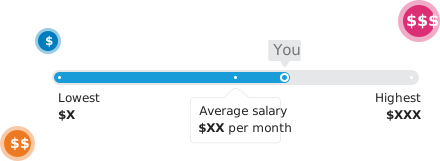
Get an estimated calculation of how much you should be earning and insight into your career options.
What Is the Cost of Living Near Lawrence?
| Expense Category | Estimated Monthly Cost | Key Considerations / Notes |
|---|---|---|
| Housing (1-BR Apt Rent) | $900 - $1,400+ | A significant portion of Indigenous Studies salary. Location choices impact this heavily. |
| Utilities (Basic) | $130 - $220 | Electricity, Heating, Cooling, Water etc. |
| Public Transportation | $30 (Lawrence Transit monthly pass) | Essential for most commuters; car ownership is costly. |
| Groceries (Single Person) | $380 - $560 | Can be higher with more dining out or specialty stores. |
| Personal & Leisure | $350 - $650+ | Dining out, entertainment, shopping. Highly variable. |
| Healthcare (Individual) | $360 - $660+ | Varies significantly by plan & employer contribution. |
| Subtotal (Excluding Taxes) | $2,150 - $3,490+ | This subtotal does not include income taxes (federal, state, local), which can significantly impact your take-home pay. |
FAQs of Indigenous Studies
1. How much does Indigenous Studies in the United States pay?
Indigenous Studies pays its employees an average of $86,093 per year. The average salary at Indigenous Studies range from $75,251 to $98,551 per year. It's important to remember that these are overall averages, actual salaries vary significantly based on specific job titles, years of experience, skills and location.
2. Do Indigenous Studies employees get a higher salary than its peer company?
The salary at Indigenous Studies is lesser than its peer company. The average annual salary at Indigenous Studies is $86,093, or an hourly wage of $41, in comparison to Great Bear Of College Point Inc which pays $106,282 per year or $51 per hour.
3. How much does salary increase with years of experience at Indigenous Studies?
Salary progression with years of experience at Indigenous Studies is typical. Generally, as employees gain more relevant experience, develop more skills, and take on greater responsibilities, their earning potential increases. For example, a role with 5-7 years of experience will usually pay more than the same role requiring 0-2 years.
4. Do salaries at Indigenous Studies vary by office location?
Yes, it's very likely that salaries at Indigenous Studies vary by office location. Companies often adjust pay based on local market rates, cost of living, and talent competition in different geographic areas. For instance, a role in a high-cost city like New York City may offer a higher nominal salary than the same role in a lower-cost city like Omaha, NE. Our Cost of Living Insights for Lawrence section provides more context.
5. Does Indigenous Studies offer good benefits?
Indigenous Studies typically offers a comprehensive benefits package that adds significant value to an employee's total compensation. Common benefits include health, dental, and vision insurance, a 401(k) plan often with a company match, paid time off. For example, a strong 401(k) match or excellent, low-cost health insurance can be worth thousands of dollars annually, effectively increasing your overall earnings beyond your base salary. For a more detailed list of benefits, please see our "Employee Benefits at Indigenous Studies" section on this page.
For Employer
The trusted data and intuitive software your organization needs to get pay right.
Explore CompAnalyst ®Enhance your organization's compensation strategy with salary data sets that HR and team managers can use to pay your staff right.
Surveys & Data SetsReal-time global intelligence that empowers you to make competitive pay decisions and align offers with global trends.
SalaryIQTMIf your compensation planning software is too rigid to deploy winning incentive strategies, it’s time to find an adaptable solution.
Compensation Planning