


Color Theory Salary


 Thanks for your feedback!
Current Job Openings at Color Theory
Is Color Theory’s Pay Competitive? Salary Benchmarking Analysis
| Competitor / Benchmark | Avg. Salary | Variance | Primary Market Influence Factor & Explanation |
|---|---|---|---|
| Essential Elements | $52 |
-1.1%
|
Indicates identical technical requirements and experience levels between the two firms. |
| Supreme Color Pac | $41 |
-22.5%
|
Supreme Color Pac focuses strategically on recruiting and training entry-level apprentices. |
| Titanium Dioxide Pigments | $48 |
-7.9%
|
Titanium Dioxide Pigments may offer non-monetary perks in lieu of competitive base salaries. |
| National Pigments Chemica | $47 |
-10.3%
|
Normalized for lower cost-of-living zones where National Pigments Chemica primarily operates. |
| Chemicals Industry | $63 |
+19.7%
|
Pay variances are driven by organizational scale, specialized skill requirements, or geographic cost-of-living factors. |
Companies Similar to Color Theory and Their Hourly Pay Rates
Essential Elements
$52 / hour
Salary Range: $46 - $59
Los Angeles, CA

Supreme Color Pac
$41 / hour
Salary Range: $36 - $46
Fort Smith, AR
Titanium Dioxide Pigments
$48 / hour
Salary Range: $43 - $55
Houston, TX
National Pigments Chemica
$47 / hour
Salary Range: $41 - $53
Garland, TX
AgroSource Inc
$45 / hour
Salary Range: $40 - $51
Tequesta, FL
Basic Elements Design Production Company Ltd
$52 / hour
Salary Range: $46 - $59
Baldwin Park, CA
Industrial Gases Mfg
$52 / hour
Salary Range: $46 - $59
Santa Fe Springs, CA
Vision Elements Ltd
$45 / hour
Salary Range: $40 - $51
Durham, NC
Sunbelt Lpg Products Ltd
$44 / hour
Salary Range: $39 - $49
Santa Fe, NM
Employee Reviews: Working at Color Theory
Color Theory Overview
What Benefits Does Color Theory Offer Beyond Salary?
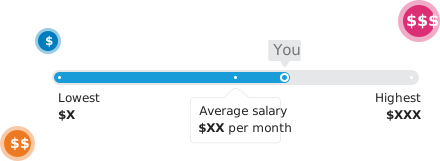
Get an estimated calculation of how much you should be earning and insight into your career options.
What Is the Cost of Living Near San Francisco?
| Expense Category | Estimated Monthly Cost | Key Considerations / Notes |
|---|---|---|
| Housing (1-BR Apt Rent) | $3,200 - $5,000+ | A significant portion of Color Theory salary. Location choices impact this heavily. |
| Utilities (Basic) | $200 - $320 | Electricity, Heating, Cooling, Water etc. |
| Public Transportation | $81 (Muni Monthly Pass 'M') | Essential for most commuters; car ownership is costly. |
| Groceries (Single Person) | $550 - $850 | Can be higher with more dining out or specialty stores. |
| Personal & Leisure | $600 - $1,200+ | Dining out, entertainment, shopping. Highly variable. |
| Healthcare (Individual) | $450 - $850+ | Varies significantly by plan & employer contribution. |
| Subtotal (Excluding Taxes) | $5,081 - $8,221+ | This subtotal does not include income taxes (federal, state, local), which can significantly impact your take-home pay. |
FAQs of Color Theory
1. How much does a Color Theory employee make?
Color Theory pays its employees an average of $52 per hour. The average salary at Color Theory range from $46 to $59 per hour. It's important to remember that these are overall averages, actual salaries vary significantly based on specific job titles, years of experience, skills, and location.
2. Which similar company tend to pay more or less than Color Theory?
The salary at Color Theory is higher than the similar company. The average annual salary at Color Theory is $109,182, or an hourly wage of $52, in comparison to Essential Elements which pays $107,959 per year or $52 per hour.
3. Do employees with advanced degrees (Master's, PhD) earn more at Color Theory?
In many roles at Color Theory, particularly those requiring specialized knowledge or research capabilities (e.g., certain engineering, scientific, or financial roles), an advanced degree like a Master's or PhD can lead to a higher starting salary and faster career progression, thus higher earnings. However, for some roles, direct experience and skills might be valued as much or more than an advanced degree. The impact varies by field and specific job requirements.
4. How does the cost of living near San Francisco affect the perceived value of a Color Theory salary?
San Francisco's Cost of Living Index is approximately 243.5 (143.5% more expensive than US average; 74.2% more than CA average). This significantly impacts the purchasing power of a salary from Color Theory based there. Our "Cost of Living Insights for San Francisco" module details this impact, helping you assess the 'real feel' value of your compensation.
5. What kind of benefits does Color Theory typically offer employees?
Color Theory generally offers a range of employee benefits designed to support their workforce's health, financial well-being, and work-life balance. Comprehensive health insurance (medical, dental, vision), a 401(k) retirement savings plan (often with a company match), paid time off (PTO), and potentially disability and life insurance are included. For a more detailed list of benefits, please see our "Employee Benefits at Color Theory" section on this page.
For Employer
The trusted data and intuitive software your organization needs to get pay right.
Explore CompAnalyst ®Enhance your organization's compensation strategy with salary data sets that HR and team managers can use to pay your staff right.
Surveys & Data SetsReal-time global intelligence that empowers you to make competitive pay decisions and align offers with global trends.
SalaryIQTMIf your compensation planning software is too rigid to deploy winning incentive strategies, it’s time to find an adaptable solution.
Compensation Planning