


Penn Program on Regulation Salary


How Much Does Penn Program on Regulation Pay for Different Roles?
 Thanks for your feedback!
Current Job Openings at Penn Program on Regulation
Is Penn Program on Regulation’s Pay Competitive? Salary Benchmarking Analysis
| Competitor / Benchmark | Avg. Salary | Variance | Primary Market Influence Factor & Explanation |
|---|---|---|---|
| Shellist Lazarz Slobin LLP | $91,441 |
-2.0%
|
Reflects stabilized pricing equilibrium for commercial construction roles in this region. |
| TEAK IP Services | $84,194 |
-9.8%
|
Reflects market rates for standard general contracting, differing from specialized roles. |
| Darryl | $87,612 |
-6.1%
|
Darryl focuses strategically on recruiting and training entry-level apprentices. |
| Conley Law Office PLLC | $78,298 |
-16.1%
|
Conley Law Office PLLC operates with a leaner overhead structure, impacting base wage offers. |
| Business Services Industry | $120,931 |
+29.6%
|
Pay variances are driven by organizational scale, specialized skill requirements, or geographic cost-of-living factors. |
How Penn Program on Regulation's Salaries Compare to Similar Companies?
Shellist Lazarz Slobin LLP
$91,441 / year
Salary Range: $80,364 - $103,453
Houston, TX

TEAK IP Services
$84,194 / year
Salary Range: $74,005 - $95,259
Farmington, UT
Darryl
$87,612 / year
Salary Range: $77,001 - $99,124
Atlanta, GA
Conley Law Office PLLC
$78,298 / year
Salary Range: $68,818 - $88,589
Parkersburg, WV
Jerimy Kirschner & Associates PLLC
$96,725 / year
Salary Range: $85,019 - $109,440
Bellevue, WA
Albert Kalter PC
$107,305 / year
Salary Range: $94,311 - $121,402
New York City, NY
Paul Boone Law
$82,485 / year
Salary Range: $72,493 - $93,320
Fernandina, FL
Valanzola Law Group
$94,774 / year
Salary Range: $83,297 - $107,221
Mansfield, MA
Passman & Kaplan PC
$97,875 / year
Salary Range: $86,027 - $110,733
Washington, DC
Employee Reviews: Working at Penn Program on Regulation
Penn Program on Regulation Overview
What Benefits Does Penn Program on Regulation Offer Beyond Salary?
Get an estimated calculation of how much you should be earning and insight into your career options.
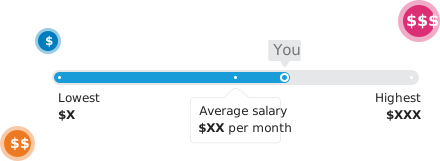
What Is the Cost of Living Near Philadelphia?
| Expense Category | Estimated Monthly Cost | Key Considerations / Notes |
|---|---|---|
| Housing (1-BR Apt Rent) | $1,400 - $2,200+ | A significant portion of Penn Program on Regulation salary. Location choices impact this heavily. |
| Utilities (Basic) | $150 - $250 | Electricity, Heating, Cooling, Water etc. |
| Public Transportation | $96 (SEPTA TransPass monthly) | Essential for most commuters; car ownership is costly. |
| Groceries (Single Person) | $430 - $630 | Can be higher with more dining out or specialty stores. |
| Personal & Leisure | $400 - $750+ | Dining out, entertainment, shopping. Highly variable. |
| Healthcare (Individual) | $390 - $730+ | Varies significantly by plan & employer contribution. |
| Subtotal (Excluding Taxes) | $2,866 - $4,566+ | This subtotal does not include income taxes (federal, state, local), which can significantly impact your take-home pay. |
FAQs of Penn Program on Regulation
1. What is the typical salary range (low to high) for most roles at Penn Program on Regulation?
The typical annual salary range for most roles at Penn Program on Regulation is approximately from $82,004 to $105,563. It's important to remember that these are overall averages, actual salaries vary significantly based on specific job titles, years of experience, skills, and location.
2. How much does Penn Program on Regulation pay compared to Shellist Lazarz Slobin LLP?
The average annual salary at Penn Program on Regulation is $93,297, or an hourly wage of $45, in comparison to Shellist Lazarz Slobin LLP which pays $91,441 per year or $44 per hour.
3. How does experience level affect salary at Penn Program on Regulation?
Experience level is a significant factor in determining salary at Penn Program on Regulation, as it is with most employers. Generally, employees with more years of relevant experience and a proven track record can command higher salaries. For example, a senior-level role will typically have a higher pay band than an entry-level or mid-career position within the same job family.
4. How can I determine if a salary offer from Penn Program on Regulation in Philadelphia is fair given the local cost of living?
To determine if a salary offer from Penn Program on Regulation in Philadelphia is fair, first compare the gross salary to our data for similar roles at Penn Program on Regulation and its competitors (see our similar company salaries section) . Then, critically, use our "Cost of Living Insights for Philadelphia" to understand its purchasing power.
5. Are the salaries listed for Penn Program on Regulation on Salary.com pre-tax or after-tax?
All salary figures displayed for Penn Program on Regulation, including average base salary and estimated total compensation, are pre-tax amounts. They do not account for federal, state, or local income taxes, nor deductions for benefits like health insurance or 401(k) contributions.
For Employer
The trusted data and intuitive software your organization needs to get pay right.
Explore CompAnalyst ®Enhance your organization's compensation strategy with salary data sets that HR and team managers can use to pay your staff right.
Surveys & Data SetsReal-time global intelligence that empowers you to make competitive pay decisions and align offers with global trends.
SalaryIQTMIf your compensation planning software is too rigid to deploy winning incentive strategies, it’s time to find an adaptable solution.
Compensation Planning