


Ryder Canada Salary
How much does the Ryder Canada Pay for employees?


 Thanks for your feedback!
Current Job Openings at Ryder Canada
Is Ryder Canada’s Pay Competitive? Salary Benchmarking Analysis
How Ryder Canada's Salaries Compare to Similar Companies?
CGP CANADIAN Ltd
$96,303 / year
Salary Range: $84,414 - $109,233
Dallas, TX

Professional Sports Investment Group LLC
$91,652 / year
Salary Range: $80,364 - $103,892
Charlotte, NC
Bode Holdings Inc
$92,095 / year
Salary Range: $80,758 - $104,392
Tempe, AZ
Ancla Motorsports
$86,588 / year
Salary Range: $75,947 - $98,112
Hialeah, FL
Maritime Escrow Inc
$95,712 / year
Salary Range: $83,956 - $108,465
Carlsbad, CA
Karrikin Technologies
$87,759 / year
Salary Range: $76,983 - $99,453
Scottsdale, AZ
eVenture Capital Partners II LLC
$112,431 / year
Salary Range: $98,618 - $127,402
San Francisco, CA
RBW Equity Holdings Inc
$93,962 / year
Salary Range: $82,371 - $106,550
Austin, TX
TekMountain
$82,464 / year
Salary Range: $72,337 - $93,442
Wilmington, NC
Employee Reviews: Working at Ryder Canada
Ryder Canada Overview
What Benefits Does Ryder Canada Offer Beyond Salary?
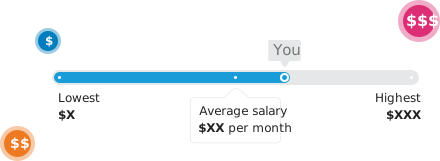
Get an estimated calculation of how much you should be earning and insight into your career options.
FAQs of Ryder Canada
1. What is the typical salary range (low to high) for most roles at Ryder Canada?
The typical annual salary range for most roles at Ryder Canada is approximately from $80,657 to $104,270. It's important to remember that these are overall averages, actual salaries vary significantly based on specific job titles, years of experience, skills, and location.
2. How much does Ryder Canada pay compared to CGP CANADIAN Ltd?
The average annual salary at Ryder Canada is $91,979, or an hourly wage of $44, in comparison to CGP CANADIAN Ltd which pays $96,303 per year or $46 per hour.
3. How does experience level affect salary at Ryder Canada?
Experience level is a significant factor in determining salary at Ryder Canada, as it is with most employers. Generally, employees with more years of relevant experience and a proven track record can command higher salaries. For example, a senior-level role will typically have a higher pay band than an entry-level or mid-career position within the same job family.
4. What factors influence salary increases at Ryder Canada?
Salary increases at Ryder Canada are likely influenced by a combination of factors, including: individual employee performance against set goals, overall company performance and profitability, budget availability, changes in the market rate for similar roles (market adjustments), and sometimes cost-of-living increases.
For Employer
The trusted data and intuitive software your organization needs to get pay right.
Explore CompAnalyst ®Enhance your organization's compensation strategy with salary data sets that HR and team managers can use to pay your staff right.
Surveys & Data SetsReal-time global intelligence that empowers you to make competitive pay decisions and align offers with global trends.
SalaryIQTMIf your compensation planning software is too rigid to deploy winning incentive strategies, it’s time to find an adaptable solution.
Compensation Planning