


Take Salary


How Much Does Take Pay for Different Roles?
Director, Operations
$181,471 / year
Salary Range: $172,699 - $190,209
Operations

Editorial Director
$158,914 / year
Salary Range: $142,560 - $167,946
Technical Writing and Documentation
Project Manager
$109,651 / year
Salary Range: $98,226 - $121,386
Project Management
Director, Project & Grants
$77,463 / year
Salary Range: $68,311 - $89,993
Proposal Management
Certified Health Coach
$68,411 / year
Salary Range: $60,162 - $76,099
Health Education
Program Coordinator
$65,634 / year
Salary Range: $58,394 - $73,723
Program Coordination
 Thanks for your feedback!
Current Job Openings at Take
Is Take’s Pay Competitive? Salary Benchmarking Analysis
| Competitor / Benchmark | Avg. Salary | Variance | Primary Market Influence Factor & Explanation |
|---|---|---|---|
| Graduate School of Medical Sciences of Cornell University | $107,653 |
+4.1%
|
Data suggests Graduate School of Medical Sciences of Cornell University's workforce skews heavily towards veteran, high-tenure roles. |
| Life Support Training Institute | $90,955 |
-12.1%
|
Typical compensation structure for smaller regional agencies like Life Support Training Institute. |
| Heritage Pines Community Association Inc | $86,821 |
-16.1%
|
Heritage Pines Community Association Inc operates with a leaner overhead structure, impacting base wage offers. |
| North Carolina Department of Insurance Permit Number | $80,492 |
-22.2%
|
North Carolina Department of Insurance Permit Number may offer non-monetary perks in lieu of competitive base salaries. |
| Edu., Gov't. & Nonprofit Industry | $115,341 |
+11.5%
|
Pay variances are driven by organizational scale, specialized skill requirements, or geographic cost-of-living factors. |
How Take's Salaries Compare to Similar Companies?
Graduate School of Medical Sciences of Cornell University
$107,653 / year
Salary Range: $94,100 - $123,244
New York City, NY
Life Support Training Institute
$90,955 / year
Salary Range: $79,503 - $104,112
Southfield, MI
Heritage Pines Community Association Inc
$86,821 / year
Salary Range: $75,902 - $99,368
Cary, NC
North Carolina Department of Insurance Permit Number
$80,492 / year
Salary Range: $70,376 - $92,125
Oxford, MS
Western Territorial of the Salvation
$77,580 / year
Salary Range: $67,819 - $88,796
Gillette, WY
Sikeston Police Department
$84,205 / year
Salary Range: $73,601 - $96,393
Sikeston, MO
Mounted Eagles Inc
$86,483 / year
Salary Range: $75,590 - $99,002
Brainerd, MN
Beverly Health Department
$101,999 / year
Salary Range: $89,152 - $116,757
Beverly, MA
Eupora High School Yearbook
$75,608 / year
Salary Range: $66,106 - $86,540
Eupora, MS
Employee Reviews: Working at Take
Take Overview
What Benefits Does Take Offer Beyond Salary?
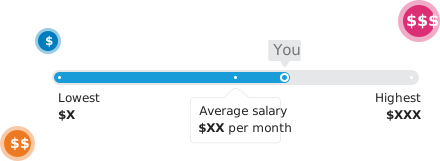
Get an estimated calculation of how much you should be earning and insight into your career options.
What Is the Cost of Living Near New York?
| Expense Category | Estimated Monthly Cost | Key Considerations / Notes |
|---|---|---|
| Housing (1-BR Apt Rent) | $3,500 - $5,000+ (Highly variable by borough) | A significant portion of Take salary. Location choices impact this heavily. |
| Utilities (Basic) | $150 - $250 | Electricity, Heating, Cooling, Water etc. |
| Public Transportation | $127 (MTA 30-day MetroCard) | Essential for most commuters; car ownership is costly. |
| Groceries (Single Person) | $450 - $700 | Can be higher with more dining out or specialty stores. |
| Personal & Leisure | $500 - $1,000+ | Dining out, entertainment, shopping. Highly variable. |
| Healthcare (Individual) | $450 - $800+ | Varies significantly by plan & employer contribution. |
| Subtotal (Excluding Taxes) | $5,177 - $7,877+ | This subtotal does not include income taxes (federal, state, local), which can significantly impact your take-home pay. |
FAQs of Take
1. What is the average salary for employees at Take?
The average annual total compensation for employees at Take is approximately $103,423. However, this is an aggregate figure, actual salaries can range significantly, typically from $90,435 to $118,342, depending on factors like job role, experience, and location.
2. How much does Take pay compared to Graduate School of Medical Sciences of Cornell University?
The average annual salary at Take is $103,423, or an hourly wage of $50, in comparison to Graduate School of Medical Sciences of Cornell University which pays $107,653 per year or $52 per hour.
3. What is the lowest salary at Take?
The lowest-paying job at Take is a Program Coordinator with a salary of $65,634 per year. The lowest- paying job depends heavily on the specific role, location, whether it's an hourly or salaried position, and if it's full-time, part-time, or an internship. Generally, entry-level positions might represent the lower end of the pay scale.
4. How does having a professional certification impact salary for relevant roles at Take?
Professional certifications like PMP (for Project Managers), CPA (for Accountants), or another relevant certification for the industry can often lead to higher salaries and better job prospects at Take for applicable roles. Certifications demonstrate a verified level of expertise and commitment to a profession, making candidates more competitive.
5. Does Take offer cost-of-living adjustments (COLA) for employees in high-cost areas like New York?
While some companies offer formal COLA, many, including potentially Take, incorporate cost of living considerations into their overall salary structure for different locations rather than as a separate, itemized adjustment. This means their base pay bands for roles in high-cost cities like New York City are generally set higher to account for these local market factors.
6. What's the typical process for salary reviews and raises at Take?
Most companies, likely including Take, conduct formal salary reviews annually, often tied to performance evaluations. During these reviews, factors like individual performance, meeting goals, company performance, and market adjustments are typically considered for potential salary increases.
For Employer
The trusted data and intuitive software your organization needs to get pay right.
Explore CompAnalyst ®Enhance your organization's compensation strategy with salary data sets that HR and team managers can use to pay your staff right.
Surveys & Data SetsReal-time global intelligence that empowers you to make competitive pay decisions and align offers with global trends.
SalaryIQTMIf your compensation planning software is too rigid to deploy winning incentive strategies, it’s time to find an adaptable solution.
Compensation Planning