


Progressive Credit Union Salary


How Much Does Progressive Credit Union Pay for Different Roles?
Senior Loan Review Officer
$91,921 / year
Salary Range: $79,178 - $105,446
Loan Review

Executive Assistant
$85,334 / year
Salary Range: $76,168 - $94,915
Administrative Support
Internal Auditor
$76,365 / year
Salary Range: $69,794 - $83,254
Internal Auditor
HR Operations Analyst
$74,530 / year
Salary Range: $67,903 - $81,318
Human Resources
Loan Specialist
$71,081 / year
Salary Range: $62,043 - $79,050
-
Senior Advisor
$52,675 / year
Salary Range: $47,353 - $58,469
Academic Advising
Loan Assistant
$52,618 / year
Salary Range: $47,793 - $57,083
Banking
Loan Officer Assistant
$45,019 / year
Salary Range: $40,599 - $49,725
Loan Processing
Member Service Representative
$37,690 / year
Salary Range: $35,058 - $41,300
-
Member Services Representative
$37,690 / year
Salary Range: $35,058 - $41,300
-
Member Services Officer
$35,393 / year
Salary Range: $32,491 - $38,153
Banking
 Thanks for your feedback!
Current Job Openings at Progressive Credit Union
Is Progressive Credit Union’s Pay Competitive? Salary Benchmarking Analysis
| Competitor / Benchmark | Avg. Salary | Variance | Primary Market Influence Factor & Explanation |
|---|---|---|---|
| Allegro Advisors LLC | $105,912 |
-0.4%
|
Confirms Allegro Advisors LLC is a direct competitor vying for the exact same talent pool. |
| Procu Inc | $107,284 |
+0.8%
|
Reflects stabilized pricing equilibrium for commercial construction roles in this region. |
| Reflex Capital | $111,366 |
+4.7%
|
Reflects structural premiums typical of Reflex Capital's large-cap national operations. |
| Depositfinancedept.com | $101,957 |
-4.2%
|
Depositfinancedept.com likely leverages performance bonuses over the high base salary shown here. |
| Financial Services Industry | $121,514 |
+14.2%
|
Pay variances are driven by organizational scale, specialized skill requirements, or geographic cost-of-living factors. |
How Progressive Credit Union's Salaries Compare to Similar Companies?
Allegro Advisors LLC
$105,912 / year
Salary Range: $92,900 - $120,012
New York City, NY
Procu Inc
$107,284 / year
Salary Range: $94,100 - $121,561
Richmond Hill, NY
Reflex Capital
$111,366 / year
Salary Range: $97,683 - $126,195
San Francisco, CA
Depositfinancedept.com
$101,957 / year
Salary Range: $89,436 - $115,537
Englewood Cliffs, NJ
Hirst Financial Independence Planning Inc
$92,959 / year
Salary Range: $81,546 - $105,343
Fall River, MA
Star of Texas
$88,276 / year
Salary Range: $77,432 - $100,027
Austin, TX
AAC Credit Union
$86,504 / year
Salary Range: $75,874 - $98,027
Grand Rapids, MI
Finex credit union
$95,059 / year
Salary Range: $83,379 - $107,709
East Hartford, CT
Idadiv Credit Union
$82,411 / year
Salary Range: $72,291 - $93,393
Nampa, ID
Employee Reviews: Working at Progressive Credit Union
Progressive Credit Union Overview
What Benefits Does Progressive Credit Union Offer Beyond Salary?
Get an estimated calculation of how much you should be earning and insight into your career options.
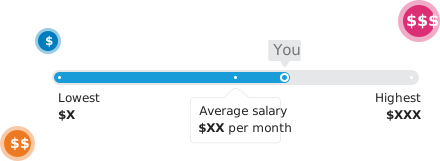
What Is the Cost of Living Near New York?
| Expense Category | Estimated Monthly Cost | Key Considerations / Notes |
|---|---|---|
| Housing (1-BR Apt Rent) | $3,500 - $5,000+ (Highly variable by borough) | A significant portion of Progressive Credit Union salary. Location choices impact this heavily. |
| Utilities (Basic) | $150 - $250 | Electricity, Heating, Cooling, Water etc. |
| Public Transportation | $127 (MTA 30-day MetroCard) | Essential for most commuters; car ownership is costly. |
| Groceries (Single Person) | $450 - $700 | Can be higher with more dining out or specialty stores. |
| Personal & Leisure | $500 - $1,000+ | Dining out, entertainment, shopping. Highly variable. |
| Healthcare (Individual) | $450 - $800+ | Varies significantly by plan & employer contribution. |
| Subtotal (Excluding Taxes) | $5,177 - $7,877+ | This subtotal does not include income taxes (federal, state, local), which can significantly impact your take-home pay. |
FAQs of Progressive Credit Union
1. What is the typical salary range (low to high) for most roles at Progressive Credit Union?
The typical annual salary range for most roles at Progressive Credit Union is approximately from $93,321 to $120,561. It's important to remember that these are overall averages, actual salaries vary significantly based on specific job titles, years of experience, skills, and location.
2. How much does Progressive Credit Union pay compared to Allegro Advisors LLC?
The average annual salary at Progressive Credit Union is $106,387, or an hourly wage of $51, in comparison to Allegro Advisors LLC which pays $105,912 per year or $51 per hour.
3. Do salaries differ significantly between departments at Progressive Credit Union?
Yes, salaries often differ between departments at Progressive Credit Union due to varying market demand for specific skill sets and the nature of the roles. For example, technical roles in Engineering or IT may command different salary ranges compared to roles in Marketing or Human Resources.
4. How does experience level affect salary at Progressive Credit Union?
Experience level is a significant factor in determining salary at Progressive Credit Union, as it is with most employers. Generally, employees with more years of relevant experience and a proven track record can command higher salaries. For example, a senior-level role will typically have a higher pay band than an entry-level or mid-career position within the same job family.
5. How can I determine if a salary offer from Progressive Credit Union in New York is fair given the local cost of living?
To determine if a salary offer from Progressive Credit Union in New York is fair, first compare the gross salary to our data for similar roles at Progressive Credit Union and its competitors (see our similar company salaries section) . Then, critically, use our "Cost of Living Insights for New York" to understand its purchasing power.
6. Are the salaries listed for Progressive Credit Union on Salary.com pre-tax or after-tax?
All salary figures displayed for Progressive Credit Union, including average base salary and estimated total compensation, are pre-tax amounts. They do not account for federal, state, or local income taxes, nor deductions for benefits like health insurance or 401(k) contributions.
For Employer
The trusted data and intuitive software your organization needs to get pay right.
Explore CompAnalyst ®Enhance your organization's compensation strategy with salary data sets that HR and team managers can use to pay your staff right.
Surveys & Data SetsReal-time global intelligence that empowers you to make competitive pay decisions and align offers with global trends.
SalaryIQTMIf your compensation planning software is too rigid to deploy winning incentive strategies, it’s time to find an adaptable solution.
Compensation Planning